

TL;DR:
- Vet your wealth advisor by independently verifying their regulatory history, credentials, and fiduciary commitment. Use free tools like FINRA BrokerCheck and SEC IAPD to review dual registration and detailed Form ADV disclosures. Assess advisors with a structured scoring method focusing on fees, process, conflicts, and client access to ensure long-term trustworthiness.
Vetting wealth advisors independently is the process of systematically checking an advisor’s regulatory history, credentials, fee structure, and fiduciary commitment before entrusting them with your wealth. Most people skip this process entirely, relying instead on a warm referral or a polished website. That is a costly mistake. Free tools like FINRA BrokerCheck and the SEC’s Investment Adviser Public Disclosure database (IAPD) give you access to the same regulatory records that professionals use, at no cost and in minutes. The criteria that actually predict long-term advisor value are fiduciary alignment, fee transparency, and process quality, not brand recognition or a persuasive personality.
What tools and databases are essential for vetting wealth advisors independently?
Checking an advisor’s regulatory status via FINRA BrokerCheck, SEC IAPD, and state regulators is free, takes roughly five minutes, and is the single most effective step you can take to prevent fraud. Both databases are publicly accessible and require no account to search. Start with the advisor’s full legal name and their CRD (Central Registration Depository) number, which they are obliged to provide on request.

Many advisors are dually registered as both brokers and investment advisers. Disciplinary actions recorded under one registration do not automatically appear under the other. You must check both FINRA BrokerCheck and SEC IAPD separately to get the complete picture. Skipping one database means you could miss a serious regulatory breach.
Once you have confirmed registration, request and read the advisor’s Form ADV Part 2A. Form ADV Part 2A contains detailed information on fees, conflicts of interest, and custody arrangements. Most investors skim it or ignore it entirely. That is where advisors bury the details that matter most.
Key credentials to verify independently
Beyond regulatory databases, verify professional designations directly with their issuing bodies:
- CFP (Certified Financial Planner): Verify at cfp.net using the advisor’s name.
- CFA (Chartered Financial Analyst): Verify at cfainstitute.org.
- CPA (Certified Public Accountant): Verify through your state’s accountancy board.
- ChFC (Chartered Financial Consultant): Verify through The American College of Financial Services.
Each designation has its own standards and disciplinary records. An advisor can lose a designation without losing their licence, so checking both is not redundant.
Pro Tip: Always search using the advisor’s full legal name and CRD number together. Common names produce multiple results in BrokerCheck. Using the CRD number eliminates any ambiguity and confirms you are reviewing the correct individual.
Which criteria should you use to evaluate and compare wealth advisors?
Fiduciary commitment, transparent fees, and a repeatable investment process are the main predictors of long-term advisor value. Brand reputation and past performance are not. This distinction matters because advisors who operate under a fiduciary standard are legally required to act in your best interest, whereas those operating under a suitability standard only need to recommend products that are broadly appropriate for you.
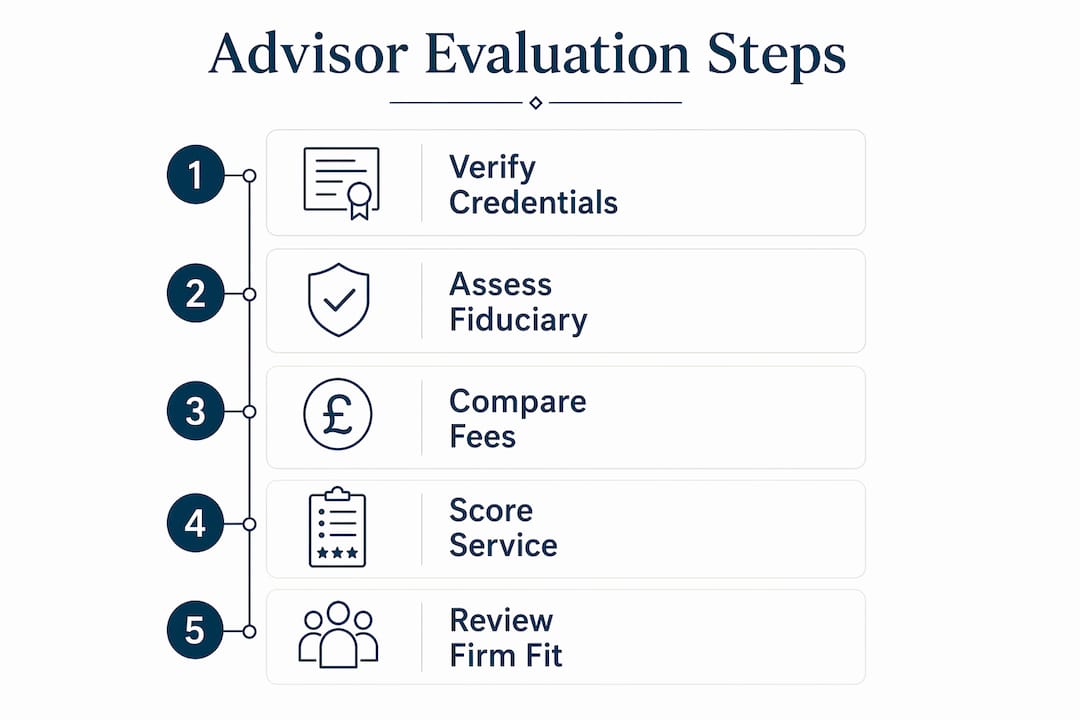
Fiduciary status: get it in writing
Ask every advisor directly: “Are you a fiduciary at all times, for all services?” A genuine fiduciary will confirm this in writing without hesitation. If an advisor qualifies their answer or says they are “sometimes” a fiduciary, that is a meaningful warning sign. Written confirmation protects you if a dispute arises later.
Comparing fee models
Investment advisers typically charge fees from 0.5% to 1.5% of assets under management (AUM). Understanding the fee model is as important as knowing the rate.
| Fee model | How it works | Key risk |
|---|---|---|
| Fee-only | Flat fee, hourly, or AUM percentage; no commissions | Lower conflict of interest |
| Fee-based | Combination of fees and commissions | Commissions can create bias |
| Commission-based | Paid per product sold | Strongest conflict of interest |
Fee-only advisors carry the lowest conflict of interest because their income does not depend on which products they sell you. Fee-based and commission-based models are not automatically disqualifying, but they require more scrutiny of the specific products being recommended.
A six-factor scoring framework
Personal rapport is the least reliable predictor of long-term success with an advisor. A structured scoring approach removes emotional bias. Within one hour of each advisor meeting, score the advisor from 1 to 5 on each of these six criteria:
- Fee transparency: Did they explain all costs clearly and in writing?
- Investment process: Do they follow a documented, repeatable approach?
- Conflicts disclosure: Did they proactively name their conflicts of interest?
- Planning depth: Did they ask about your tax position, estate plans, and goals?
- Relationship accessibility: Who will you actually speak to day-to-day?
- Willingness to disqualify: Did they acknowledge clients they are not suited to serve?
Score immediately after the meeting, before the memory fades and before likeability starts to colour your judgement.
Pro Tip: Ask each advisor to send you a written summary of their fee structure before the second meeting. If they resist or delay, that tells you something important about how they will handle transparency once you are a client.
How to assess service quality and firm characteristics for long-term fit
Firm-level factors matter as much as individual advisor quality. An excellent advisor inside a poorly run firm will eventually let you down.
Households should work with firms maintaining a client-to-advisor ratio under 75 to receive genuinely personal attention. Firms with ratios above 100 clients per advisor are structurally unable to provide proactive service. Ask directly: “How many clients do you personally manage?” A vague answer is itself informative.
Custody arrangements are another critical factor. Independent custody by firms like Schwab or Fidelity offers significant fraud protection compared to self-custody by advisory firms. When a firm holds its own clients’ assets, the risk of misappropriation rises sharply. Independent custody is the industry norm and a non-negotiable standard for any serious private banking relationship.
Evaluate the investment process itself by asking specific questions. Does the firm use tax-aware investment strategies such as tax-loss harvesting? Do they have documented rebalancing rules, or do they rebalance based on gut feel? Is risk management defined by a written policy? Process quality matters more than brand or historical performance because markets change but a sound process adapts.
Pro Tip: Search the firm’s name alongside terms like “complaint”, “regulatory action”, and “SEC enforcement” in Google News. Public records and news archives often surface issues that do not appear in formal databases, particularly for smaller or newer firms.
What are the most common mistakes when vetting advisors independently?
Most people make at least one of these errors, and each one can be expensive.
- Mistaking personality for quality. A confident, likeable advisor is not necessarily a competent or honest one. Charm is not a credential.
- Relying on brand recognition. A well-known firm name does not guarantee that your specific advisor within that firm is qualified or aligned with your interests.
- Skipping dual registration checks. Checking only FINRA BrokerCheck or only SEC IAPD leaves half the regulatory record unseen.
- Skimming Form ADV. The conflicts of interest and fee sections are deliberately dense. Read them end-to-end, not just the summary.
- Ignoring unregistered advisors. Anyone managing money or providing investment advice for compensation must be registered. If they are not, stop the conversation immediately.
- Relying on gut feeling over structured scoring. A systematic framework consistently outperforms instinct when selecting advisors.
“The biggest misconception is that brand recognition or performance history reliably indicate advisor quality. Process quality and fiduciary alignment matter more.”
Typical red flags include guaranteed returns, refusal to disclose fees in writing, urgency to buy proprietary products, and vague answers about conflicts of interest. Any one of these signals is sufficient reason to walk away. You can also cross-reference financial advisory relationships with resources on identifying fraudulent financial schemes to sharpen your awareness of deceptive patterns.
Key takeaways
Independent advisor vetting requires regulatory verification, structured scoring, and fee scrutiny before any other consideration.
| Point | Details |
|---|---|
| Check both databases | Search FINRA BrokerCheck and SEC IAPD separately to catch dual-registration disciplinary records. |
| Read Form ADV fully | The fees, conflicts, and custody sections contain details most investors never see. |
| Use a scoring framework | Score six objective criteria within one hour of each meeting to remove emotional bias. |
| Confirm fiduciary status in writing | Verbal assurances are not enforceable; written confirmation is the only acceptable standard. |
| Assess firm-level factors | Client-to-advisor ratio under 75 and independent custody are non-negotiable quality indicators. |
Why the vetting process rewards discipline over instinct
I have spoken with dozens of high-net-worth individuals who chose their wealth advisor based on a recommendation from a friend or a confident first impression. Almost none of them had checked BrokerCheck. Several had never read their Form ADV. A handful discovered, years later, that their advisor was operating under a suitability standard rather than a fiduciary one. The financial consequences were real and, in most cases, entirely avoidable.
The most common objection I hear is that the process feels clinical or distrustful. My view is the opposite. A thorough, structured vetting process is an act of respect, both for your own wealth and for the advisor who has nothing to hide. Advisors who resist scrutiny are telling you something important. Advisors who welcome it are demonstrating exactly the transparency you need.
Using a systematic scoring framework after advisor interviews objectively clarifies the best choice over relying on gut feelings or likeability. The data supports this. So does experience. The clients I have seen make the best long-term advisory relationships are those who treated the selection process like a professional hire, not a social introduction.
One final point: quantitative scoring and personal comfort are not mutually exclusive. You can score an advisor highly on all six criteria and still feel that the relationship is not the right fit. That is a valid conclusion. The framework gives you confidence that your decision is grounded in evidence, not just emotion.
— Alex Goldstein
How Nxdfamilyoffice approaches independent wealth management
Nxdfamilyoffice was built on a direct rejection of the conflicts that make independent vetting so necessary in the first place. The firm accepts no referral fees and no commissions, which means every recommendation it makes is driven entirely by what is right for the client.
For high-net-worth individuals and families who want bespoke wealth management services without the hidden incentives that plague traditional advisory firms, Nxdfamilyoffice offers a fiduciary-first model with full fee transparency from day one. The firm’s advisors maintain low client-to-advisor ratios to deliver the personal attention that complex financial situations demand. Whether you are growing wealth, restructuring assets, or exploring private wealth structuring options, the team operates as a genuine advocate for your interests. Consider it done.
FAQ
What is the fastest way to verify a financial advisor’s credentials?
Checking FINRA BrokerCheck and SEC IAPD takes roughly five minutes and is free. Use the advisor’s full legal name and CRD number to confirm registration and review any disciplinary history.
What does fiduciary mean for a wealth advisor?
A fiduciary is legally required to act in your best interest at all times, not merely recommend suitable products. Always request written confirmation of fiduciary status before signing any agreement.
How much should a wealth advisor charge?
Investment advisers typically charge between 0.5% and 1.5% of assets under management annually. Fee-only advisors carry the lowest conflict of interest because they earn no commissions on product sales.
Why do I need to check both FINRA BrokerCheck and SEC IAPD?
Dual registration is common among advisors, and disciplinary records on one registration do not automatically appear on the other. Checking only one database leaves a significant gap in your due diligence.
What is a safe client-to-advisor ratio?
Firms maintaining a ratio under 75 clients per advisor provide meaningfully better personal attention and responsiveness. Ratios above 100 make proactive, tailored service structurally difficult to deliver.