

FX trading is the act of buying and selling currencies on the global foreign exchange market, where insight and timing determine whether a position makes money or loses it. The forex market is the largest financial market in the world, operating 24 hours a day across major financial centres including London, New York, and Tokyo. For individual traders and investors, the gap between profit and loss often comes down to the quality of their foreign exchange analysis and the discipline of their strategy. This guide cuts through the noise to give you the forex trading insights that matter most right now.
What are the major FX market trends shaping 2026?
The US Dollar is the dominant force in 2026 currency markets, and its strength is rooted in Federal Reserve policy expectations. Markets currently price in a 75% probability of a Fed rate hike by September 2026. That single data point explains why the Dollar has outperformed nearly every major peer this year.
The US Dollar Index has exceeded 101.00 for the first time since May 2025, supported by 2-year Treasury yields rising above 4.20%. Rising yields attract capital flows into Dollar-denominated assets, which pushes the Dollar higher against currencies where rates are lower or falling.

The Japanese Yen tells the sharpest story of 2026. The Yen is trading near 40-year lows around 161.59, with speculative net-short positioning near record highs. That combination is dangerous. When a currency is both fundamentally weak and heavily shorted, the risk of a violent reversal from Bank of Japan intervention is real and asymmetric.
Three additional forces are shaping FX market trends right now:
- Oil price rebounds are supporting commodity-linked currencies such as the Canadian Dollar and Norwegian Krone, while adding inflationary pressure that complicates central bank decisions.
- Geopolitical tensions, including ongoing US-Iran diplomatic talks, are creating short-term volatility spikes that can disrupt even well-constructed positions.
- Diverging central bank paths between the Fed, the Bank of England, and the European Central Bank are creating relative-value opportunities across G10 currency pairs.
Understanding these forces is the foundation of any credible currency trading strategy in 2026.
How do traders use foreign exchange analysis to make better decisions?
Foreign exchange analysis is not a single method. It is a combination of macro reading, pattern recognition, and institutional signal interpretation. Traders who rely on one approach alone consistently underperform those who combine several.
The limits of interest rate differential theory
Classical economics teaches that currencies with higher interest rates attract capital and appreciate. The reality is more complicated. Forex market patterns are driven more by market expectations and structural features than by interest rate differentials alone. Traders who build positions purely on rate spreads often find themselves on the wrong side of a move driven by positioning or institutional flows.
Fixing times and intraday patterns
One of the most underappreciated tools in forex trading is the study of fixing times. FX markets show systematic intraday patterns around official fixing times at Tokyo 9:55 AM, Frankfurt 2:15 PM, and London 4:00 PM, with the USD price spiking then weakening after each fixing. Daily swings around these windows can exceed US$1 billion. Knowing when institutional demand concentrates gives individual traders a genuine timing edge.
Institutional model signals
Professional desks at banks including HSBC publish G10 FX model updates that flag which currencies are statistically rich or cheap relative to fair value. Current signals show the USD is slightly rich, GBP is the most interesting rich currency for short positions, and JPY carries asymmetric upside potential due to intervention risks. These signals are not trading instructions. They are inputs to be weighed alongside macro conditions.
A practical framework for foreign exchange analysis combines four steps:
- Assess the macro backdrop: central bank policy direction, yield differentials, and geopolitical risk.
- Check institutional model signals for currency richness or cheapness across G10 pairs.
- Identify fixing time windows relevant to your target currency pair.
- Confirm positioning data to understand whether the market is already crowded in your direction.
Pro Tip: Never trade a model signal in isolation. Pair it with a view on positioning. A currency that is both model-rich and heavily long in speculative positioning is a far stronger short candidate than one that is model-rich alone.
What are the key FX trading strategies and risk management practices?
Effective currency trading strategies in 2026 require more than a view on direction. They require a clear framework for managing the risks that come with a market this large and this fast-moving.
Carry trades: still viable, but with conditions
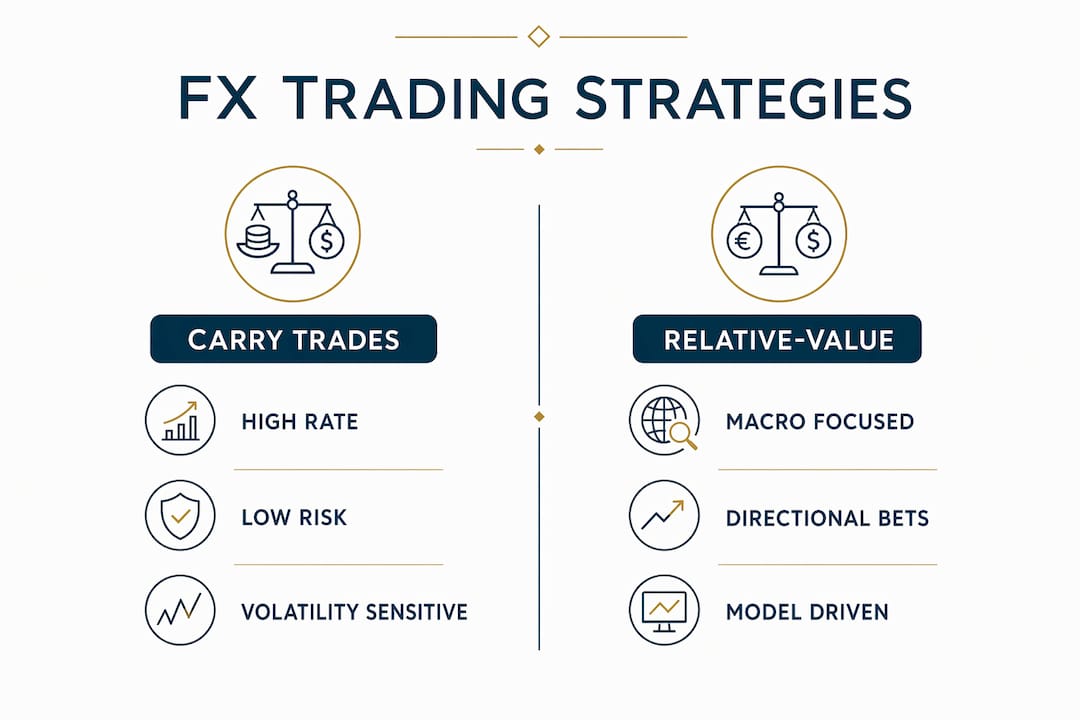
The carry trade, borrowing in a low-rate currency to invest in a high-rate one, remains a popular strategy. The Fed’s removal of explicit forward guidance has elevated volatility and reduced the attractiveness of traditional carry trades. Higher volatility compresses the risk-reward ratio. Carry trades work best in calm, trending markets. In 2026, that environment is fragile.
Timing around economic data and fixings
Experienced traders structure entries and exits around known catalysts. Key risk management practices include:
- Avoid holding large positions into major data releases such as US Non-Farm Payrolls or CPI prints, where slippage and spread widening can destroy a position’s edge.
- Use fixing windows as short-term entry points when you have a directional view aligned with institutional demand patterns.
- Size positions relative to volatility, not just account size. A pair moving 1.5% per day requires a smaller position than one moving 0.5%.
- Monitor intervention risk on JPY positions. The Bank of Japan has a history of unannounced intervention, and with the Yen near 40-year lows, the risk is elevated.
Relative-value trades over directional bets
Institutional model signals should be interpreted with respect to overarching macro conditions, favouring relative-value and model-aligned trades rather than absolute shorts or longs. A GBP/JPY short, for example, combines a model-rich GBP with a model-cheap JPY that has intervention upside. That is a more disciplined trade than a naked USD long.
Pro Tip: Before entering any carry trade in 2026, check the implied volatility on the pair. If implied volatility is rising, the carry income is likely insufficient to compensate for the risk of a sharp reversal.
How do FX trading instruments compare for different trader needs?
The forex market offers several instruments, and choosing the right one depends on your objective, time horizon, and risk appetite.
Spot FX trading volumes rose by 38% from 2022 to 2025, while EUR/USD FX swaps declined by 14%. This shift reflects a market moving towards outright trading and away from hedging-driven swap activity. Individual traders and active investors are driving spot volume growth, responding to news cycles and macro events in real time.
| Instrument | Best suited for | Key benefit | Main risk |
|---|---|---|---|
| Spot FX | Active traders, speculators | Immediate execution, tight spreads | Overnight funding costs |
| FX forwards | Corporates, hedgers | Lock in a rate for future transactions | Opportunity cost if rates move favourably |
| FX swaps | Institutional, treasury desks | Manage short-term liquidity and funding | Complexity, counterparty risk |
| FX options | Sophisticated traders, hedgers | Defined risk, asymmetric payoff | Premium cost, time decay |
Spot FX suits traders who want direct exposure to currency moves with fast execution. FX options suit those who want to cap downside while keeping upside open, particularly around event risk such as central bank meetings. FX forwards suit businesses and high-net-worth individuals managing cross-border cash flows, where certainty of rate matters more than capturing upside.
Key takeaways
Successful FX trading in 2026 requires combining macro awareness, institutional signals, and disciplined risk management rather than relying on any single analytical method.
| Point | Details |
|---|---|
| Fed policy drives USD | Markets price a 75% chance of a Fed rate hike by september 2026, keeping the Dollar elevated. |
| Fixing times create edge | USD spikes predictably around Tokyo, Frankfurt, and London fixing windows, offering intraday timing opportunities. |
| Model signals need context | Institutional signals flag GBP as rich and JPY as cheap, but intervention risk must be factored into any JPY trade. |
| Carry trades carry more risk | Elevated volatility in 2026 reduces carry trade reward. Size positions to match current volatility, not historical norms. |
| Spot FX dominates volumes | Spot FX volumes rose 38% from 2022 to 2025, reflecting trader preference for direct, news-driven exposure. |
The uncomfortable truth about FX analysis in 2026
Alex Goldstein’s perspective
After years of watching traders build elaborate models and then lose money on positions that were technically correct but practically wrong, I have come to one firm conclusion: the biggest risk in FX trading is not the market. It is overconfidence in a single framework.
The interest rate differential argument for a strong Dollar in 2026 is sound. The macro case for JPY weakness is also sound. But the Yen sitting near 40-year lows with record short positioning is not a trade. It is a crowded room with one exit. The traders who will make money on JPY are the ones who wait for the Bank of Japan to blink, not the ones who pile into shorts because the fundamentals justify it.
What I have found actually works is combining macro conviction with intraday discipline. Know your fixing windows. Know your positioning data. And know when the model signal you are following is already priced in by every other desk on the street. The edge in FX is rarely in the analysis itself. It is in the timing and the sizing.
For high-net-worth individuals managing real currency exposure, the stakes are higher than for a retail speculator. A poorly timed FX position on a cross-border acquisition or a portfolio rebalancing can cost far more than any trading loss. That is where independent currency advice from advisors who are not earning a spread on your trade becomes genuinely valuable. The traditional bank model has its hand in the client’s till on every FX transaction. That is not analysis. That is a conflict of interest dressed up as a service.
— Alex Goldstein
How NXD Family Office supports FX exposure and wealth strategy
High-net-worth individuals face FX risks that go well beyond a single trade. Cross-border assets, international property, overseas investments, and multi-currency income streams all create currency exposure that requires active management, not passive acceptance.

NXD Family Office works with clients to assess and manage FX exposure as part of a broader wealth management strategy, free from the commissions and referral fees that compromise advice at traditional institutions. The approach is direct: understand the client’s actual currency risk, identify the instruments that suit their objectives, and connect them with advisors who have no financial incentive to push a particular product. For clients who want to understand how a family office structure supports this kind of bespoke financial oversight, the 2026 family office guide is a practical starting point.
FAQ
What is FX trading and why does insight matter?
FX trading is the exchange of one currency for another on the global forex market, with the goal of profiting from price movements. Insight matters because currency prices respond to macro events, institutional flows, and fixing patterns that are not visible from price charts alone.
What drives the US Dollar’s strength in 2026?
Markets price a 75% probability of a Federal Reserve rate hike by september 2026, pushing the US Dollar Index above 101.00 for the first time since may 2025. Rising 2-year Treasury yields above 4.20% are reinforcing that strength by attracting capital into Dollar-denominated assets.
What are fixing times and why do they matter for forex trading?
Fixing times are scheduled windows at Tokyo 9:55 AM, Frankfurt 2:15 PM, and London 4:00 PM when institutional demand for USD concentrates, causing predictable intraday price spikes. Traders who understand these patterns can time entries and exits more precisely around known liquidity events.
Is the carry trade still a viable currency trading strategy?
The carry trade remains viable but is less attractive in 2026 because the Fed’s removal of explicit forward guidance has elevated market volatility. Higher volatility reduces the risk-reward ratio, so carry positions require tighter sizing and clearer exit rules than in previous low-volatility cycles.
How do I choose between spot FX and FX options?
Spot FX suits active traders who want direct, fast exposure to currency moves with tight spreads. FX options suit traders and hedgers who want a defined maximum loss, particularly when positioning around high-impact events such as central bank decisions or geopolitical announcements.