

Wealth solutions beyond investment management are defined as integrated advisory services that extend past portfolio returns to include tax planning, estate structuring, family governance, cybersecurity, and lifestyle support. High-net-worth families in 2026 face a reality that traditional investment-only models were never built to address. Fidelity’s 2026 wealth management research confirms that next-generation clients now prioritise peace of mind and multi-generational wealth structuring alongside financial returns. The gap between what investment-focused advisors deliver and what affluent families actually need has never been wider.
1. Wealth solutions beyond investment management: what they actually cover
The industry term for this expanded model is integrated wealth management, and it covers a far broader remit than most families realise. Family offices are the clearest example of this model in practice. They coordinate financial administration, household bill pay, estate and succession planning, family business consulting, and philanthropic strategy, all under one roof.
The distinction matters because siloed advice creates gaps. A tax adviser who does not speak to your estate solicitor, or an investment manager who ignores your cash flow needs, leaves your wealth exposed. Integrated wealth management closes those gaps by treating every financial and personal decision as part of one connected picture.

STEP, the professional body for trust and estate practitioners, has highlighted how family offices are evolving into hubs for generational stewardship, requiring legal, tax, governance, and financial services to work in genuine collaboration. That shift reflects what clients are demanding, not what advisors have decided to offer.
2. How integrated financial planning enhances wealth beyond investments
Financial planning is the foundation of any serious wealth strategy. It covers cash flow management, risk assessment, retirement structuring, and the day-to-day administration that keeps a family’s finances running without friction.
Operational tasks such as bill pay and vendor coordination directly affect liquidity and the timing of estate and tax execution. That is a point most investment managers overlook entirely. A missed payment to a trust administrator or a delayed vendor invoice can disrupt carefully planned tax positions.
The family financial management checklist approach, where every financial obligation is tracked and coordinated centrally, reduces the risk of these operational failures. For high-net-worth families with multiple properties, business interests, and investment vehicles, this level of coordination is not optional. It is the difference between a plan that works on paper and one that executes in practice.
Pro Tip: Ask any prospective wealth adviser how they coordinate with your tax and legal teams. If the answer involves forwarding emails, that is a warning sign.
Cybersecurity has also become a core component of financial planning for affluent clients. Fidelity’s 2026 research shows that next-generation HNW clients push wealth managers to allocate more adviser time to non-investment services, with personal security and digital protection ranking prominently among their concerns.
3. Tax planning strategies that preserve and transfer wealth efficiently
Tax planning is where the gap between theoretical advice and practical execution is most costly. The tools available to high-net-worth families are well established: lifetime gifting, irrevocable trusts, spousal portability, and generation-skipping transfer tax planning. The question is whether your advisers are actually deploying them in a coordinated way.
Estate planning law firms describe tiered tax planning that layers multiple strategies simultaneously. At the first tier, lifetime gifting and spousal portability reduce the taxable estate. At the second tier, irrevocable trusts remove assets from the estate permanently. At the third tier, dynasty trusts and charitable remainder trusts (CRTs) address multi-generational transfer and philanthropic goals.
Real estate tax strategies add another layer. Charitable and real estate planning tools such as qualified opportunity zone investments and 1031 exchanges are essential components of a complete tax plan for families with significant property holdings. These are not standalone tactics. They work best when coordinated with your overall estate and investment positions.
The critical point, as Fidelity’s 2026 analysis makes clear, is that tax and estate planning must function as implementation constraints, not theoretical advice. The best tax strategy is the one that actually reduces your compliance burden and executes without friction. NXD Family Office’s tax advisory services are built on exactly this principle: advice that reduces complexity, not adds to it.
4. Estate and succession planning for multi-generational legacy
Estate planning for high-net-worth families is not simply a matter of writing a will. The complexities multiply quickly: blended families, special needs provisions, spendthrift protections, and the governance of family businesses all require bespoke legal and financial structures.
Succession planning for a family business is one of the most demanding challenges in wealth management. Leadership transitions require legal documentation, tax structuring, and family communication to work in parallel. A poorly managed succession can destroy in months what took decades to build.
Family governance sits alongside succession planning as an equally important discipline. Governance frameworks define how family members make decisions about shared assets, how disputes are resolved, and how the next generation is educated about wealth stewardship. Private wealth structuring is the formal mechanism through which these frameworks are given legal and financial substance.
Pro Tip: Establish a family charter before a succession event forces the conversation. Families that agree on governance principles in advance navigate transitions far more effectively than those who improvise under pressure.
Family offices coordinate estate and succession planning by working directly with legal and tax advisers, ensuring that every document reflects the family’s current financial position and future intentions. That coordination function is what separates a family office model from a collection of separate professional relationships.
5. Lifestyle and personal services as a wealth management dimension
Lifestyle services are not a luxury add-on. For high-net-worth clients, managing luxury assets, securing access to rare events, and coordinating personal services are genuine time and risk management challenges.
Fidelity’s 2026 research identifies a clear shift in client expectations: next-generation investors value return on time invested as highly as financial returns. They want advice that supports lifestyle goals, not just balance sheet growth.
NXD Family Office addresses this directly. Clients gain access to lifestyle asset advisory covering cars, aviation, asset watches, and property, alongside concierge services that extend to experiences most advisers cannot offer. Securing Wimbledon tickets, arranging a behind-the-scenes tour of Northern Ballet, or organising a private meeting with a current Formula 1 racing driver are not marketing claims. They are examples of what genuine client care looks like when an adviser is not constrained by commission structures.
Philanthropic strategy also sits within this dimension. Charitable giving is most effective when it is integrated with tax planning and estate structuring, rather than treated as a separate personal decision. A well-structured charitable remainder trust, for example, provides income during your lifetime, reduces estate tax exposure, and delivers a meaningful legacy gift.
6. Coordinated wealth hubs versus siloed investment advice
The practical difference between a coordinated wealth model and a traditional investment-only adviser is not philosophical. It shows up in execution.
| Feature category | Coordinated wealth hub | Investment-only model |
|---|---|---|
| Financial planning | Integrated with tax and estate | Separate engagement required |
| Tax planning | Implemented as part of wealth strategy | Referred to external accountant |
| Estate structuring | Coordinated with legal and tax advisers | Client manages separately |
| Lifestyle services | Included within client relationship | Not offered |
| Advisory coordination | Single point of contact | Client coordinates multiple advisers |
| Next-generation planning | Family governance and education included | Investment portfolio handover only |
The coordinated model reduces the execution burden on the family. The investment-only model places that burden on the client, who must manage multiple professional relationships and ensure they are communicating with each other. For busy entrepreneurs and family principals, that coordination cost is significant.
STEP’s analysis of family office evolution confirms that multi-disciplinary collaboration across legal, tax, and governance disciplines is now the expected standard for serious wealth advisory relationships. Families selecting advisers in 2026 should treat this coordination capability as a baseline requirement, not a premium feature.
Key takeaways
Effective wealth management in 2026 requires coordinated delivery across financial planning, tax, estate, and lifestyle services, not investment advice delivered in isolation.
| Point | Details |
|---|---|
| Integration is the standard | Tax, estate, and financial planning must work together, not as separate engagements. |
| Operations affect outcomes | Bill pay and vendor coordination directly influence liquidity and tax execution timing. |
| Tax tools require deployment | Trusts, lifetime gifting, and portability strategies only work when actively implemented. |
| Lifestyle services have real value | Return on time invested is now a core client priority alongside financial returns. |
| Coordination reduces family burden | A single advisory hub removes the cost of managing multiple disconnected professionals. |
Why the wealth management industry needs to catch up
The honest observation, from years of working alongside high-net-worth families, is that most wealth advisers are still selling yesterday’s model. They lead with investment performance, present a portfolio review, and consider the job done. The family is left to manage everything else: the tax filing, the estate solicitor, the succession conversation, the lifestyle complexity.
What I see consistently is that the families who feel most in control of their wealth are not necessarily those with the highest returns. They are the ones whose advisers have taken the time to understand the full picture. When a family knows that their tax position, estate documents, and financial administration are all aligned and being actively managed, the quality of their decision-making improves. They stop making reactive choices driven by anxiety and start making considered ones.
The cybersecurity dimension is one that still catches many traditional advisers off guard. High-net-worth families are targets. Their digital footprint, their property holdings, their travel patterns, and their business interests all create exposure. Treating cybersecurity as a personal safety matter, not an IT problem, is a mindset shift the industry has been slow to make.
The families I work with increasingly want advisers who will say “consider it done” and mean it. That requires a service model built around the client’s life, not around the adviser’s product range.
— Alex Goldstein
NXD Family Office: wealth management built around your life
NXD Family Office brings together expert advisers across financial planning, tax, estate structuring, and lifestyle services, with no referral fees and no commissions. Every recommendation reflects what is right for the client, not what generates revenue for the adviser.
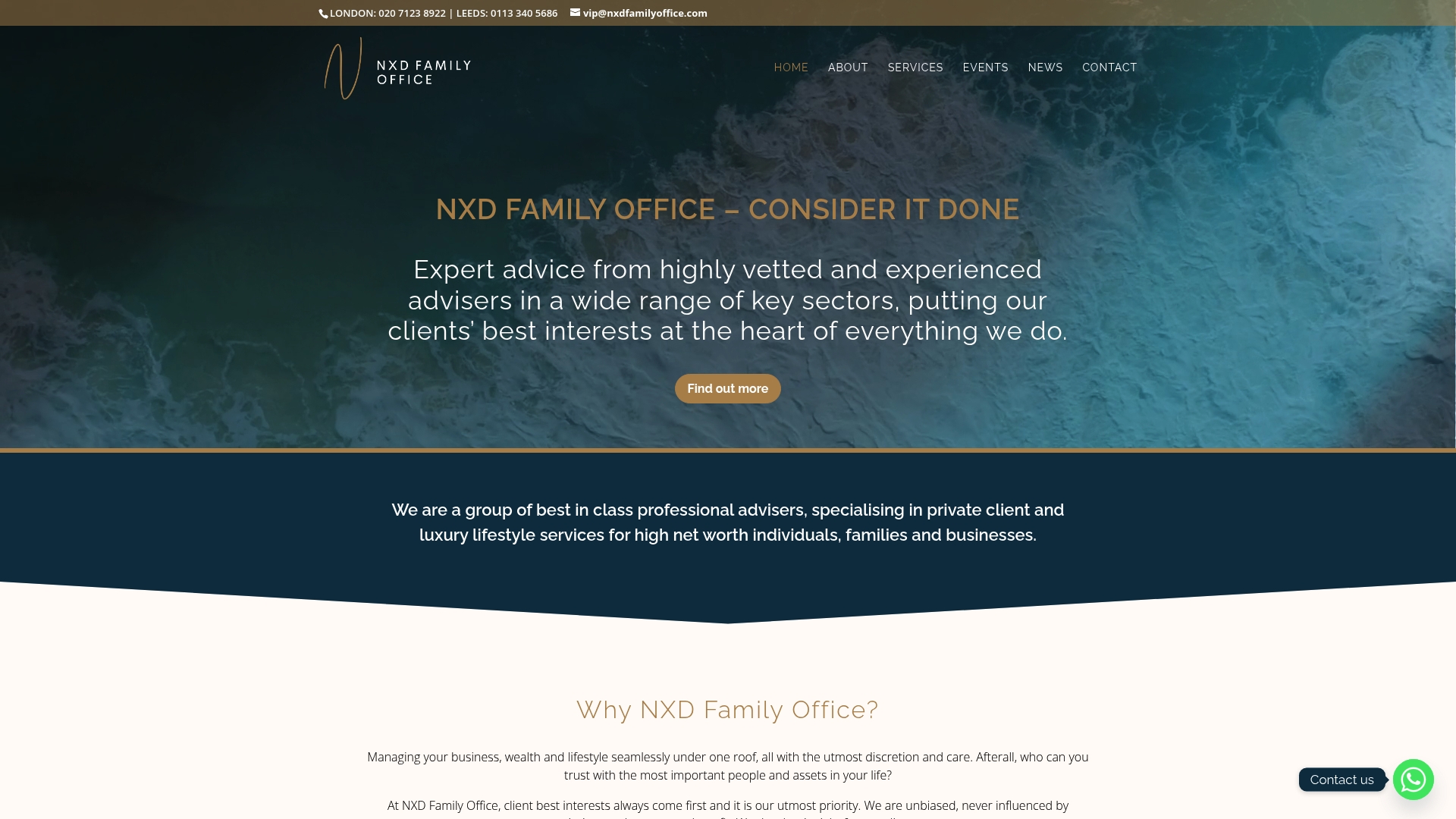
For high-net-worth individuals and families who want a single, trusted point of coordination across every dimension of their wealth, NXD Family Office delivers exactly that. From bespoke wealth management tailored to your specific circumstances, to lifestyle services that go well beyond what any standard advisory firm can offer, the approach is built on one principle: your interests come first. Explore NXD Family Office’s full range of wealth management services to see what genuinely integrated advice looks like in practice.
FAQ
What are wealth solutions beyond investment management?
Wealth solutions beyond investment management are integrated advisory services covering tax planning, estate structuring, financial administration, family governance, and lifestyle support. They address the full complexity of high-net-worth family life, not just portfolio performance.
Why do high-net-worth families need more than investment advice?
Investment returns alone do not address tax exposure, succession risk, estate complexity, or lifestyle management. Fidelity’s 2026 research confirms that next-generation HNW clients now prioritise peace of mind and multi-generational structuring alongside financial growth.
What tax tools are most effective for high-net-worth estate planning?
The most effective tools are lifetime gifting, irrevocable trusts, spousal portability, charitable remainder trusts, and dynasty trusts. These work best when deployed as part of a coordinated strategy across retirement, business, and real estate positions.
What is the role of a family office in wealth management?
A family office acts as the central coordinator of a family’s financial life, managing everything from estate and succession planning to bill pay, philanthropic strategy, and family business consulting.
How do lifestyle services fit into a wealth management strategy?
Lifestyle services address the time and risk management demands that come with significant wealth, including luxury asset management, personal security, and access to rare experiences. They are most valuable when integrated with financial and estate planning rather than managed separately.