

Net worth is defined as total assets minus total liabilities, giving you a single number that shows your true financial position. If you own more than you owe, your net worth is positive. If your debts exceed your assets, it is negative. Understanding net worth is one of the most practical steps you can take in personal finance, whether you are a student with a small savings account or a young professional building your first investment portfolio. Net worth is not the same as income, and confusing the two is one of the most common financial mistakes people make.
What does net worth mean, and how is it different from income?
Net worth and income measure entirely different things. Income is cash flow; net worth is accumulated wealth. You can earn a high salary and still carry a negative net worth if your mortgage, car loans, and credit card balances outweigh everything you own. Equally, someone on a modest income who has spent decades paying down debt and saving consistently can hold a strong positive net worth.
The distinction matters because lenders, financial planners, and advisors use net worth to assess your real financial strength. A pay cheque tells them what you earn this month. Net worth tells them what you have built over your lifetime. For anyone serious about financial independence planning, net worth is the number that actually counts.
Think of income as the speed of a car and net worth as the distance already travelled. Speed matters, but distance is what gets you to your destination.

What assets and liabilities count towards net worth?
Assets are everything you own that holds financial value. Liabilities are every debt or financial obligation you carry. The gap between the two is your net worth.
Assets typically include:
- Cash and savings accounts
- Investments such as stocks, bonds, and ISAs
- Pension and retirement accounts
- Property at current market value
- Vehicles at current market value
- Valuables such as jewellery, art, or watches
Liabilities typically include:
- Mortgage balances outstanding
- Personal loans and student loans
- Car finance agreements
- Credit card balances
- Any other outstanding debts
Current market value should always be used for assets, not the original purchase price. A property bought for £300,000 a decade ago may now be worth £450,000. Using the outdated figure understates your net worth significantly.
For assets tied to loans, such as a home or a car, you count only the equity. If your property is worth £450,000 and your outstanding mortgage is £200,000, the asset contributes £250,000 to your net worth, not £450,000. Subtracting outstanding loan balances from the market value of each asset gives you the true equity figure.
Pro Tip: Review your asset values at least once a year. Property prices, investment portfolios, and vehicle values all shift. An outdated figure gives you a misleading picture of where you actually stand.
How do you calculate your net worth step by step?
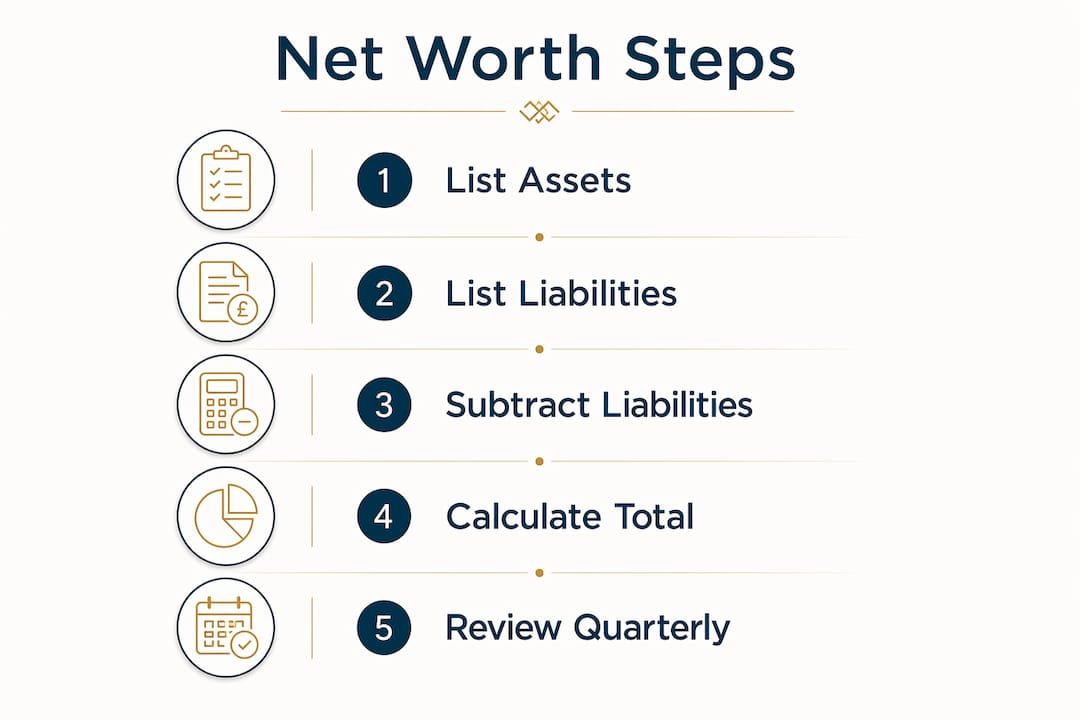
The net worth calculation formula is straightforward: Net Worth = Total Assets minus Total Liabilities. The process of applying it accurately takes a little more care.
- List every asset you own. Include cash, savings, investments, pension funds, property, vehicles, and any other valuables. Use current market values throughout.
- List every liability you carry. Include mortgages, loans, credit card balances, and any other debts. Use the current outstanding balance, not the original loan amount.
- Calculate total assets. Add up all asset values.
- Calculate total liabilities. Add up all outstanding debts.
- Subtract liabilities from assets. The result is your net worth.
Here is a simple example to make it concrete:
| Item | Value (£) |
|---|---|
| Savings account | 15,000 |
| Investment ISA | 25,000 |
| Property equity | 250,000 |
| Pension fund | 40,000 |
| Total assets | 330,000 |
| Personal loan | 8,000 |
| Credit card balance | 2,000 |
| Total liabilities | 10,000 |
| Net worth | 320,000 |
Digital tools and spreadsheets make tracking these figures far easier over time. A simple spreadsheet updated quarterly is enough for most people starting out.
Do not wait until you have perfect figures before you begin. Starting with rough estimates and refining them over time is far more productive than delaying the exercise entirely. Precision improves with practice.
Pro Tip: Set a recurring calendar reminder every three months to update your net worth. Watching the number grow over time is one of the most motivating habits in personal finance.
Why does monitoring your net worth matter for financial health?
Tracking your net worth regularly shows whether your financial decisions are actually working. A rising net worth means your assets are growing faster than your debts. A falling net worth is an early warning sign that something needs to change.
Net worth tracking is critical for anyone building long-term wealth, not just the ultra-wealthy. A student paying down a student loan and building a small ISA is already moving their net worth in the right direction. Seeing that progress in numbers makes the habit stick.
Net worth also affects your access to credit. A higher net worth signals to lenders that you are a lower credit risk, which can lead to easier loan approvals and better interest rates. That translates directly into lower borrowing costs over a lifetime.
Net worth works best alongside your credit score and debt-to-income ratio as part of a complete financial health picture. No single number tells the whole story. Used together, these three indicators give you and any advisor a clear view of where you stand and what to prioritise next.
For anyone working towards retirement, net worth is the primary measure of progress. Your pension pot, your property equity, and your investment accounts all feed into it. Monitoring the total regularly keeps your long-term wealth management on track.
Common mistakes when calculating net worth
The most frequent error is including the gross value of an asset without deducting the related loan. Including gross asset values instead of equity inflates your net worth and gives a false sense of financial security. A £400,000 home with a £350,000 mortgage contributes only £50,000 to your net worth.
A second mistake is confusing net worth with income. A high salary does not guarantee a strong net worth. Spending patterns, debt levels, and saving habits determine the outcome far more than earnings alone.
Net worth is a snapshot, not a fixed constant. It fluctuates as asset values change and debts are paid down or taken on. Treat it as a living number, not a permanent verdict on your finances.
Many people also assume net worth tracking is only relevant once you have significant wealth. That belief delays the habit by years. The earlier you start measuring, the earlier you can correct course. Waiting for perfect accuracy before you begin is equally counterproductive. Start with your best estimates and improve them over time.
Key takeaways
Net worth is total assets minus total liabilities, and tracking it regularly is the single most reliable way to measure genuine financial progress over time.
| Point | Details |
|---|---|
| Core definition | Net worth equals total assets minus total liabilities, showing your true financial position. |
| Assets and liabilities | Use current market values for assets and deduct related loan balances to calculate equity accurately. |
| Net worth vs income | High income does not guarantee positive net worth; accumulated wealth is what matters long term. |
| Why tracking matters | Regular monitoring shows whether your financial decisions are working and supports better credit access. |
| Start now, refine later | Begin with estimates and improve accuracy over time rather than waiting for perfect figures. |
Net worth as a habit, not a one-off exercise
Most people check their net worth once, feel either pleased or alarmed, and then forget about it for years. That is the wrong approach. Net worth only becomes useful when you track it consistently over time.
What I have observed, working with clients across very different financial situations, is that the act of measuring net worth changes behaviour. When you see your liabilities clearly listed next to your assets, discretionary spending decisions feel different. A new car finance agreement stops looking like a monthly payment and starts looking like a direct reduction in your net worth.
The other thing worth saying plainly: net worth is not a measure of personal worth. A negative net worth at 25, after a student loan and a first car, is entirely normal. What matters is the direction of travel. Is the number improving quarter on quarter? That is the only question worth asking.
I would also push back on the idea that net worth tracking is only for people with significant assets. The clients who arrive at NXD Family Office with the clearest financial picture are rarely the ones who started wealthy. They are the ones who started measuring early and made decisions accordingly. That discipline compounds over time just as interest does.
— Alex Goldstein
How NXD Family Office supports your financial planning

Understanding your net worth is the foundation. Building on it requires the right guidance. NXD Family Office works with clients at every stage of wealth building, from those taking their first serious look at their finances to established high-net-worth individuals managing complex asset portfolios. Every client receives unbiased advice, with no referral fees or commissions influencing the guidance they receive.
The team at NXD Family Office can help you structure your assets, review your liabilities, and build a clear picture of where your wealth stands today and where it needs to go. For clients ready to take that next step, professional wealth management from advisors who put your interests first makes a measurable difference. Get in touch with NXD Family Office to discuss your financial goals.
FAQ
What is the definition of net worth?
Net worth is total assets minus total liabilities. A positive figure means you own more than you owe; a negative figure means your debts exceed your assets.
How is net worth different from income?
Income is the cash you earn over a period of time. Net worth is the total wealth you have accumulated. You can earn a high income and still carry a negative net worth if your debts outweigh your assets.
What is the net worth calculation formula?
The formula is: Net Worth = Total Assets minus Total Liabilities. Use current market values for assets and outstanding balances for liabilities to get an accurate result.
Does net worth affect my ability to get a loan?
A higher net worth signals lower risk to lenders, which can improve your chances of loan approval and secure better interest rates.
How often should I calculate my net worth?
Updating your net worth quarterly is a practical habit for most people. At minimum, review it once a year to track progress and catch any negative trends early.