

Offshore wealth management is the practice of structuring and managing financial assets across foreign jurisdictions to protect, grow, and allocate wealth beyond domestic borders. Recognised in professional circles as international private wealth management, it draws on legal vehicles such as offshore trusts, holding companies, and multi-currency bank accounts to achieve asset protection, tax efficiency, and global diversification. Regulatory frameworks including FATCA and the Common Reporting Standard (CRS) now govern every aspect of this field. Approximately 1.5 million Americans hold foreign financial accounts for diversification and investment management. That figure signals how mainstream offshore financial services have become for high-net-worth families worldwide.
What is offshore wealth management and how does it work?
Offshore wealth management is the coordinated use of foreign financial structures to separate legal ownership from personal control, protect assets from domestic creditors, and access global investment opportunities. The term covers everything from a single foreign bank account to a layered network of trusts, companies, and investment funds operating across multiple jurisdictions. The goal is not secrecy. Modern offshore investors prioritise resilience and jurisdictional mobility over secrecy and tax evasion. That shift in purpose defines the entire contemporary approach.

Three regulatory bodies shape the field most directly: FATCA (the US Foreign Account Tax Compliance Act), the OECD’s Common Reporting Standard, and national beneficial ownership registers. Each requires automatic exchange of financial information between governments. Any family or individual building an offshore structure must treat compliance with these frameworks as the foundation, not an afterthought.
What are the main structures used in offshore wealth management?
The core building blocks of offshore wealth management are offshore bank accounts, offshore trusts, and offshore companies. Each serves a distinct function, and the most effective structures combine all three.
An offshore bank account provides multi-currency liquidity outside the domestic banking system. It holds operational funds and allows families to transact in foreign currencies without conversion costs. An offshore trust removes legal ownership of assets from the settlor entirely. A trustee in a foreign jurisdiction holds the assets for named beneficiaries, making those assets resistant to domestic court orders. An offshore company acts as an operational or holding vehicle, owning investments, intellectual property, or real estate in a tax-efficient manner.
| Structure | Primary function | Key benefit |
|---|---|---|
| Offshore bank account | Liquidity and currency management | Access to multi-currency accounts outside domestic banking |
| Offshore trust | Legal ownership separation | Assets protected from domestic creditor claims |
| Offshore company | Holding and operational vehicle | Tax-efficient ownership of investments and property |
| Offshore fund | Pooled investment management | Access to global markets and asset classes |
Offshore trusts combined with bank accounts form asset protection structures resistant to repatriation orders. The trust removes legal control while the account holds operational liquidity outside the domestic jurisdiction. That combination is the gold standard for families seeking genuine protection.
Pro Tip: Choose your offshore jurisdiction based on its legal system, treaty network, and regulatory reputation. The Cayman Islands, Jersey, and Singapore each offer distinct advantages depending on whether your priority is investment funds, trust law, or Asian market access.
What are the benefits and risks of offshore wealth management?
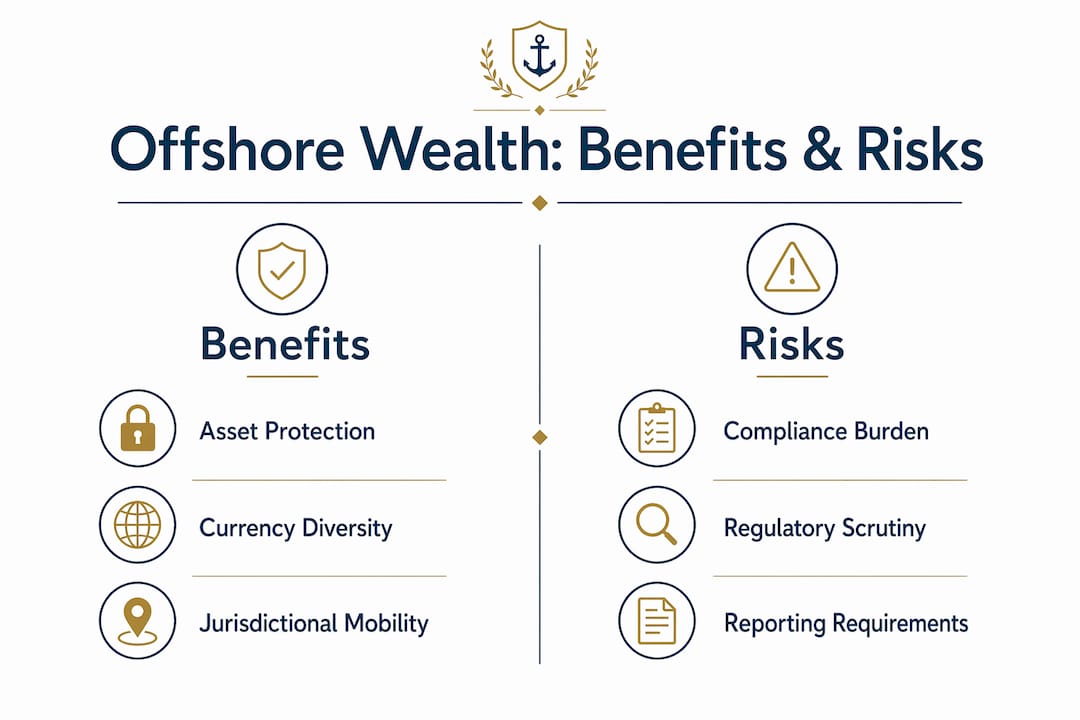
The primary benefits of offshore accounts and structures are asset protection, jurisdictional mobility, currency diversification, and access to investment markets unavailable domestically. A family with assets spread across Jersey, Singapore, and the Cayman Islands faces a fundamentally different risk profile from one concentrated in a single domestic market. Geopolitical disruption, currency devaluation, or domestic litigation affects only a portion of the total estate.
The risks are equally real. Compliance burdens include due diligence on source of funds, beneficial ownership, and transaction documentation. Regulatory scrutiny has intensified sharply since CRS came into force. Reputational risk is a genuine concern if structures are perceived as aggressive or opaque.
Several misconceptions persist about offshore wealth management:
- Misconception: Offshore means illegal. Reality: Offshore structures are entirely legal when properly reported and documented.
- Misconception: Offshore accounts hide money from tax authorities. Reality: FATCA and CRS require automatic disclosure to home-country tax authorities.
- Misconception: Only the ultra-wealthy use offshore structures. Reality: Families with assets above £500,000 regularly use offshore trusts and accounts for estate planning.
- Misconception: Offshore banking is only about tax. Reality: Asset protection, currency diversification, and succession planning are equally important drivers.
Failing to declare offshore accounts forfeits asset protection benefits entirely. Undeclared structures collapse under audit, leaving families worse off than if they had never created them.
Pro Tip: When selecting a jurisdiction, assess its OECD compliance rating, its bilateral tax treaty network, and the quality of its local legal profession. A jurisdiction chosen purely for low tax rates without these foundations creates more risk than it removes.
How do global megatrends reshape offshore investment strategies in 2026?
Geopolitical fragmentation is the defining force reshaping offshore investment strategies in 2026. The shift from a single globalised economy to a multipolar, regionally fragmented system demands a more considered approach to where and how assets are held. Offshore investors in 2026 focus on investments with pricing power, strategic importance, and exposure to long-term capital cycles due to geopolitical shifts. That means energy infrastructure, critical minerals, and technology supply chains rather than purely financial instruments.
The compliance environment has hardened in parallel. FATCA requires US persons to report foreign financial accounts exceeding $10,000 via FBAR. CRS extends equivalent obligations to residents of over 100 participating countries. Beneficial ownership registers now exist in most major offshore centres, making anonymous structures legally untenable.
| Regulatory framework | Jurisdiction scope | Key obligation |
|---|---|---|
| FATCA | US persons globally | Report foreign accounts above $10,000 via FBAR |
| CRS | 100+ participating countries | Automatic exchange of financial account information |
| Beneficial ownership registers | Most major offshore centres | Disclose ultimate beneficial owners of entities |
| OECD Pillar Two | Multinational groups | 15% global minimum corporate tax rate |
The shift from globalisation to multipolar complexity demands more nuanced offshore investment strategies. Families that built structures around a single dominant jurisdiction now face concentration risk they did not anticipate a decade ago.
How can families practically implement an offshore wealth strategy?
Building an offshore wealth structure is a deliberate, sequenced process. Rushing into a foreign bank account without a surrounding legal architecture is the most common and costly mistake families make. The structure must serve a documented economic purpose beyond tax reduction to withstand audit under FATCA and CRS.
- Define your objectives clearly. Separate your goals into asset protection, investment growth, succession planning, and currency diversification. Each objective points to different structures and jurisdictions.
- Establish the legal architecture first. Set up the trust or holding company before opening bank accounts. The legal wrapper determines which assets can be protected and how.
- Open multi-currency banking facilities. Select a bank in a jurisdiction with a strong regulatory framework and a broad correspondent banking network. Jersey, Singapore, and Luxembourg are established choices.
- Document the economic purpose of every entity. Successful offshore strategies require documented economic purpose beyond tax reduction to withstand audits. Regulators expect to see genuine commercial rationale for each structure.
- Separate liquidity from investment and legacy assets. Layered offshore structures splitting domestic and offshore finances increase resilience against freezes or regulatory actions. Keep household liquidity in one account, investment reserves in another, and legacy assets inside the trust.
- Engage independent advisors for ongoing compliance monitoring. Tax laws change. Reporting obligations evolve. A structure that was compliant in 2020 may require amendment today. Annual reviews with qualified advisors are not optional.
- Diversify across jurisdictions. Concentration in a single offshore centre creates the same risk as concentration in a single asset class. Two or three complementary jurisdictions provide genuine resilience.
Treating offshore banking as part of a diversified financial ecosystem rather than a way to isolate funds is the defining principle of effective implementation. Families that understand this build structures that last.
You should also vet your wealth advisors independently before engaging anyone to build or manage an offshore structure. The quality of advice at the outset determines the durability of everything that follows.
Key takeaways
Offshore wealth management works when legal architecture, compliance, and documented economic purpose are built in from the start, not added later.
| Point | Details |
|---|---|
| Compliance is non-negotiable | FATCA, CRS, and beneficial ownership rules require full disclosure; undeclared structures lose all protection. |
| Legal architecture precedes banking | Establish the trust or holding company before opening any offshore account. |
| Document economic purpose | Every entity needs a genuine commercial rationale to survive regulatory audit. |
| Diversify across jurisdictions | Spreading assets across two or three centres reduces geopolitical and regulatory concentration risk. |
| Offshore is not secrecy | Modern offshore wealth management prioritises resilience and mobility, not anonymity. |
Why legal architecture matters more than jurisdiction reputation
I have worked with enough high-net-worth families to know that the most dangerous moment in offshore wealth management is not the audit. It is the initial conversation with an advisor who leads with the name of a jurisdiction rather than the purpose of the structure.
Families arrive with a vague sense that they need to “put money offshore.” What they actually need is a clear answer to three questions: what are you protecting, from what risk, and for how long? The jurisdiction is almost the last decision, not the first. I have seen families spend significant sums establishing structures in well-regarded centres, only to find those structures collapse under scrutiny because no one documented why the entity existed beyond tax efficiency.
Legal asset protection hinges on legal architecture and compliance rather than secrecy. That is not a theoretical point. It is the practical reality of every audit I have observed. The families whose structures survive are those whose advisors built the documentation from day one, not those who chose the most fashionable jurisdiction.
The other lesson I would press on any family considering offshore structures is this: the compliance burden is real and ongoing. It does not end when the trust deed is signed. CRS and FATCA reporting, beneficial ownership updates, and economic substance requirements demand annual attention. Families who treat offshore structuring as a one-time event rather than an ongoing discipline pay for that assumption eventually.
The good news is that a well-built, fully compliant offshore structure genuinely works. It protects assets from domestic creditors, provides currency resilience, and creates a succession framework that domestic wills cannot replicate. The families I have seen benefit most are those who engaged independent wealth advisors early, documented everything, and treated compliance as a feature rather than a burden.
— Alex Goldstein
How NXD Family Office supports offshore wealth management
High-net-worth families deserve advice that is built around their interests, not around the fees an advisor earns from recommending a particular product or jurisdiction. NXD Family Office operates without referral fees or commissions, which means every recommendation is made because it is right for the client.
NXD Family Office brings together a curated network of specialists in offshore structuring, private banking, tax compliance, and succession planning. Whether you are building a first offshore structure or reviewing an existing one for post-CRS resilience, the team provides bespoke guidance grounded in your specific objectives. Explore NXD Family Office’s wealth management services to understand how a fully independent advisory approach can protect and grow your family’s wealth across borders.
FAQ
What is offshore wealth management in simple terms?
Offshore wealth management is the use of foreign legal structures, bank accounts, and investment vehicles to protect, grow, and efficiently manage assets outside your home country. It is entirely legal when all accounts and entities are properly declared to the relevant tax authorities.
Is offshore banking legal for UK residents?
Offshore banking is legal for UK residents. HMRC requires full disclosure of all foreign accounts and income, and failure to report carries significant penalties. Legal offshore structures, properly declared, provide genuine asset protection and investment benefits.
What is the difference between an offshore trust and an offshore company?
An offshore trust separates legal ownership of assets from the settlor, placing them under a trustee for named beneficiaries. An offshore company is a corporate vehicle used to hold investments or property. The two structures are often combined for layered asset protection.
Do I need to report offshore accounts to HMRC?
Yes. UK residents must report all foreign financial accounts and income to HMRC under CRS obligations. Domestic banks report transfers of $10,000 or more to the IRS in the US context, and equivalent automatic exchange applies across CRS-participating countries including the UK.
What are offshore funds and how do they differ from domestic funds?
Offshore funds are pooled investment vehicles domiciled in foreign jurisdictions such as the Cayman Islands, Luxembourg, or Ireland. They provide access to asset classes and markets often unavailable through domestic fund structures, and they are regulated by the laws of their domicile rather than UK financial regulation.