

Managing family wealth discreetly is a strategic process that combines carefully designed governance structures with expert adviser coordination to protect privacy while ensuring full legal compliance. For high net worth families in the UK, this is not simply a preference. It is a practical necessity shaped by the Economic Crime and Corporate Transparency Act 2023 (ECCTA), evolving Register of Overseas Entities obligations, and the growing scrutiny applied to complex ownership chains. The right approach uses structures such as Family Investment Companies (FICs), controlled information flow, and a trusted network of independent advisers to achieve genuine confidentiality. This guide covers every layer of that process, from structure selection to regulatory compliance and risk avoidance.
What are Family Investment Companies and how do they support discreet wealth management?
Family Investment Companies are bespoke private companies designed to hold and transfer wealth across generations while keeping control firmly within the family. FICs suit families with assets exceeding £2 million, where the cost of establishing and maintaining the structure is justified by the governance and tax planning benefits. That threshold matters because below it, simpler structures often deliver comparable results at lower cost and complexity.
The core mechanism of a FIC is its share structure. Founders typically retain voting shares, which preserve control over investment decisions and distributions, while transferring economic shares to children or other beneficiaries. This separation of control from economic interest is what makes FICs so effective for confidential asset management within families. The family retains authority without needing to expose its decision-making to outside parties.

The choice between a limited and an unlimited FIC carries significant privacy implications. Unlimited companies do not require the filing of annual accounts at Companies House, which removes a major source of public disclosure. The trade-off is that shareholders carry unlimited personal liability, meaning personal assets are exposed if the company cannot meet its obligations.
| Feature | Limited FIC | Unlimited FIC |
|---|---|---|
| Annual accounts filing | Required at Companies House | Not required if no commercial borrowing |
| Public disclosure of financials | Yes | Minimal |
| Shareholder liability | Limited to share capital | Unlimited personal liability |
| Privacy level | Moderate | High |
| Best suited for | Most families | Families with low debt and high privacy priority |
Pro Tip: An unlimited FIC works best when the family has no external borrowing and no commercial counterparties who would require audited accounts. If either condition changes, the liability exposure becomes a serious risk.
How have 2023–2026 transparency regulations changed discreet wealth management?
The ECCTA 2023 marks the end of what practitioners now call the “light-touch” era of UK company regulation. The Act mandates identity verification for all UK company directors and Persons with Significant Control (PSCs), with phased compliance running from november 2025 through november 2026. Failure to comply carries criminal penalties, not just civil fines.
For families using layered ownership structures, the implications are direct. Every individual who exercises significant control over a company must now be identifiable and verifiable. Ownership chains that were once tolerated as complex but technically compliant are now a regulatory flag. Non-compliance with IDV requirements causes enforcement action and, critically, the kind of publicity that defeats the purpose of discreet wealth management entirely.
| Compliance milestone | Deadline | Action required |
|---|---|---|
| Identity verification for new directors | From november 2025 | Verify identity before appointment |
| IDV for existing directors and PSCs | By november 2026 | Submit verification through Companies House |
| Ownership chain documentation | Ongoing | Maintain explainable, auditable records |
| Register of Overseas Entities updates | Ongoing | Annual confirmation and updates |
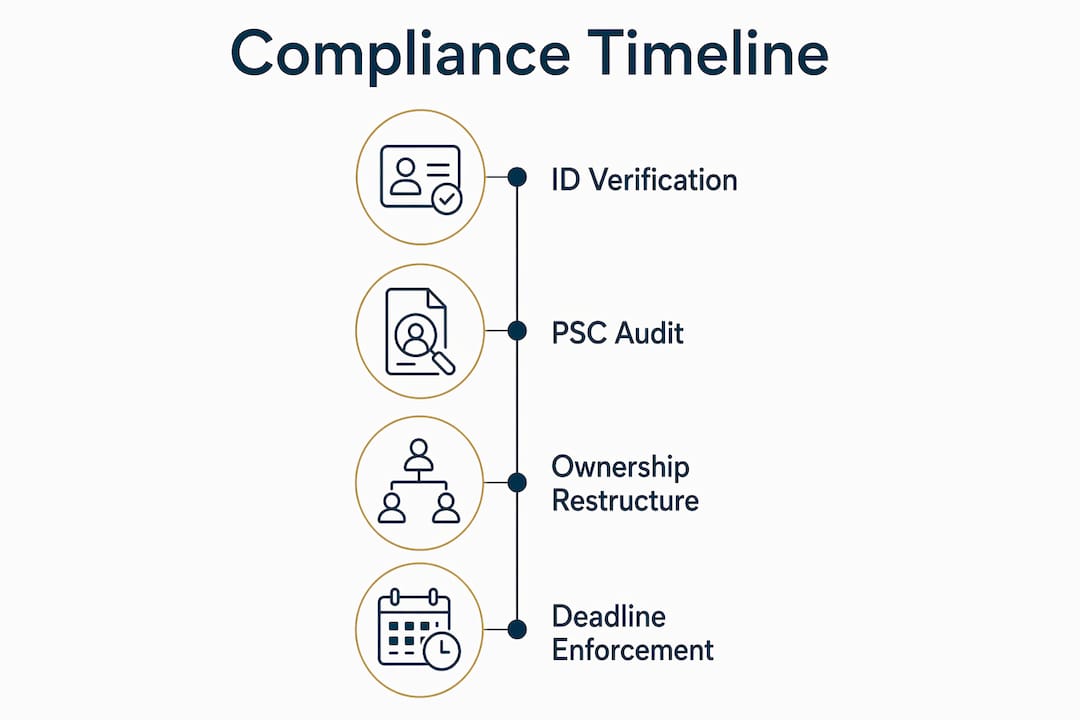
Families should treat these deadlines as planning triggers, not administrative tasks. Restructuring a complex ownership chain under regulatory pressure is far more expensive and visible than doing so proactively. Legal counsel should review all existing structures against ECCTA requirements before the november 2026 deadline.
Pro Tip: Commission a full PSC audit across every entity in your family structure now. Gaps discovered during a regulatory review are far harder to explain than gaps discovered and corrected internally.
What practical steps optimise discreet family wealth management?
Genuine discretion in private wealth structuring depends on how information flows between advisers, not just on which legal structures are in place. Effective discretion is achieved by controlling the narrative and limiting the dissemination of information, rather than pursuing complete anonymity, which is neither achievable nor legally permissible under current UK rules.
The adviser team is the first line of defence. A family’s legal counsel should act as the central gatekeeper, coordinating disclosures to tax advisers, investment managers, and other professionals on a need-to-know basis. This prevents the common problem of multiple advisers holding overlapping but inconsistent information, which creates both confusion and exposure. Independent advisers who operate without referral fee arrangements are better placed to prioritise confidentiality over commercial relationships.
Governance structures reinforce this. A well-drafted family constitution or investment policy statement embeds the family’s values and decision-making protocols in writing, reducing the need for ad hoc conversations that can leak sensitive information. Formal board meetings with documented minutes replace informal discussions, creating a clear and defensible record.
Best practices for coordinating adviser communications include:
- Designating a single point of contact within the family for all external adviser communications
- Using encrypted communication channels for all document sharing between advisers
- Requiring non-disclosure agreements before any transaction-related briefings
- Limiting the number of advisers with access to consolidated family balance sheet information
- Reviewing information-sharing protocols annually, particularly after any change in family circumstances
Pro Tip: During a property transaction or business sale, brief each adviser only on their specific role. The solicitor does not need to know the full investment portfolio. The investment manager does not need to know the property price. Compartmentalisation is the most underused tool in discreet wealth management.
How to manage risks and avoid common pitfalls in discreet wealth management?
The most damaging mistake families make is conflating discretion with secrecy. Over-engineered wealth structures attract more regulatory scrutiny than simpler, transparent ones. A structure that appears designed to obscure ownership rather than manage it efficiently will draw exactly the attention it was meant to avoid.
Common pitfalls include:
- Assuming that off-market transactions guarantee privacy without managing the adviser network around them
- Delaying pre-nuptial agreements until close to the wedding date, which undermines their legal weight
- Failing to update PSC registers when family circumstances change, creating compliance gaps
- Using nominee directors or shareholders in ways that conflict with ECCTA identity verification requirements
- Treating the family office structure as static rather than reviewing it as regulations evolve
Pre-nuptial agreements deserve specific attention. They must be signed at least 28 days before marriage and accompanied by full financial disclosure and independent legal advice for each party. Under the precedent set by Radmacher v Granatino 2010, courts give significant weight to agreements that meet these conditions. A pre-nuptial agreement signed a week before the wedding, without proper disclosure, offers far weaker protection.
“Discretion is not about hiding. It is about choosing, deliberately and carefully, who knows what and when. Families that understand this distinction protect themselves far more effectively than those chasing impossible anonymity.”
Balancing confidentiality with legal transparency is not a contradiction. The families that manage this best treat compliance as the foundation of their privacy strategy, not an obstacle to it.
What alternative tools support confidential asset management for families?
Beyond FICs, several structures offer different privacy and control profiles depending on the family’s circumstances. Offshore wealth management structures, when properly established and reported, can provide additional layers of governance and, in some jurisdictions, reduced public disclosure requirements. The key word is “properly.” Offshore structures that are not fully declared to HMRC and the relevant regulators create legal risk, not privacy.
Trusts remain a widely used vehicle for family asset protection. A discretionary trust gives the trustees full authority over distributions, which means no beneficiary has a fixed entitlement that could be targeted in litigation or divorce proceedings. The trade-off is that the family cedes direct control to the trustees. Off-market property transactions rely on trusted adviser networks managing the timing and narrative of disclosures, not simply on avoiding public listings.
| Vehicle | Privacy level | Control retained | Key trade-off |
|---|---|---|---|
| Limited FIC | Moderate | High | Annual accounts publicly filed |
| Unlimited FIC | High | High | Unlimited shareholder liability |
| Discretionary trust | High | Low to moderate | Trustees hold legal control |
| Offshore structure | Variable | Moderate | Full HMRC reporting required |
| Off-market property | Moderate | High | Depends entirely on adviser network quality |
The right vehicle depends on the family’s specific priorities. A family prioritising succession planning and control will favour a FIC. A family prioritising asset protection from litigation or matrimonial claims may prefer a discretionary trust. Most families with significant wealth use a combination of both, coordinated through a family office structure.
Key takeaways
Discreet family wealth management requires the right legal structures, a coordinated adviser network, and full compliance with ECCTA 2023 to protect privacy without attracting regulatory scrutiny.
| Point | Details |
|---|---|
| FICs as the core structure | Families with £2 million or more in assets benefit most from FIC governance and succession planning. |
| Unlimited FICs for maximum privacy | Unlimited companies avoid public account filings but transfer full liability risk to shareholders. |
| ECCTA 2023 compliance is non-negotiable | All directors and PSCs must complete identity verification by november 2026 or face criminal penalties. |
| Discretion means controlled disclosure | True privacy comes from managing who knows what, not from attempting full anonymity. |
| Pre-nuptial agreements need time | Sign at least 28 days before marriage with full financial disclosure to carry significant legal weight. |
The real cost of getting discretion wrong
Families often come to me after a structure has already attracted attention, and the pattern is almost always the same. The structure was built for a tax outcome, not for governance. Privacy was assumed to follow automatically. It rarely does.
The families I have seen manage this most effectively share one characteristic: they treat their adviser network as a system, not a collection of individual relationships. Each adviser knows their role, their boundaries, and who coordinates the whole. Legal counsel sits at the centre. Everyone else operates within defined lanes. That discipline is what creates genuine confidentiality, not the choice of entity type.
The ECCTA 2023 changes have actually clarified something that was always true. You cannot hide behind complexity. The families that tried to do so are now spending significant sums on remediation. The families that built explainable, well-governed structures are finding that compliance is straightforward because the structure was designed properly from the start.
My honest recommendation is to start with governance, not with tax. Define how the family makes decisions, who has authority, and how information is shared. The right legal structure follows from that. The families that reverse this order, starting with the most tax-efficient vehicle and then trying to retrofit governance, almost always end up with something that is neither efficient nor discreet.
Early planning also matters more than most families realise. Pre-nuptial agreements, trust structures, and FIC share allocations all become significantly more complex and more visible when done under time pressure. The families with the most effective privacy strategies built them years before they needed them.
— Alex Goldstein
How NXD Family Office supports discreet wealth management
High net worth families need advisers who put their interests first, without referral fees or hidden commercial agendas distorting the advice.

NXD Family Office provides a coordinated network of independent experts across legal, tax, governance, and investment disciplines, specifically structured to support confidential wealth management services for families with complex needs. From FIC structuring and ECCTA compliance reviews to off-market transactions and succession planning, every recommendation is free from commission influence. If your family’s current advisory arrangements feel fragmented or you are concerned about how your structures stand up to 2026 regulatory requirements, NXD Family Office is the right starting point. Explore the full range of private client services to see how bespoke, unbiased guidance works in practice.
FAQ
What does managing family wealth discreetly actually mean?
Discreet family wealth management means controlling who has access to financial information through governance structures and trusted advisers, rather than seeking full anonymity. It combines legal structures such as FICs with coordinated information flow to protect privacy within the bounds of UK law.
Are Family Investment Companies still effective after ECCTA 2023?
Yes. FICs remain highly effective for succession planning and governance. ECCTA 2023 requires identity verification for directors and PSCs but does not undermine the core privacy and control benefits that FICs provide.
What is the minimum asset level for a Family Investment Company?
FICs are generally cost-effective for families with assets exceeding £2 million. Below that threshold, the administrative and legal costs of establishing and maintaining a FIC often outweigh the benefits.
How early should a pre-nuptial agreement be signed to protect family wealth?
Pre-nuptial agreements should be signed at least 28 days before the wedding, with full financial disclosure and independent legal advice for both parties. Agreements that meet these conditions carry significant weight in English courts under the Radmacher v Granatino 2010 precedent.
What is the difference between a limited and an unlimited FIC for privacy?
A limited FIC must file annual accounts at Companies House, making financial information publicly accessible. An unlimited FIC avoids this filing requirement, offering greater privacy, but shareholders carry unlimited personal liability for the company’s debts.