

A family wealth education plan is a formal, age-appropriate curriculum designed to build financial literacy, stewardship, and governance skills among family members so that inherited wealth survives across generations. Without one, the statistics are stark. Up to 70% of family wealth is lost by the second generation, and up to 90% by the third. The industry term for this structured approach is a “next-generation education programme,” and it sits at the heart of serious wealth management for families who intend to preserve what they have built.
Why is family wealth education critical for multi-generational wealth?
Wealth erosion across generations is not primarily a market problem. It is an education problem. The three leading causes are poor succession planning, low financial literacy among heirs, and tax inefficiencies that compound over decades. Each of these is addressable through deliberate family financial education, but only when that education begins early and is sustained over time.
Generational wealth longevity depends more on the quality of stewardship education than on the size of assets or investment returns. A family with £50 million and a rigorous education programme will almost always outperform a family with £200 million and none.
The distinction between technical knowledge and stewardship mindset is where most families go wrong. Teaching a 22-year-old heir to read a balance sheet is useful. Teaching them why responsible stewardship matters, and connecting that to family values and identity, is what builds lasting financial behaviour. Both are necessary, but the latter is harder to deliver and far more consequential.
Early integration with family governance is the other factor most families underestimate. Education that runs parallel to governance, rather than feeding into it, produces heirs who understand theory but lack practical accountability. The most effective programmes tie learning milestones directly to governance participation, so that progression feels earned rather than inherited.

Pro Tip: Start financial education no later than age 8, and frame early lessons around family values rather than asset values. Children who understand the “why” behind wealth are significantly more likely to become responsible stewards than those who only learn the “how.”
What does a family wealth education plan include?
A well-structured plan covers four distinct life phases, each with its own learning objectives and engagement methods. The phases are not arbitrary. They reflect the cognitive and professional development of heirs, and the governance responsibilities they will eventually carry.
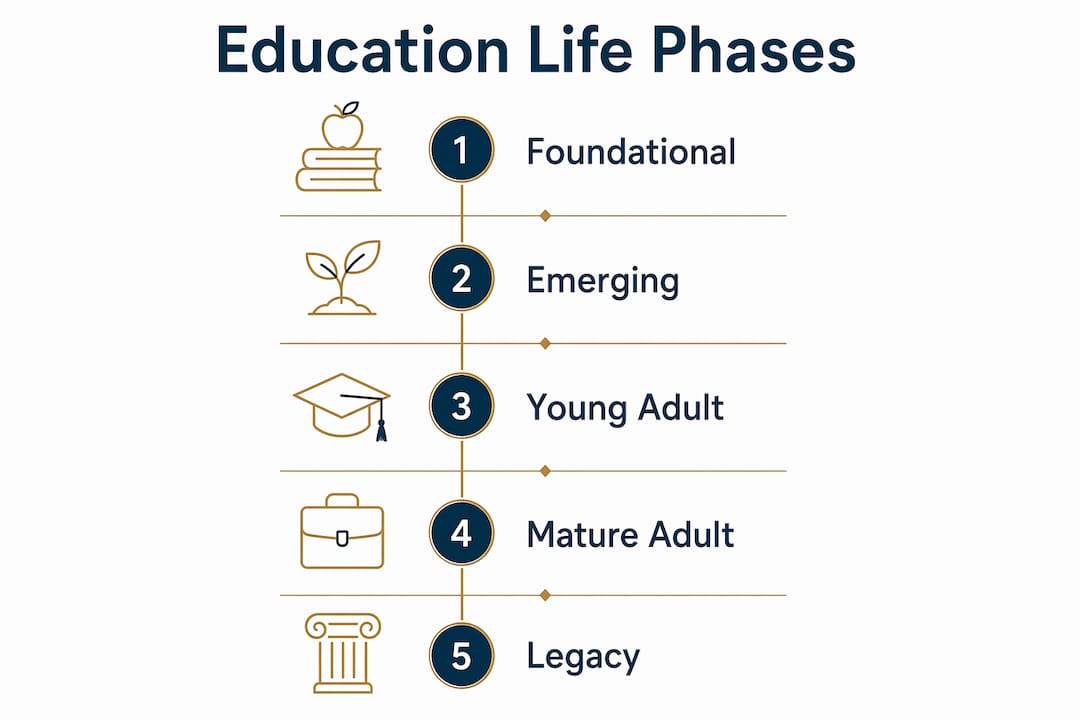
| Life phase | Age range | Core learning domains | Engagement methods |
|---|---|---|---|
| Foundational | 8–14 | Money mechanics, saving, family values | Family discussions, age-appropriate books, guided allowances |
| Adolescent | 15–18 | Investment basics, tax awareness, family history | Workshops, mentoring, family meeting observation |
| Emerging adult | 19–25 | Portfolio management, legal literacy, governance | External programmes, internal rotations, committee participation |
| Active stakeholder | 26+ | Full governance, philanthropy, succession | Board roles, formal assessment, leadership mentorship |
The domains covered across all four phases include financial mechanics, investment concepts, tax and legal literacy, family governance, and philanthropic stewardship. No single phase covers all domains at full depth. Instead, each phase builds on the last, so that by the time an heir reaches the active stakeholder stage, they have a decade or more of structured learning behind them.
Educational methods vary by phase and should be deliberately mixed:
- External programmes from universities or specialist providers
- Internal mentoring by senior family office staff or trusted advisors
- Rotation through family office functions such as investment, operations, and compliance
- Formal governance participation, beginning with observer status and progressing to committee roles
- Written assessments and competency reviews at each phase transition
Emerging adults benefit from participating in governance committees with limited budget authority, typically 0.1–0.5% of distributions. This gives them real decision-making experience without exposing the family to material risk.
What are the common challenges in implementing a wealth education plan?
The most common obstacle is cultural resistance. Many high-net-worth families treat wealth as a private matter, even within the family itself. Parents who built significant wealth often feel uncomfortable disclosing the full picture to children, fearing it will reduce motivation or create entitlement. This reluctance is understandable, but it produces heirs who are unprepared for the responsibilities they will inherit.
A second challenge is the confusion between technical training and stewardship development. These are separate but complementary tracks. Technical training covers financial modelling, tax structures, and investment analysis. Stewardship development covers identity, values, purpose, and the responsibilities that come with significant wealth. Families that focus exclusively on technical skills produce competent analysts who may still make poor governance decisions. Families that focus only on values produce well-intentioned heirs who lack the practical knowledge to act on them.
The third challenge is governance readiness. Placing next-generation members on governance boards without a structured readiness assessment creates real risk, both for the family and for the institutions they govern. Readiness must be assessed formally, not assumed based on age or relationship.
- Establish a written competency framework for each governance role before any heir is considered
- Require completion of the education programme as a prerequisite for governance membership
- Use external assessors where possible to remove family politics from the evaluation
Pro Tip: Making programme completion a formal prerequisite for governance appointments removes the politics from the process. Heirs who know the criteria in advance are more motivated to meet them, and families avoid the damaging perception of nepotism.
Formal documentation is the final piece most families neglect. A written curriculum anchored in the family constitution ensures the programme survives changes in personnel, advisors, and family leadership. Without documentation, education depends on the enthusiasm of one or two individuals and collapses when they step back.
How do you design and implement a multi-year wealth education plan?
The first decision is stewardship of the programme itself. Someone must own it. In families with a family office structure, this is typically a senior staff member or a designated family education trustee. In families without a formal office, an independent advisor or trusted professional can serve this function. The programme cannot be owned collectively by the family without a named individual accountable for its delivery.
Budgeting is a practical consideration that families often underestimate. External programmes for heirs cost between USD 5,000 and USD 25,000 per heir annually. Senior staff and family member time commitments typically amount to 15–20% of their roles. These are not trivial numbers, but they are modest relative to the cost of unprepared heirs inheriting governance responsibilities.
The implementation sequence for a new programme typically follows this order:
- Conduct a baseline assessment of each heir’s current financial literacy and governance readiness
- Draft a written education charter aligned with the family constitution or governance documents
- Map each heir to the appropriate life phase and assign a personal learning plan
- Identify and contract external programme providers for the emerging adult phase
- Establish internal rotation schedules through family office functions
- Appoint mentors, including compensated external mentors where appropriate
- Schedule formal competency assessments at each phase transition
- Review and update the programme every three years to reflect changes in family structure and wealth complexity
Next-generation heirs benefit from two to three years of professional experience outside the family before taking internal roles. External experience builds professional accountability and removes the perception of nepotism when heirs eventually join family governance. This external period should be planned, not left to chance.
Integration with estate planning and private wealth structuring ensures the education plan aligns with the legal and tax architecture of the family’s wealth. Heirs who understand the structures they will inherit are far better positioned to make sound decisions when the time comes.
Key takeaways
A family wealth education plan is the single most effective tool for preventing the well-documented erosion of wealth across generations, and it requires formal structure, written documentation, and multi-decade commitment to succeed.
| Point | Details |
|---|---|
| Start early | Begin financial education at age 8, framing lessons around family values before asset values. |
| Use four life phases | Structure the plan across foundational, adolescent, emerging adult, and active stakeholder stages. |
| Separate the two tracks | Treat technical training and stewardship development as distinct but equally necessary programmes. |
| Document everything | Anchor the curriculum in the family constitution to ensure continuity across generations. |
| Tie education to governance | Make programme completion a formal prerequisite for any governance appointment. |
Why stewardship education is the investment most families skip
I have worked with enough high-net-worth families to know that the education plan is almost always the last item on the agenda. Families spend months debating investment allocation and hours reviewing tax structures, then allocate thirty minutes to “the next generation question.” That imbalance is where fortunes are lost.
The families I have seen preserve wealth across three or more generations share one characteristic. They treat education as governance, not as an optional extra. They write it down, they fund it properly, and they hold people accountable for delivering it. They also understand that the stewardship mindset, the sense of responsibility and identity that comes with significant wealth, cannot be taught in a weekend workshop. It takes years of deliberate exposure, mentoring, and real accountability.
The uncomfortable truth is that technical knowledge is the easy part. Any competent advisor can teach an heir to read a fund prospectus. What no advisor can do is instil the values and judgement that make an heir choose the right course of action when no one is watching. That comes from the family itself, supported by a structured programme and sustained over decades.
My advice to any family reading this: do not wait until a wealth transfer is imminent. The best time to start a family wealth education plan was ten years ago. The second best time is now. Begin with an honest assessment of where each family member currently stands, write down what you want them to know and when, and find advisors who will hold you to that plan rather than simply validate your existing approach.
— Alex Goldstein
How NXD Family Office supports family wealth education
Families who take wealth education seriously quickly realise they need advisors who are equally serious about it. NXD Family Office works with high-net-worth families to build and sustain bespoke education programmes that sit within a broader governance and wealth management framework. Every recommendation is independent, free from referral fees or commissions, and built entirely around the family’s interests.
NXD Family Office brings together specialists across financial planning, governance, tax, and family advisory, so that education plans are integrated with the legal and structural realities of each family’s wealth. Whether you are starting from scratch or reviewing an existing programme, the team provides the independent guidance that traditional advisors rarely offer. Contact NXD Family Office to discuss how a structured education plan can be built around your family’s specific circumstances and long-term goals.
FAQ
What is a family wealth education plan?
A family wealth education plan is a structured, multi-phase curriculum that prepares current and future generations to manage, govern, and steward family wealth responsibly. It covers financial literacy, investment knowledge, tax and legal awareness, governance skills, and philanthropic stewardship across four life stages from childhood to adulthood.
At what age should family wealth education begin?
Financial education should begin at age 8, starting with foundational money concepts and family values. The four-phase model progresses through adolescence, emerging adulthood, and active stakeholder roles, with each stage building on the last.
How much does a family wealth education programme cost?
External programmes for heirs typically cost between USD 5,000 and USD 25,000 per heir annually. Senior staff and family member time commitments add a further 15–20% of their working roles, making total investment significant but proportionate to the wealth at stake.
Why do heirs need external professional experience before joining family governance?
Two to three years of external professional experience builds accountability, professional credibility, and practical judgement that internal roles alone cannot provide. It also removes the perception of nepotism when heirs eventually take governance positions within the family.
How does a family wealth education plan prevent wealth loss?
Up to 70% of family wealth is lost by the second generation and up to 90% by the third, primarily due to poor succession planning and low financial literacy. A structured education plan directly addresses these causes by building competence and stewardship values before heirs assume governance responsibilities.