

A multi-family office is an independent firm that manages the complex financial, legal, and administrative affairs of multiple high-net-worth families through a shared infrastructure. This model, known in the industry as an MFO, gives families access to specialist expertise across investments, tax, succession planning, and lifestyle management at a fraction of the cost of running a dedicated private office. Typical MFO fees range from £750,000 to £4.5 million per family annually, compared to £2–5 million for a standalone single-family office. That cost difference is the central reason families with assets between £25 million and £500 million choose the multi-family office model. NXD Family Office operates on precisely this principle: unbiased, integrated advice with no referral fees or commissions distorting the guidance you receive.
How does a multi-family office differ from a single-family office?
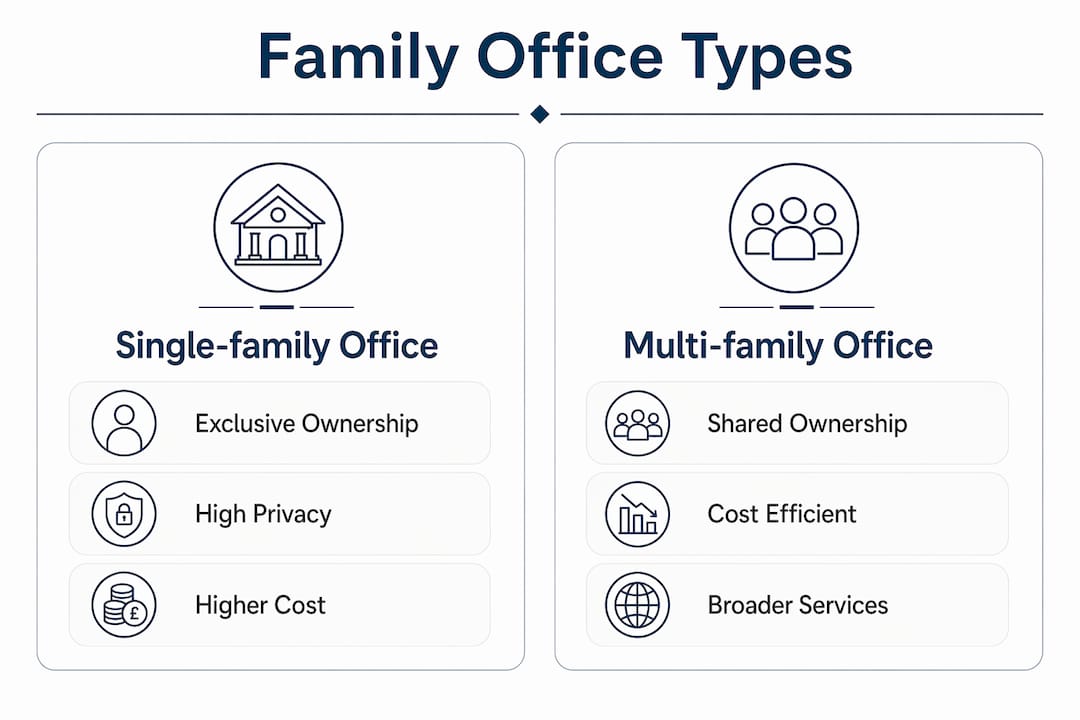
The structural difference between a single-family office (SFO) and a multi-family office (MFO) is ownership and exclusivity. An SFO is built, staffed, and funded entirely by one family. An MFO serves multiple families simultaneously, sharing the cost of its specialist team across its client base.
That shared model has direct financial consequences. A single-family office typically costs £2–5 million per year to operate, which means it only makes economic sense for families with assets well above £100 million. An MFO spreads those operational costs, making institutional-grade advisory accessible to families with investable assets between £25 million and £500 million.
Control and privacy are the trade-offs. An SFO answers exclusively to one family, with complete discretion over every decision. An MFO serves multiple clients, which introduces a degree of shared governance and, in some cases, shared service frameworks. Families who prioritise absolute control and bespoke infrastructure tend to favour the SFO model as their wealth grows.
Pro Tip: When evaluating an MFO, ask directly whether the firm is independently owned or part of a larger financial institution. Bank-owned MFOs may face pressure to recommend proprietary products, which compromises the impartiality you are paying for.

| Feature | Single-family office | Multi-family office |
|---|---|---|
| Ownership | One family | Multiple families |
| Annual cost | £2–5 million+ | £750,000–£4.5 million |
| Privacy | Maximum | High, but shared |
| Service customisation | Fully bespoke | Highly tailored |
| Minimum asset level | £100 million+ | £25 million+ |
| Independence | Fully family-controlled | Varies by firm structure |
What services do multi-family offices typically provide?
MFOs provide integrated services across financial, legal, administrative, and lifestyle domains. The defining characteristic is coordination: a single team manages every dimension of a family’s wealth rather than leaving the client to manage a fragmented network of independent advisers.
Core services offered by most MFOs include:
- Investment management: Access to institutional-grade funds, private equity, and alternative assets not available through retail wealth managers
- Tax planning and compliance: Cross-jurisdictional tax coordination, including US-UK estate and trust frameworks for internationally mobile families
- Succession planning: Structuring wealth transfers across generations with legal and governance frameworks
- Family governance: Establishing family constitutions, investment committees, and decision-making protocols
- Philanthropy management: Coordinating charitable foundations, donor-advised funds, and impact investment strategies
- Risk management and insurance advisory: Reviewing coverage across property, liability, and specialist assets
- Lifestyle and concierge services: Managing property, travel, aviation, and access to exclusive events
The lifestyle dimension is often underestimated. NXD Family Office, for instance, secures access to experiences that money alone cannot buy through conventional channels, from Wimbledon tickets to behind-the-scenes tours of Northern Ballet and private meetings with Formula 1 drivers. That breadth of service reflects what a genuine MFO delivers beyond pure financial management.
Pro Tip: Do not judge an MFO solely on its investment track record. The real value lies in the coordination of tax, legal, and lifestyle functions that independent advisers rarely manage together. Ask for a worked example of how the firm handled a complex cross-border succession.
Investment management alone is insufficient for families with complex governance needs. The MFO model exists precisely because wealthy families need a central hub, not a collection of disconnected specialists.
Who should consider using a multi-family office?
The typical MFO client is a family with net worth between £25 million and £200 million whose financial affairs have grown too complex for a standard wealth manager but who cannot yet justify the cost of a dedicated private office. That gap is where MFOs deliver the clearest value.
Three client profiles consistently benefit most from the MFO model:
-
First-generation wealth creators: Entrepreneurs who have built significant wealth through a business sale or IPO often lack the governance structures to manage it. An MFO provides immediate access to specialists in tax, investment, and succession without the delay of building an internal team.
-
Families with cross-border complexity: Families with assets, residency, or beneficiaries across multiple jurisdictions need coordinated advice on tax treaties, reporting obligations, and estate law. An MFO with cross-border tax expertise handles this as a standard service.
-
Growing families transitioning between models: Families often begin with an MFO and move to a single-family office as wealth and complexity increase. A hybrid model, maintaining a lean private office while outsourcing specialist functions to an MFO, reduces key-person risk and preserves flexibility.
The cost-benefit calculation is straightforward. A family paying £1.5 million annually to an MFO receives a full team of tax lawyers, investment managers, and lifestyle coordinators. Assembling that team independently would cost considerably more and introduce significant coordination risk. For families researching high-net-worth advisory services, the MFO model consistently offers the strongest value proposition in the £25 million to £200 million asset range.
What are the main benefits and limitations of multi-family offices?
The primary benefit of an MFO is cost efficiency through shared infrastructure. Families access a team of specialists in tax, law, investment, and lifestyle management at a cost that no single family could replicate independently. MFOs provide deep expertise across all these domains, with scalability that adjusts as a family’s needs evolve.
A second, often overlooked benefit is reduced operational burden. Managing a private family office requires hiring, compliance oversight, and administrative governance. An MFO absorbs all of that, freeing the family to focus on decisions rather than operations.
The limitations are real and worth stating plainly. The term “multi-family office” is unregulated in the UK, which means any firm can use the label regardless of its actual service model or independence. Some MFOs are owned by banks or financial institutions and face commercial pressure to recommend proprietary products. That is a direct conflict of interest, and families must audit a firm’s ownership structure before engaging.
| Benefit | Limitation |
|---|---|
| Shared costs reduce annual fees significantly | Less exclusivity than a single-family office |
| Access to institutional investment opportunities | Reduced family control over day-to-day decisions |
| Coordinated tax, legal, and lifestyle management | “MFO” label is unregulated in the UK |
| Scalable as family complexity grows | Bank-owned MFOs may push proprietary products |
| Reduces key-person and operational risk | Shared service frameworks may not suit all families |
Families should focus on an MFO’s actual operational model and independence rather than its label. The right question is not “are you a multi-family office?” but “who owns you, and how are your advisers compensated?” That distinction separates genuine independent advisory from a rebranded product distribution business. For a deeper look at why independent advisors matter, the structure of compensation is always the clearest signal of whose interests the firm actually serves.
Key takeaways
A multi-family office delivers institutional-grade wealth management to families with £25 million to £500 million in assets, at a cost that a single-family office cannot match, provided the firm operates independently and without product conflicts.
| Point | Details |
|---|---|
| Cost advantage is significant | MFO fees of £750,000–£4.5 million annually compare favourably to £2–5 million for a standalone office. |
| Independence is non-negotiable | Always audit ownership structure; bank-owned MFOs may not deliver impartial advice. |
| Services extend beyond investment | Tax, succession, governance, philanthropy, and lifestyle management are all core MFO functions. |
| Client profile is specific | Families with £25 million to £200 million in net worth gain the most from the MFO model. |
| Hybrid models are common | Many families use an MFO alongside a lean private office to balance control and cost. |
What I have learned about choosing a multi-family office
The single biggest mistake families make when selecting an MFO is treating it like a product purchase. They compare fee schedules, look at investment performance tables, and sign an engagement letter. What they rarely do is audit the firm’s commercial relationships before committing.
I have seen families pay for “independent” advice only to discover their MFO had undisclosed revenue-sharing arrangements with fund managers. The advice was not impartial. It was a dressed-up distribution model. The UK’s lack of regulation around the MFO label makes this easier to obscure than it should be.
The questions that actually matter are direct ones. Ask who owns the firm. Ask how every adviser in the team is compensated. Ask whether the firm receives any income from third parties in connection with your account. If the answers are vague or defensive, that tells you everything.
The other thing families consistently underestimate is the value of the non-financial services. A well-run MFO does not just manage your portfolio. It manages the complexity of your life. The families I have seen get the most from the model are those who treat their MFO as a genuine partner across every domain, not just a more expensive wealth manager. That shift in mindset changes the relationship entirely.
— Alex Goldstein
How NXD Family Office approaches family wealth management
NXD Family Office was built on a straightforward principle: clients deserve advice that serves them, not the adviser. No referral fees. No commissions. No proprietary products pushed to meet a sales target.
NXD Family Office provides integrated wealth management services spanning investments, tax coordination, insurance, lifestyle assets, and concierge access, all delivered through a curated network of independent specialists. Whether you are a first-generation entrepreneur structuring post-exit wealth or an established family managing cross-border complexity, NXD Family Office builds the advisory team around your specific situation. Clients also gain access to rare experiences, from VIP event access to private aviation, that reflect what genuine wealth solutions beyond investment management actually look like in practice. To discuss your family’s needs, contact NXD Family Office directly.
FAQ
What is a multi-family office?
A multi-family office is a firm that manages the financial, legal, administrative, and lifestyle affairs of multiple high-net-worth families through a shared team and infrastructure. It provides integrated services including investment management, tax planning, succession, and concierge support.
How much does a multi-family office cost?
MFO fees typically range from £750,000 to £4.5 million per family annually, significantly less than the £2–5 million annual cost of operating a standalone single-family office.
What is the difference between a single-family office and a multi-family office?
A single-family office serves one family exclusively and offers maximum privacy and control, while a multi-family office serves several families simultaneously, sharing costs and specialist expertise across its client base.
Is the term “multi-family office” regulated in the UK?
No. The term is unregulated in the UK, which means firms can use it regardless of their actual service model or independence. Families must assess ownership structure and adviser compensation directly to determine whether a firm genuinely operates in their interest.
Who is best suited to a multi-family office?
Families with investable assets between £25 million and £200 million who need coordinated tax, legal, investment, and lifestyle management, but cannot justify the cost of a dedicated private office, are the strongest candidates for the MFO model.