

Holistic wealth management is defined as the ongoing coordination of every financial aspect of a person’s life, from investments and tax planning to estate strategy and protection, into a single unified plan aligned with personal values and lifetime goals. Unlike traditional financial advice, which tends to be transactional and product-focused, this approach treats your entire financial picture as one interconnected system. The industry term for the most rigorous version of this practice is integrated wealth management, and it is gaining ground as the standard that high-net-worth individuals rightly expect. Holistic wealth management integrates tax, estate, retirement goals, and protection into a single strategy that evolves over a lifetime. That evolution is precisely what separates it from a one-off pension review or an isolated investment recommendation.
How does holistic wealth management differ from traditional financial advising?
Most wealth management today is investment management with financial planning attached superficially. True integrated planning reverses this: planning is the foundation, and investments are subordinate to it. That distinction matters enormously in practice.
Traditional financial advice is typically transactional. An adviser recommends a product, you buy it, and the relationship largely ends there. The adviser may revisit you at renewal or when a new product suits their book. There is no overarching written plan, no coordination between your pension, your business interests, and your property portfolio, and no one proactively raising issues you have not thought to ask about.

A relationship-based, goal-oriented approach changes this entirely. Your adviser understands your values, your fears, your ambitions for the next generation, and the shape of your life over the coming decades. Every financial decision is tested against that picture before it is made.
The regulatory environment is also pushing in this direction. FCA Consumer Duty regulations now drive advisers to deliver good outcomes by considering the client’s entire financial picture, demanding more thorough advice than product-led models can provide. This is not a minor compliance adjustment. It is a structural shift in what responsible advice looks like.
- Proactive issue-raising: A good integrated adviser flags problems before you encounter them, such as a pension contribution gap or an inheritance tax exposure you were unaware of.
- Behavioural coaching: Keeping clients disciplined during market volatility is a core part of the relationship, not an optional extra.
- Whole-balance-sheet thinking: Every asset and liability is visible to the adviser, not just the portion they manage directly.
Pro Tip: Ask any prospective adviser to show you a sample written financial plan. If they cannot produce one, they are offering investment management, not integrated wealth management.
What are the main components of a holistic wealth management strategy?
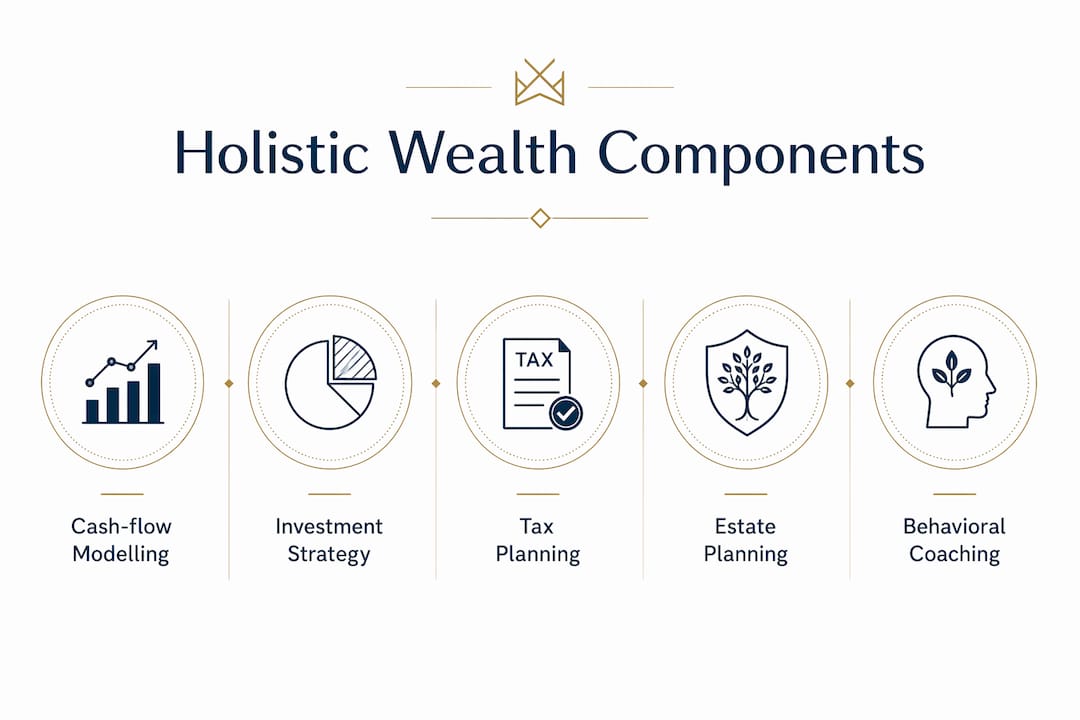
A properly constructed integrated wealth strategy covers six distinct areas. Each one affects the others, which is why they must be planned together rather than in isolation.
-
Cash-flow modelling and financial planning. This is the foundation. A detailed model maps your income, expenditure, assets, and liabilities across your lifetime. It answers the question: will you run out of money, and when? It also models retirement income and intergenerational wealth transfer, showing how decisions today affect your family decades from now.
-
Investment management. Investments are built to serve the plan, not the other way around. Risk tolerance is set in the context of your full financial picture, not just your attitude to markets in the abstract. Holistic advisers offer ongoing support including cash-flow modelling and intergenerational wealth transfer, which shapes how portfolios are constructed and rebalanced.
-
Continuous tax efficiency. Effective planning involves continuous tax optimisation throughout the year, managing allowances and timing gifts rather than treating tax as a year-end exercise. Annual allowances for ISAs, pensions, and capital gains are used in full, every year, without exception.
-
Estate, inheritance, and succession planning. This covers wills, trusts, lasting powers of attorney, and the structuring of assets to minimise inheritance tax. The role of estate planning is not simply to reduce a tax bill. It is to ensure your wealth reaches the people and causes you care about, in the way you intend.
-
Protection planning. Life insurance, income protection, and critical illness cover are assessed against the plan. The question is not “what cover can I sell you?” but “what happens to your plan if you die, become ill, or cannot work?”
-
Annual review and adaptation. Annual reviews of the plan are essential to adjust for changes in your circumstances and the policy environment. Tax legislation changes. Family situations change. The plan must change with them.
| Component | Primary purpose |
|---|---|
| Cash-flow modelling | Maps lifetime income, expenditure, and asset trajectory |
| Investment management | Aligns portfolio construction with the overall plan |
| Tax efficiency | Maximises allowances and minimises liabilities year-round |
| Estate and succession planning | Ensures wealth transfers as intended |
| Protection planning | Safeguards the plan against life’s major risks |
| Annual review | Keeps the strategy current as circumstances evolve |
How do you build a wealth strategy aligned with your values and life goals?
Building a genuinely personal wealth strategy starts before any financial product is selected. The first step is identifying what you actually want your wealth to do. Retirement at 55, funding a child’s education, building a philanthropic legacy, or simply never having to think about money again: each of these requires a different plan.
- Define your values and goals in writing. Vague intentions produce vague plans. Write down your priorities, your non-negotiables, and your timeline. Share these with your adviser at the outset and revisit them annually.
- Choose an adviser with the right credentials. Chartered Financial Planner status signals ethical practice and commitment to comprehensive, integrated advice. It is a meaningful credential, not a marketing label.
- Integrate emotional intelligence into financial decisions. Successful integrated wealth management combines emotional intelligence with technical expertise, focusing on clients’ values and purpose to provide peace of mind beyond mere returns. Your adviser should understand what keeps you awake at night, not just your risk questionnaire score.
- Follow the plan through discomfort. Market falls, tax changes, and life shocks all create pressure to abandon a well-constructed strategy. The plan exists precisely for those moments.
- Synchronise all components. Tax, investment, estate, and protection strategies must reinforce each other. A pension contribution decision, for example, affects your business profit extraction, your income tax position, and your inheritance tax exposure simultaneously.
- Update the plan at every major life change. A new child, a business sale, a health diagnosis, or a divorce each requires a plan review. These are not optional check-ins. They are the moments when integrated planning delivers its greatest value.
Pro Tip: Treat your annual wealth review like a board meeting. Prepare an agenda, bring your updated goals, and expect your adviser to challenge your assumptions, not simply confirm them.
Examples of holistic wealth management in practice
Abstract principles become clear through concrete situations. Consider a business owner in their late forties with a trading company, a commercial property held in a self-invested personal pension (SIPP), a concentrated equity holding in a listed business, and two children approaching university age.
A product-led adviser might review the pension in isolation, recommend a fund switch, and leave the rest untouched. An integrated approach looks at all of it together. Pension contribution headroom impacting business profit extraction is a classic example of how a joined-up plan unlocks value that isolated advice misses entirely. The business owner may be able to extract profit more tax-efficiently through pension contributions than through salary or dividends, but only if someone is looking at both sides of the equation at once.
Tax planning is another area where the difference is stark. A reactive approach files a tax return and pays what is owed. A proactive approach manages capital gains throughout the year, times the disposal of assets around allowances, and coordinates gifts to family members in a way that reduces the eventual inheritance tax bill. These are not complex manoeuvres. They simply require someone who is watching the whole picture, all year round.
| Scenario | Product-led approach | Integrated approach |
|---|---|---|
| Business owner with pension and property | Reviews pension in isolation | Coordinates pension, profit extraction, and property strategy together |
| Concentrated equity holding | Manages position within portfolio | Aligns disposal timing with capital gains allowances and estate plan |
| Market volatility | Reacts to client anxiety | Maintains client discipline through coaching and plan reference |
| Annual tax position | Year-end compliance exercise | Continuous allowance management throughout the year |
| Life change (new child, divorce) | No automatic review | Triggers immediate plan update across all components |
Behavioural coaching is the component that most advisers underestimate. Clients who abandon their investment strategy during a market correction lock in losses and miss the recovery. Advisers who maintain client discipline during volatility deliver substantial long-term value. That value does not appear on a product illustration. It shows up in outcomes over a decade.
Key takeaways
Integrated wealth management delivers superior outcomes because it treats every financial decision as part of a single, living plan rather than a series of isolated transactions.
| Point | Details |
|---|---|
| Planning leads, investments follow | A written financial plan is the foundation; investment decisions serve it, not the reverse. |
| Tax efficiency is year-round | Managing allowances and timing decisions throughout the year produces far better outcomes than year-end compliance. |
| Credentials signal commitment | Chartered Financial Planner status indicates an adviser is trained for integrated, ethical practice. |
| Life changes require plan updates | Major events such as a business sale or new child must trigger an immediate review across all components. |
| Behavioural coaching has real value | Keeping clients disciplined during market volatility is a measurable, long-term contribution to wealth outcomes. |
Why I believe most people are still being underserved
I have spent years watching clients arrive with folders full of financial products and no coherent plan connecting any of them. A pension here, an ISA there, a life policy taken out a decade ago that no longer reflects their circumstances. Each product was sold in good faith, no doubt. But nobody was looking at the whole picture.
The uncomfortable truth is that the financial services industry has been structured, historically, to reward product sales rather than planning outcomes. Advisers earn when transactions happen. That creates a quiet but persistent incentive to recommend action over patience, and products over plans. The shift towards integrated wealth management is, in part, a correction of that structural flaw.
What I find most striking is how much value clients leave on the table simply because nobody has ever sat down with them and mapped their entire financial life in one place. The wealth solutions that go beyond investment management are not exotic or complex. They are logical, coordinated, and available. They simply require an adviser whose interests are fully aligned with yours.
The clients I have seen thrive are those who treat their wealth plan as a living document, not a filing cabinet. They review it annually, update it when life changes, and trust their adviser to raise issues they have not thought to ask about. That relationship is worth far more than any single investment return.
— Alex Goldstein
How NXD Family Office approaches integrated wealth management
NXD Family Office was built on a straightforward conviction: clients deserve advice that serves their interests, not the adviser’s revenue line. There are no referral fees, no commissions, and no incentive to recommend anything other than what is right for you.
NXD Family Office coordinates comprehensive wealth management services across investment strategy, tax advisory, estate planning, and protection, alongside lifestyle services that most advisers do not touch. Whether you need a tax advisory specialist to manage your allowances year-round, or a team that can handle the full scope of your financial life, NXD Family Office brings the right experts to the table without the conflicts of interest that plague traditional advisory models. If you are ready to move from a collection of financial products to a plan that actually reflects your life, speak to NXD Family Office.
FAQ
What is holistic wealth management in simple terms?
Holistic wealth management is the coordination of all financial aspects of your life, including investments, tax, estate planning, and protection, into one unified strategy aligned with your personal goals. It treats every financial decision as connected rather than isolated.
How does integrated wealth management differ from standard financial advice?
Standard financial advice is typically product-focused and transactional. Integrated wealth management is ongoing, relationship-based, and driven by a comprehensive written plan covering your entire balance sheet.
What credentials should I look for in a holistic wealth adviser?
Chartered Financial Planner status is the most recognised credential for integrated, ethical advice in the UK. It signals a commitment to comprehensive planning rather than product sales.
How often should a holistic wealth plan be reviewed?
Annual reviews are the minimum standard, with additional reviews triggered by major life changes such as a business sale, marriage, divorce, or significant inheritance. The plan must adapt as your circumstances and the regulatory environment change.
Does holistic financial planning include lifestyle and non-financial goals?
Yes. A properly constructed plan accounts for your values, your family priorities, and your life ambitions, not just your financial assets. Emotional intelligence and behavioural coaching are recognised components of effective integrated wealth management.