

Legal services are the professional legal tools and advice that protect your assets, preserve your legacy, and secure your financial future after a major life transition. For private clients and entrepreneurs preparing for a business exit, the Solicitors Regulation Authority and the Office of the Public Guardian both regulate the frameworks that govern these protections in England and Wales. Getting this right is not optional. A poorly structured estate or an exit completed without proper legal oversight can unravel years of wealth creation in a matter of months.
The core insight is this: exiting a business is one of the most financially significant events in a person’s life, and the legal work that follows the transaction matters as much as the deal itself. NXD Family Office works with private and entrepreneurial clients to ensure that the structures protecting their success are in place before, during, and after any major transition.
What legal services cover for estate planning and asset protection
A complete estate plan requires four components: a will, two Lasting Powers of Attorney (LPAs), trust structures, and a tax mitigation strategy. Each serves a distinct purpose, and omitting any one of them leaves a gap that can prove costly.
A solicitor-drafted will typically costs between £150 and £300, rising with complexity. That is a modest sum relative to the assets it governs. A will directs where your estate goes after death, but it does nothing to protect you or your family while you are alive.

That is where LPAs become critical. There are two types: one for Property and Financial Affairs, and one for Health and Welfare. The registration fee for each LPA in England and Wales is £92 as of may 2026, totalling £184 per person or £368 for a couple. That cost is fixed and predictable. What is not predictable is the alternative.
If you lose mental capacity without LPAs in place, your family must apply to the Court of Protection for a deputyship order. That process costs approximately £1,200 in the first year alone, with ongoing annual fees, and takes around six months to complete. Six months during which no one has legal authority to manage your finances or make medical decisions on your behalf.
Trusts add another layer of control. A well-structured trust can ring-fence assets from divorce, creditors, or future care costs, and it allows you to direct how and when beneficiaries receive their inheritance. Combined with inheritance tax planning, including the seven-year gifting rule, a trust can significantly reduce the tax burden on your estate. NXD Family Office connects clients with specialist solicitors who understand both the legal mechanics and the personal objectives behind these structures. For clients who want to understand the tax dimension in depth, inheritance tax strategies are covered separately.
Pro Tip: Register your LPAs well before you need them. The Office of the Public Guardian currently takes 14–20 weeks to process registrations in 2026. Waiting until a health event forces the issue is too late.
| Legal tool | Purpose | Typical cost | Key consideration |
|---|---|---|---|
| Solicitor-drafted will | Directs estate distribution after death | £150–£300+ | Must be updated after major life changes |
| LPA: Property & Financial Affairs | Authorises financial decisions during incapacity | £92 registration fee | Two required per person for full coverage |
| LPA: Health & Welfare | Authorises medical decisions during incapacity | £92 registration fee | Cannot be used until incapacity is confirmed |
| Trust structure | Controls asset distribution and provides protection | Varies by complexity | Reduces inheritance tax and protects from creditors |
| Seven-year gifting | Reduces inheritance tax liability | No direct cost | Gifts must survive seven years to be fully exempt |
How legal advice protects business owners during an exit
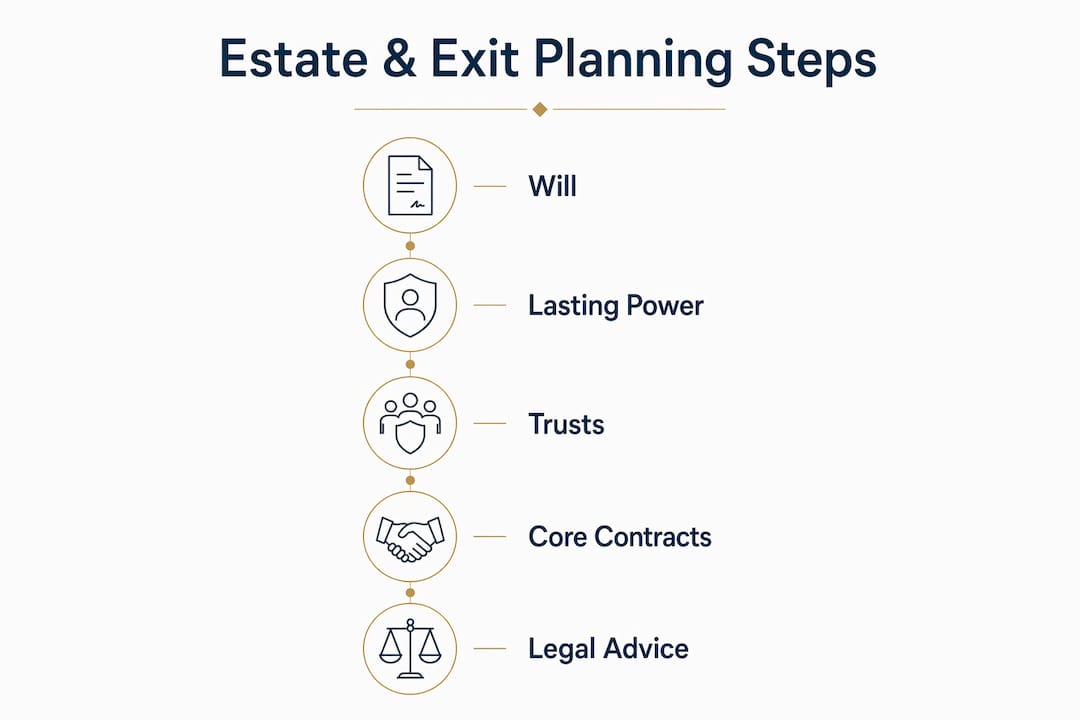
Exiting a business without commercially minded legal counsel is one of the most expensive mistakes an entrepreneur can make. Commercially aligned legal advice improves exit outcomes and reduces the risk of over-lawyering, where solicitors bill hours on issues that a well-prepared client could have resolved in advance. The difference lies in preparation.
The legal documents that govern a business exit are numerous and consequential. Each one requires a solicitor who understands your business model, your growth stage, and your long-term financial goals. The key documents include:
- Share purchase agreements and asset purchase agreements
- Shareholders’ agreements and articles of association
- Employment contracts and settlement agreements for departing staff
- Non-compete and confidentiality clauses
- Warranties and indemnities given to the buyer
- Tax structuring documents aligned with your post-exit wealth plan
Proactive planning consistently outperforms reactive legal work. Engaging solicitors before major contracts are signed, rather than after a dispute arises, avoids the far higher costs of litigation. A business owner who documents their internal position on key negotiating points before instructing a solicitor saves billable hours and arrives at better outcomes.
Building what practitioners call a “core contracts” foundation, meaning documented internal guidelines on key commercial positions, means your solicitor spends time on legal strategy rather than understanding your business from scratch. That distinction matters when you are paying by the hour and the clock is running during due diligence. For clients aligning legal advice with business growth and exit planning, investment and exit advisory is a natural complement.
Pro Tip: Before your first meeting with a commercial solicitor, write down your three non-negotiable exit objectives. A solicitor who understands your priorities from the outset will give you sharper, faster advice.
How to choose the right legal services provider
The fit between a solicitor and their client is as important as the solicitor’s technical expertise. Clear communication and personal understanding between solicitor and client are defining factors in whether the relationship delivers results. A brilliant lawyer who cannot explain your options in plain English is not the right lawyer for you.
When selecting a solicitor for estate or exit planning, apply these criteria:
- Specialisation. Choose a solicitor who practises specifically in private client law, estate planning, or commercial law, depending on your need. General practitioners rarely have the depth required for complex exits or trust structures.
- Experience with comparable clients. Ask directly whether they have advised clients at your wealth level and business complexity. Vague answers are a warning sign.
- Transparent fee structures. The Solicitors Regulation Authority requires solicitors to provide clear cost information. If a firm cannot give you a realistic estimate upfront, look elsewhere.
- Payment terms in writing. Payment on account conditions must be explicitly stated in your retainer agreement. Without this, unexpected fee disputes can disrupt your matter at the worst possible moment.
- Communication style. You will share sensitive financial and personal information with this person. If the first consultation feels transactional or rushed, trust that instinct.
Pro Tip: Ask your prospective solicitor: “What would you need from me to give you the best possible advice?” A good solicitor will have a specific answer. A poor one will say they have everything they need.
Common misconceptions that put your estate at risk
The most damaging misconception in estate planning is that a will alone provides sufficient protection. A complete estate plan requires wills, LPAs, and tax strategies working together. A will only takes effect after death. It does nothing to protect your assets or your family’s ability to act while you are alive and incapacitated.
The risks of acting too late are concrete and measurable:
- Without LPAs, a six-month deputyship process leaves your finances unmanaged and your family powerless during a health crisis.
- Deputyship costs approximately £1,200 in year one, with ongoing supervision fees, compared to £184 for two LPAs registered in advance.
- LPA registration currently takes 14–20 weeks. Starting the process after a diagnosis is frequently too late.
- Business owners who engage solicitors only after a buyer approaches them lose negotiating leverage and pay premium fees for rushed work.
- Trusts established reactively, after an inheritance tax liability has crystallised, offer far less protection than those structured years in advance.
The pattern across all these risks is the same: delay is expensive. Proactive legal planning is not a luxury for the cautious. It is the most cost-effective financial decision most entrepreneurs and private clients will ever make. The role of estate planning for new wealth covers this in greater detail for clients who have recently experienced a significant financial event.
Key takeaways
Effective legal protection after a business exit requires wills, LPAs, trusts, and commercially aligned solicitor advice working together from the outset.
| Point | Details |
|---|---|
| A will alone is insufficient | Full estate protection requires LPAs and trust structures alongside a will. |
| LPA timing is critical | The Office of the Public Guardian takes 14–20 weeks to register LPAs; start early. |
| Exit planning needs commercial lawyers | Solicitors aligned with your business model reduce costs and improve outcomes. |
| Solicitor fit matters | Communication style and personal understanding are as important as technical expertise. |
| Proactive planning saves money | Deputyship costs far exceed LPA registration fees; early action is always cheaper. |
Why I believe early legal planning is the defining factor
I have seen the consequences of both approaches, and the contrast is stark. Clients who arrive at NXD Family Office with their legal structures already in place, wills updated, LPAs registered, trusts established, move through a business exit with confidence. They know their family is protected regardless of what happens next. Clients who arrive without those structures spend the first months after an exit firefighting legal gaps rather than enjoying what they have built.
The part that frustrates me most is how avoidable this is. The legal costs involved in proper estate planning are genuinely modest relative to the wealth being protected. A couple can register four LPAs for £368. A solicitor-drafted will costs less than a decent dinner in London. Yet I regularly speak with entrepreneurs who have spent decades building significant businesses and have never updated their will or registered a single LPA.
The solicitor relationship is where I see the second failure point. Clients sometimes choose a solicitor based on a referral from their accountant or a name on a letterhead, without asking whether that solicitor actually understands their situation. The legal marketing landscape has made it easier than ever to find specialists, but harder to distinguish genuine expertise from polished presentation. My advice is to interview at least two solicitors before committing, and to ask specific questions about clients they have advised in comparable situations.
The legal environment for estate and exit planning in 2026 is more demanding than it was five years ago. Inheritance tax thresholds, LPA processing times, and the complexity of business exit structures have all increased. The clients who will protect their success most effectively are those who treat legal planning not as a one-off task but as an ongoing discipline, reviewed whenever their circumstances change.
— Alex Goldstein
How NXD Family Office supports your legal protection
NXD Family Office works with private clients and entrepreneurs who want their legal, financial, and lifestyle needs managed by people who are genuinely on their side. There are no referral fees and no commissions. Every solicitor and adviser in the NXD network is selected because they are the right fit for the client, not because they pay to be recommended.
For clients preparing for a business exit or navigating a significant life transition, NXD Family Office coordinates the legal, tax, and wealth planning work that protects what you have built. The starting point is understanding your full picture. Explore wealth management services to see how NXD Family Office brings the right expertise together for clients at every stage of their financial life.
FAQ
What does a complete estate plan include?
A complete estate plan includes a will, two Lasting Powers of Attorney (for Property and Financial Affairs, and for Health and Welfare), trust structures, and an inheritance tax mitigation strategy such as seven-year gifting.
How long does it take to register an LPA in England and Wales?
The Office of the Public Guardian currently takes 14–20 weeks to register an LPA in 2026. Starting the process well before it is needed is the only way to guarantee it is in place when required.
What happens if I lose capacity without an LPA?
Without an LPA, your family must apply to the Court of Protection for a deputyship order. This costs approximately £1,200 in the first year and takes around six months to complete.
When should a business owner instruct a commercial solicitor for an exit?
A business owner should instruct a commercial solicitor before a buyer approaches, not after. Proactive engagement allows the solicitor to understand your business model and objectives, reducing billable hours and improving negotiating outcomes.
How much do solicitor-drafted wills cost in the UK?
Solicitor-drafted wills typically cost between £150 and £300, rising with complexity. That cost increases significantly for mirror wills, trust provisions, or cross-border estate elements.