
The 2026 supercar market is the strongest it has been in years. Combustion engines have been given a legislative reprieve, hybrid powertrains are now the performance baseline, and a handful of genuinely extraordinary machines are either available to order or arriving imminently in the UK. Here is the definitive list of what matters right now.
Key models at a glance:
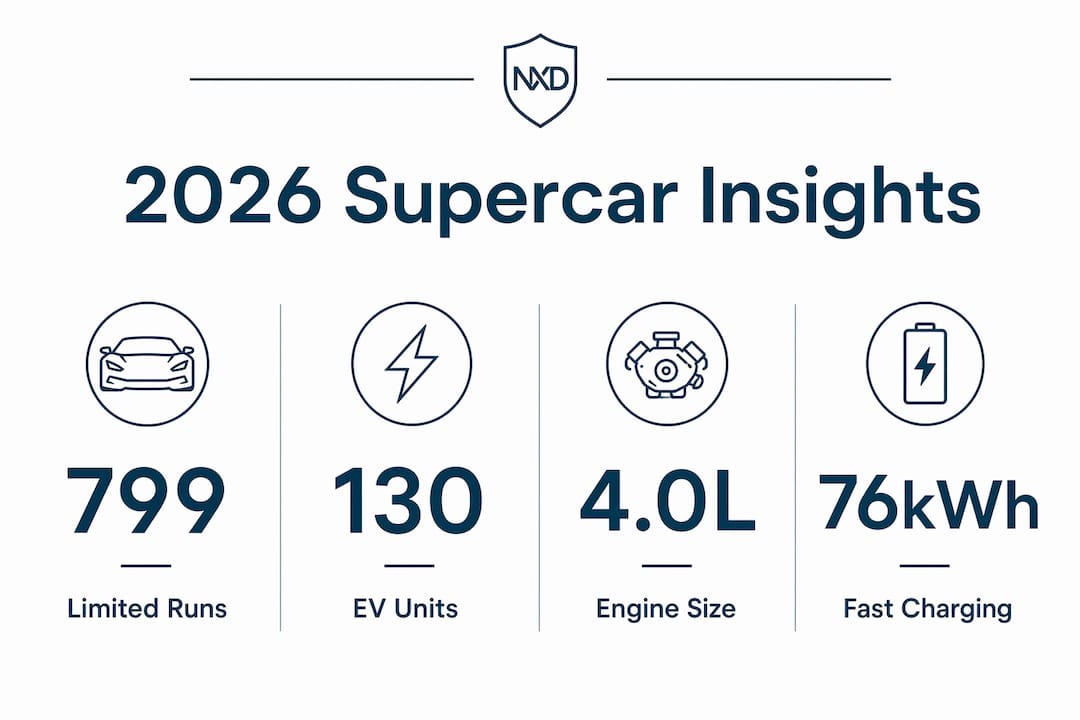
- Ferrari F80 — limited to 799 units globally, hybrid V6, hypercar-grade performance
- Ferrari 296 GTB — twin-turbo V6 hybrid, 819bhp, available now in the UK
- McLaren 750S — 750bhp twin-turbo V8, the sharpest current McLaren road car
- McLaren Speedtail — 1,036bhp hybrid, 250mph top speed, 106 units produced
- Lamborghini Temerario — twin-turbo V8 hybrid, revs to 10,000rpm, arriving 2026
- Lamborghini Sián — 819bhp V12 hybrid, 63 units, largely sold out
- Aston Martin Valhalla — 1,064bhp plug-in hybrid, 999 units, bespoke carbon chassis
- Aston Martin Vanquish — V12 grand tourer, direct rival to Ferrari 12 Cilindri
- Bugatti Chiron Super Sport — 1,578bhp W16, 273mph, ultra-limited production
- Rimac Nevera — 1,914bhp all-electric, 0–62mph in 1.97 seconds
- Pininfarina Battista — 1,877bhp electric, 150 units worldwide
- Maserati MC20 — 630bhp twin-turbo V6, mid-engined, available in UK now
- Lotus Evija — 2,000bhp electric, 130 units, UK-built at Hethel
- Porsche 911 GT3 RS — naturally aspirated 4.0-litre flat-six, the driver’s benchmark
- Ferrari 812 Competizione — 830bhp naturally aspirated V12, 999 units, largely delivered
Production timelines vary sharply. Several of these models are already in UK showrooms; others, including the Lamborghini Temerario and Ferrari F80, are in final delivery phases or accepting orders now. Special editions and bespoke configurations are available across most marques, with lead times extending well into 2027 for the most sought-after variants.
What are the latest supercars you can buy in the UK now?
The current crop of available high-performance vehicles covers an unusually wide range of powertrain philosophies, from naturally aspirated V12s to full-electric machines producing figures that would have seemed fictional five years ago.
Ferrari 812 Competizione
Ferrari built just 999 units of the 812 Competizione, and most have been delivered to customers worldwide. The 6.5-litre naturally aspirated V12 produces strong power at high rpm, making it one of the last great front-engined, high-revving Ferraris. Top speed is well over 200mph. For UK buyers, the secondary market is now the primary route, with prices above the original list price.
McLaren Speedtail
The Speedtail is McLaren’s most extreme road car to date, short of the Senna GTR. All 106 units were allocated before the car was even revealed publicly. Its 1,036bhp hybrid powertrain pushes it to a top speed of 250mph, making it the fastest McLaren road car ever built. The three-seat, centre-driving-position layout is a direct nod to the F1. Collectors view it as a landmark piece.
Maserati MC20
The MC20 is Maserati’s return to mid-engined supercar territory after two decades away. Its twin-turbo 3.0-litre Nettuno V6 produces substantial horsepower and drives the rear wheels through a six-speed dual-clutch gearbox, reaching 62mph in under three seconds. Priced competitively in the UK, it sits alongside rivals like the McLaren Artura. The Cielo spider variant is also available, adding an electrochromic glass roof that darkens on demand.
Lotus Evija
The Evija is a highly powerful British production car, with four electric motors. Lotus capped production at 130 units, all built at Hethel in Norfolk. The 70kWh battery charges at a fast rate, giving very quick acceleration times. UK buyers who secured an allocation are among a very small group globally. It represents Lotus’s pivot to electrification before the brand subsequently revised its broader EV strategy.
Aston Martin Valhalla
The Valhalla is the most technically complex car Aston Martin has ever put into series production. Its 4.0-litre flat-plane twin-turbo V8 works alongside three electric motors to produce over 1,000 horsepower in total. Production is limited to 999 units, each built around a bespoke carbon-fibre chassis not shared with any other Aston Martin. That platform exclusivity is precisely what places it at the boundary between supercar and hypercar territory. UK deliveries are under way, with prices starting above £800,000.
Pro Tip: When evaluating the Valhalla against other plug-in hybrid supercars, ask your dealer for the pure-electric range figure and the charge time on a standard Type 2 connection. The headline 1,064bhp figure tells you about peak performance; those two numbers tell you about daily usability.
Porsche 911 GT3 RS
No list of the best luxury sports cars in 2026 is complete without the GT3 RS. Its 4.0-litre naturally aspirated flat-six produces 525bhp and revs to 9,000rpm, with a top speed of 184mph. What sets it apart from every rival at its price point is the depth of driver engagement: the steering, the throttle response, and the chassis balance are calibrated to a standard that turbocharged and electrified rivals rarely match. UK prices start at approximately £230,000.
Which new supercar releases are arriving in 2026?
Several of the most anticipated new supercar releases are either in final customer delivery or accepting orders now, with the UK market well represented across the range.
Ferrari F80
Ferrari has confirmed the F80 as a limited run of 799 units globally. Its hybrid powertrain combines a twin-turbo V6 with three electric motors for a combined output that places it firmly at the hypercar end of the spectrum. Ferrari has not published a UK list price publicly, but allocations were offered to existing Ferrari clients first, and the secondary market is already active at multiples of the factory price.
McLaren 750S
The 750S replaced the 720S and represents the most developed version of the Super Series platform. Its twin-turbo 4.0-litre V8 produces 750bhp, with 0–62mph in 2.8 seconds and a top speed of 206mph. McLaren has also confirmed the 788HS as the final Super Series model, producing 788bhp from a heavily reworked version of the same engine, with just 200 units planned across coupe and spider variants. For UK buyers, the 750S remains the accessible entry point into current McLaren ownership, from around £250,000.
Lamborghini Temerario
The Temerario is Lamborghini’s replacement for the Huracán, and it takes a dramatically different technical approach. A twin-turbo V8 hybrid revs to an astonishing 10,000rpm, a figure that puts it in naturally aspirated territory for character even with forced induction. UK deliveries are beginning in 2026, with pricing expected to start above £250,000. It goes up directly against the Ferrari 296 GTB, and early impressions suggest it has the edge in engine character.
Ferrari 296 GTB
The 296 GTB is already one of the strongest mid-engined supercars available in the UK. Its 120-degree twin-turbo V6 produces 819bhp in hybrid form, with 0–62mph in 2.9 seconds. Ferrari has since developed the 296 Speciale, which takes learnings from the F80’s powertrain and boosts output to 868bhp, with revised springs, dampers, and bodywork producing 435kg of downforce. The Speciale Aperta open-top version is priced at approximately £408,000 before options.
Aston Martin Vanquish
The Vanquish returns as Aston Martin’s V12 grand tourer, positioned as a direct rival to the Ferrari 12 Cilindri. It sits above the Vantage in the range and targets buyers who want front-engined V12 character alongside genuine long-distance ability. UK availability is confirmed for 2026, with pricing and full specification details available through Aston Martin’s UK dealer network.
Lamborghini Sián
The Sián was Lamborghini’s first series-production hybrid, using a 6.5-litre V12 augmented by a 48-volt supercapacitor system for a combined 819bhp. Just 63 coupes and 19 roadsters were built, and all were sold before the car was revealed. For UK enthusiasts, it now exists primarily as a collector’s piece, with values reflecting its significance as a transitional model in Lamborghini’s electrification story.
Bugatti Chiron Super Sport
The Chiron Super Sport remains the benchmark for outright speed among road-legal production cars. Its quad-turbocharged 8.0-litre W16 produces 1,578bhp, and the car has been tested at 273mph in a modified form. Production numbers are tightly controlled, and UK buyers face a lengthy wait and a price well into seven figures. Bugatti’s bespoke La Maison programme means no two Chirons leave Molsheim identically specified.
Rimac Nevera
The Nevera is the most powerful production car Croatia has ever produced, and one of the fastest accelerating cars ever built. Four electric motors combine for 1,914bhp, with a 0–62mph time of 1.97 seconds. Production is capped at 150 units. UK buyers can order through Rimac’s European network, though availability is extremely limited. It is the car that demonstrated electric powertrains could genuinely challenge the hypercar establishment on performance terms alone.
Pininfarina Battista
The Battista is Pininfarina’s first road car in its own right, rather than a design commission for another manufacturer. Its all-electric powertrain produces very high power from four motors, with a claimed 0–62mph time of under two seconds. Only 150 units are being produced globally, each extensively personalised through Pininfarina’s bespoke programme. UK pricing is in the ultra-luxury range.
What market trends are shaping the 2026 supercar world?
The 2026 supercar market is defined by three forces pulling in different directions: hybrid integration becoming the performance norm, electric demand proving more volatile than manufacturers anticipated, and the boundary between supercars and hypercars becoming genuinely difficult to draw.

Hybrid technology is now the mainstream performance baseline rather than a novelty. The Lamborghini Revuelto demonstrated this most clearly, combining instant electric torque with V12 combustion power in a way that sets the standard for what a flagship supercar should feel like in 2026. Rivals have followed: the Aston Martin Valhalla, Ferrari F80, and Lamborghini Temerario all use hybrid systems not for efficiency but for performance gains that combustion alone cannot deliver.
The electric supercar picture is more complicated. Several European manufacturers, including Lotus and Lamborghini, have adjusted or cancelled EV-only plans, reflecting demand that has not materialised at the pace originally projected. Prospective buyers should expect evolving availability and shifting production strategies across this segment through 2027.
The supercar versus hypercar distinction matters more than ever for buyers thinking about value retention. Production scale and platform exclusivity are the decisive factors: supercars typically run in the hundreds to low thousands using shared platforms, while hypercars feature bespoke chassis and production runs often below 100 units. The Aston Martin Valhalla sits at this boundary, with its unique carbon-fibre tub and 999-unit cap placing it firmly in hypercar territory by most technical definitions, even as Aston markets it otherwise.
The most striking technology story of 2026 is the Denza Z’s Flash Charging capability: a 76kWh battery charged from 10% to 97% in nine minutes using up to 1,500kW of power, with BYD planning 300 compatible chargers across the UK by end of 2027. The system stores energy in a ground-level battery at each station, avoiding direct grid strain. At £142,900 for the Coupe, the Denza Z enters the UK market at a price that undercuts most established rivals, though brand recognition remains a genuine obstacle for many buyers.
Pro Tip: For electric supercars, look beyond the peak horsepower figure. The Denza Z weighs approximately 2,250kg, which blunts handling relative to lighter combustion rivals. Charging network access, real-world range, and kerb weight all affect the ownership experience more than the headline power output.
The collectors who understand this market best are already treating the final pure-combustion supercars as appreciating assets, often employing specialized professional services approaches to sourcing rare supercars to secure them. The McLaren 788HS, with just 200 units planned, is widely regarded as the last of its kind before McLaren’s full range revamp in 2028 brings widespread hybridisation. For those with an interest in lifestyle asset advisory, the distinction between a car as a purchase and a car as a long-term asset is one worth taking seriously before placing an order.
NXD Family Office works with clients across exactly this kind of decision, providing unbiased guidance on supercar acquisition and events without referral fees or commissions. If you are weighing a significant purchase in this market, that independence matters.

For clients who want expert, commission-free guidance on supercar acquisitions as part of a broader wealth management strategy, NXD Family Office provides the kind of honest, bespoke advice that the traditional advisory world rarely offers. Consider it done.
Key takeaways
The 2026 supercar market rewards buyers who look beyond headline horsepower figures and understand production scale, platform architecture, and charging infrastructure as equally decisive factors.
| Point | Details |
|---|---|
| Hybrid is now the baseline | Models like the Lamborghini Revuelto and Aston Martin Valhalla use hybrid systems purely for performance, not economy. |
| Production scale determines value | Supercars run in hundreds to thousands of units; hypercars use bespoke chassis and far smaller runs, affecting resale. |
| Electric demand is volatile | Lotus and Lamborghini have revised EV-only plans, meaning electric supercar availability may shift through 2027. |
| Charging speed is the EV differentiator | The Denza Z’s Flash Charging enables its 76kWh battery to be charged from 10% to 97% in nine minutes at up to 1,500kW, with 300 UK-compatible chargers planned by end of 2027. |
| Weight affects EV handling | The Denza Z’s 2,250kg kerb weight blunts dynamics compared to lighter combustion rivals, a key consideration for driving enthusiasts. |
FAQ
What is the new supercar in 2026?
Several significant models are arriving in 2026, including the Lamborghini Temerario, Ferrari F80, and Aston Martin Vanquish. The Denza Z, priced from £142,900, is also launching in the UK as a 1,582bhp all-electric supercar capable of 0–62mph in 2.25 seconds, with Flash Charging that enables a 76kWh battery to be charged from 10% to 97% in nine minutes at up to 1,500kW.
What are the top 10 best supercars available now?
The strongest current choices include the Ferrari 296 GTB, McLaren 750S, Porsche 911 GT3 RS, Lamborghini Temerario, Aston Martin Valhalla, Maserati MC20, Rimac Nevera, Bugatti Chiron Super Sport, Pininfarina Battista, and Lotus Evija, each leading its respective powertrain category.
What are the top 20 supercars across all eras?
The 2026 generation adds the Ferrari F80, Lamborghini Temerario, and McLaren 788HS to an all-time list that includes the McLaren Speedtail, Bugatti Chiron Super Sport, Lamborghini Sián, Ferrari 812 Competizione, Rimac Nevera, Pininfarina Battista, Lotus Evija, Aston Martin Valhalla, Porsche 911 GT3 RS, Maserati MC20, and Aston Martin Vanquish among the defining machines of the modern era.
How do supercars differ from hypercars in 2026?
Supercars typically use shared platforms and run in production numbers from several hundred to a few thousand units, while hypercars feature bespoke chassis and production runs often below 100 units. Prices for hypercars start above £1 million. The Aston Martin Valhalla, with its unique carbon-fibre tub and 999-unit cap, sits at this boundary.
Is the electric supercar market stable in 2026?
Not entirely. Several European manufacturers have revised or cancelled EV-only plans due to demand that has not met earlier projections. Buyers considering electric supercars should verify current order timelines and production commitments directly with manufacturers before committing.