

A family trust is a legal relationship, not a separate legal person, where a settlor transfers assets to trustees who hold and manage them for named beneficiaries under a written trust deed. The bottom line: families use them to control how and when wealth passes to the next generation, to protect assets for vulnerable or young beneficiaries, and to plan business succession. They are not a tax-avoidance shortcut, and they are not right for every family.
Common reasons UK families create a family trust:
- Asset protection — shielding wealth from future creditors or relationship breakdown (within legal limits)
- Controlled inheritance — setting conditions on when and how beneficiaries receive funds
- Supporting vulnerable beneficiaries — managing assets for a child with a disability or a beneficiary who cannot manage money independently
- Business succession — holding shares across generations without forcing an immediate sale
- Multi-generational transfer — keeping wealth within the family line over decades
Two immediate pitfalls deserve attention before you go further. Placing your main home into a trust can remove eligibility for the residence nil-rate band (RNRB), which is currently £175,000 in recent HMRC guidance—a significant IHT relief. And transfers made to avoid care fees can be reversed by local authorities under deliberate deprivation rules.
Pro Tip: A family trust adds genuine value when you need conditional control over distributions or long-term governance. If your primary goal is simply reducing an IHT bill, a well-drafted will combined with lifetime gifting may achieve the same result with far less complexity and cost.
Table of Contents
- How does a family trust work in practice?
- Who does what: settlor, trustees, and beneficiaries
- What types of family trust do UK families use?
- How are family trusts taxed in the UK?
- Advantages and disadvantages of family trusts
- How to set up a family trust: a practical checklist
- What are trustees’ legal duties and how are disputes handled?
- When should you get professional advice about a family trust?
- Are there simpler alternatives to a family trust?
- Key takeaways
- A candid view on when trusts genuinely earn their place
- Working with a specialist: your next step
- Useful sources and further reading
- FAQ
How does a family trust work in practice?
The mechanics are straightforward once you see them as a sequence. The settlor (the person creating the trust) transfers assets — property, investments, cash, business shares — to trustees. The trust deed, a formal legal document, sets out the trustees’ powers, the class of beneficiaries, and any conditions on distributions. From that point, the trustees hold legal title to the assets; the beneficiaries hold beneficial entitlement.
A short example makes this concrete. Suppose a family transfers a portfolio of investments into a discretionary trust for their adult children. Legal ownership moves to the trustees. The children do not automatically receive income or capital; the trustees decide, within the deed’s parameters, when and how much to distribute. The settlor no longer owns the assets, which is precisely the point — and precisely the risk if the arrangement is not planned carefully.
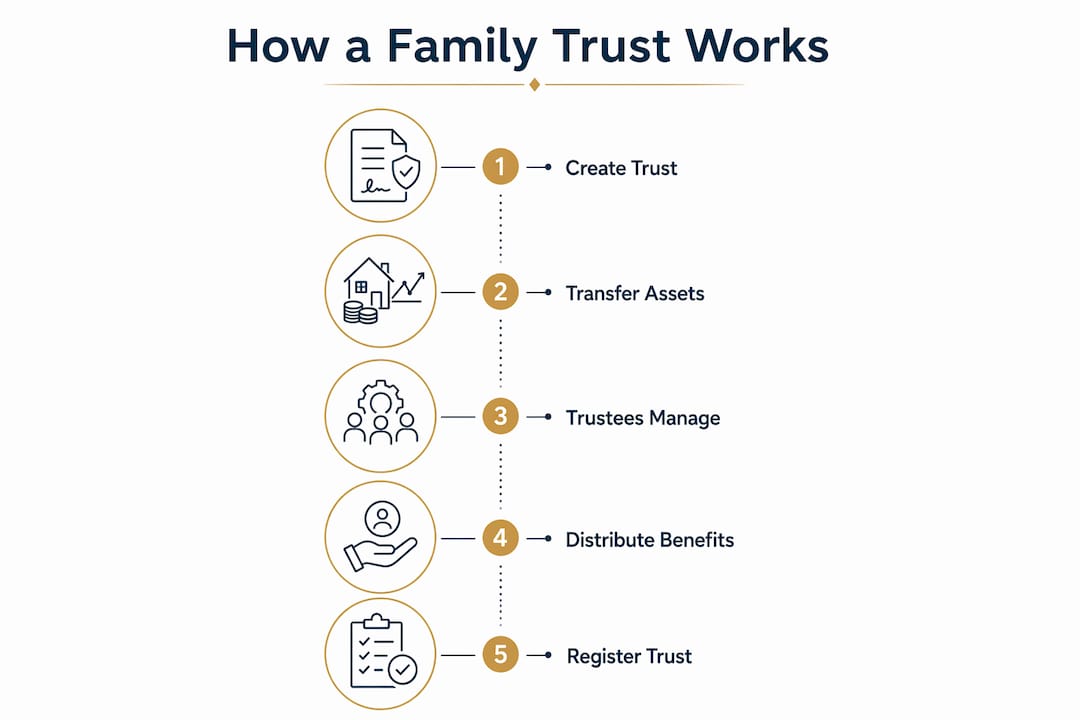
Registration matters too. Most UK trusts must be registered with HMRC’s Trust Registration Service (TRS). Trustees are responsible for keeping the register up to date and for meeting ongoing tax-reporting obligations. Failing to register can result in penalties. Ongoing administration includes maintaining accounts, filing trust tax returns, and keeping records of all trustee decisions — a workload that surprises many families who set up a trust expecting it to be a one-off exercise.
Who does what: settlor, trustees, and beneficiaries
Understanding the three roles is the fastest way to cut through the confusion around family trust definition and ownership.

The settlor creates the trust and transfers assets into it. Once transferred, those assets generally leave the settlor’s estate (subject to certain anti-avoidance rules). The settlor can also be a beneficiary in some structures, though this has tax consequences.
The trustees hold legal title and manage the assets. They can be family members, solicitors, a trust company, or a combination. A corporate or professional trustee brings expertise and continuity but charges fees; a family trustee is cheaper but may lack experience and can create conflicts of interest.
The beneficiaries are the people entitled to benefit. They do not own the assets in the legal sense; they hold a beneficial interest, which varies by trust type from a fixed entitlement to a discretionary hope.
So who owns the money in a family trust? Legally, the trustees do. Beneficially, the beneficiaries are entitled to the proceeds — but the nature and timing of that entitlement depends entirely on the trust deed and the type of trust.
Core trustee duties include:
- Acting in the best interests of all beneficiaries at all times (fiduciary duty)
- Investing the trust assets prudently, in line with the Trustee Act 2000
- Filing trust tax returns and meeting HMRC reporting obligations
- Keeping clear, accurate accounts and minutes of decisions
- Acting impartially between different classes of beneficiary (e.g. income beneficiaries versus capital beneficiaries)
- Avoiding conflicts of interest and not profiting from the trust
What types of family trust do UK families use?
The choice of trust type shapes everything: who benefits, when, and how the tax charges fall. The four most common types used by UK families are set out below.

| Trust type | Who it suits | Control retained | Typical tax position |
|---|---|---|---|
| Discretionary trust | Families wanting maximum flexibility over distributions | Trustees decide who gets what and when | Entry IHT charge if above nil-rate band; ten-year and exit charges apply |
| Interest in possession (life interest) | Surviving spouse or partner needing income for life | Fixed income entitlement; capital passes on death | Spouse exemption often available; RNRB may apply depending on structure |
| Bare trust | Young beneficiaries (e.g. grandchildren) | Beneficiary becomes absolutely entitled at 18 | Treated as beneficiary’s own assets for tax; simple and low-cost |
| Protective trust | Beneficiaries at risk of bankruptcy or financial mismanagement | Trustees can restrict access if a triggering event occurs | Treated as interest in possession until trigger; then discretionary rules apply |
Discretionary trusts are the most flexible and the most commonly sold. Trustees can decide each year who receives income or capital from a defined class of beneficiaries. A family with three adult children and several grandchildren might use one to keep options open as circumstances change. The trade-off is the full IHT charging regime: a potential entry charge, ten-year anniversary charges of up to 6% of the trust’s value, and exit charges on distributions.
Interest in possession trusts (sometimes called life interest trusts) give a named beneficiary the right to income for their lifetime. They are common in second-marriage situations where a surviving spouse needs income but the capital is intended for children from a first marriage.
Bare trusts are the simplest structure. The beneficiary has an absolute, unconditional right to the assets once they turn 18. Grandparents often use them to hold investments for grandchildren, with the assets treated as the child’s own for income tax and capital gains tax purposes.
Protective trusts are less common but useful where a beneficiary has a history of financial difficulty. If a triggering event occurs (such as bankruptcy), the trust converts from a fixed entitlement to a discretionary one, protecting the assets from creditors.
Will trusts take effect on death rather than during the settlor’s lifetime. They are written into a will and can combine any of the above structures. A discretionary will trust, for example, lets executors and trustees decide after death how best to distribute assets given the family’s circumstances at that time.
Pro Tip: Families with complex needs sometimes use multiple smaller trusts rather than one large one — for example, a bare trust for each grandchild alongside a discretionary trust for adult children. This can give more targeted control and, in some cases, make better use of nil-rate bands. A solicitor can model the options before you commit.
How are family trusts taxed in the UK?
Tax is where many families get a nasty surprise, particularly those sold a trust as a straightforward tax-planning tool. The reality is more nuanced.
Inheritance tax (IHT): Transfers into most discretionary trusts above the nil-rate band (currently £325,000) are immediately chargeable at 20% on entry. The trust then faces a periodic charge every ten years (up to 6% of the trust’s value above the nil-rate band) and an exit charge when assets leave the trust. Bare trusts and interest in possession trusts have different IHT treatment, but none is entirely free of the tax.
One of the most significant and frequently overlooked consequences: placing a main residence into a trust can remove eligibility for the residence nil-rate band, which is currently £175,000. The RNRB is only available when a home passes directly to direct descendants. A trust structure can break that direct link.
Income tax: Trust income is taxed at trust rates, which are higher than basic-rate personal tax. Discretionary trusts pay income tax at 45% on most income (39.35% on dividends). Trustees can make payments to beneficiaries with a tax credit attached, which beneficiaries may be able to reclaim depending on their own tax position.
Capital gains tax (CGT): Trustees pay CGT on gains arising within the trust, currently at the rates applicable to trusts (20% for most assets, 24% for residential property). The annual exempt amount for trusts is lower than for individuals. Holdover relief may be available when assets are transferred into or out of a trust, deferring the gain rather than eliminating it.
For current rates and thresholds, HMRC’s trust taxation guidance is the authoritative reference. Rates change, and any illustration in this article is general in nature. For tax planning services tailored to your specific position, a qualified tax adviser is essential.
- Always model entry, periodic, and exit IHT charges before transferring assets
- Check whether the RNRB applies to your estate and whether a trust would remove it
- Understand the income tax position for both the trust and its beneficiaries
- Take advice on CGT holdover relief before transferring assets in or out
Advantages and disadvantages of family trusts
The case for a family trust is real, but it is narrower than many sales pitches suggest.
Genuine advantages:
- Control over distributions — trustees can time payments to coincide with a beneficiary reaching maturity, completing education, or meeting other conditions
- Support for vulnerable beneficiaries — a discretionary trust can provide for a beneficiary with a disability without affecting means-tested benefits (with careful drafting)
- Business succession — holding shares in a trust can allow a business to pass between generations without triggering an immediate sale or loss of Business Property Relief
- Generational continuity — assets held in trust can span decades, maintaining family wealth across multiple generations
Disadvantages and risks:
- Loss of control for the settlor — once assets are in the trust, the settlor no longer owns them; this is irreversible without the trustees’ cooperation
- Complexity and cost — drafting, registration, annual accounts, tax returns, and trustee fees add up; ongoing costs for a professionally administered trust are not trivial
- Possible loss of tax reliefs — particularly the RNRB for homes, as discussed above
- Trustee disputes — family trustees can fall out, creating governance problems that require legal intervention
Many families are sold trusts as a guaranteed route to avoid care fees or eliminate IHT. Neither claim is accurate. Local authorities can treat transfers into trusts as deliberate deprivation of assets if the primary purpose was to avoid care costs — and such transfers can be reversed for means-testing purposes.
The care-fee myth is particularly persistent. A trust set up shortly before a care need arises is highly likely to be scrutinised. Even trusts set up years earlier can be challenged if the local authority believes the primary motivation was avoiding care costs.
Pro Tip: If someone approaches you with an off-the-shelf trust deed and promises of guaranteed IHT savings or care-fee protection, treat it as a red flag. Many trusts are marketed by unregulated salespeople who are not qualified to give tax or legal advice. Always verify that your adviser is regulated by the Solicitors Regulation Authority (SRA) or the Financial Conduct Authority (FCA).
How to set up a family trust: a practical checklist
Setting up a trust is not a weekend project. A straightforward discretionary trust for a modest estate might take six to twelve weeks from initial meeting to completion; complex structures involving property, business assets, or overseas elements take longer.
- Initial planning meeting — meet a solicitor or qualified trust practitioner to establish whether a trust is the right structure for your goals; bring a summary of your assets, liabilities, and family circumstances
- Choose your trustees — decide between family trustees, a professional trustee, or a combination; consider continuity, expertise, and the potential for conflict
- Draft the trust deed — your solicitor drafts the deed, specifying the trust type, trustee powers, beneficiary class, and any conditions on distributions
- Transfer assets — assets are formally transferred to the trustees; property transfers require registration at HM Land Registry and may trigger stamp duty land tax (SDLT)
- Register with the Trust Registration Service — most UK trusts must be registered with HMRC’s TRS; trustees are responsible for keeping the register current
- Open a trust bank account — trust assets must be kept separate from trustees’ personal finances
- Establish ongoing administration — agree a schedule for accounts, tax returns, trustee meetings, and record-keeping from the outset
Typical costs vary widely. A straightforward discretionary trust deed drafted by a solicitor might cost £1,500–£3,000 in legal fees. Add SDLT and Land Registry fees if property is involved, plus annual accountancy and trustee fees thereafter. Complex structures with multiple assets or overseas elements cost considerably more.
Questions to ask your solicitor or adviser before committing:
- What are the total set-up costs, including all disbursements?
- What are the estimated annual running costs?
- Who will act as trustee, and what happens if a trustee dies or becomes incapacitated?
- How will disputes between trustees or beneficiaries be resolved?
- What are the exit mechanics if the family wants to wind up the trust?
- How will the trust be reviewed as family circumstances change?
Trusts are not static. A trust deed drafted when children are young may need updating when they reach adulthood, when a beneficiary’s circumstances change, or when tax legislation shifts. Build a review cycle into the arrangement from day one.
What are trustees’ legal duties and how are disputes handled?
Trustees carry significant legal responsibility. The core duty is straightforward: act in the best interests of all beneficiaries, in accordance with the trust deed and the law. In practice, that breaks down into several distinct obligations.
Good governance starts before a dispute arises. Trustees should meet regularly (at least annually for most trusts), keep formal minutes of every decision, maintain a written investment policy, and review the trust’s performance against its objectives. Where a professional trustee is appointed, check their credentials: look for membership of STEP (the Society of Trust and Estate Practitioners) or regulation by the SRA or FCA.
Replacing a trustee is possible but requires following the procedure set out in the trust deed or, where the deed is silent, the Trustee Act 1925. If trustees cannot agree, or if a beneficiary believes trustees are acting improperly, the options escalate from informal negotiation to mediation to court proceedings. Mediation is faster and cheaper than litigation and is increasingly the preferred first step in trust disputes.
For families considering legal services for estate and business exit planning, understanding trustee governance at the outset avoids far greater costs later.
When should you get professional advice about a family trust?
The honest answer: earlier than most families think, and from someone who is genuinely qualified to give it.
Certain scenarios make professional advice not just advisable but necessary:
- Estates near or above the IHT threshold — where the interaction between the nil-rate band, RNRB, and trust charges requires careful modelling
- Business succession — where Business Property Relief, shareholder agreements, and trust structures must be coordinated
- Blended families — where competing interests between a surviving spouse and children from a previous relationship create genuine governance complexity
- Care-fee exposure — where the family is concerned about future care costs and needs honest advice about what trusts can and cannot achieve
- Overseas assets or residency — where cross-border tax rules add a layer of complexity that most generalist advisers cannot handle
When selecting an adviser, look for:
- Solicitors with trust and estate experience, regulated by the SRA
- Tax advisers with trust-specific qualifications (STEP membership is a useful indicator)
- Independent fiduciary services that charge transparent fees, not commissions
- Advisers who provide written illustrations of tax charges before any deed is signed
A family office adds a coordinating layer: bringing together legal, tax, and financial advisers under a single point of accountability, managing ongoing administration, and ensuring the trust remains fit for purpose as circumstances evolve. For families with substantial or complex estates, that coordination is often where the real value lies.
When briefing an adviser for the first time, bring: a schedule of assets and their approximate values, details of existing wills and any previous trust arrangements, a note of your key objectives, and a list of proposed beneficiaries and trustees.
Are there simpler alternatives to a family trust?
A trust is not always the right answer. For many families, simpler structures achieve the same objectives with less cost and complexity.
- Wills and testamentary trusts — a well-drafted will can include trust provisions that take effect on death, avoiding the complexity of a lifetime trust while still providing conditional distributions; estate planning through a will is often the most cost-effective starting point
- Outright lifetime gifts — gifts made more than seven years before death fall outside the IHT estate entirely; simpler and cheaper than a trust, though the donor loses all control
- Joint ownership — holding property as tenants in common allows each owner to leave their share independently, useful for blended-family planning without the governance overhead of a trust
- Powers of attorney — a lasting power of attorney (LPA) addresses incapacity planning without the need for a trust; often overlooked but frequently more relevant than a trust for families whose primary concern is what happens if they lose capacity
- Pension arrangements — pensions sit outside the estate for IHT purposes and can be nominated to pass to beneficiaries directly; maximising pension contributions is often more tax-efficient than a trust for wealth accumulation
The decision comes down to four factors: complexity of the family’s circumstances, the level of control needed over distributions, the cost of ongoing administration, and whether conditional distributions are genuinely required. A wealth preservation checklist can help you map these factors before your first adviser meeting.
Key takeaways
A family trust is a legal relationship — not a tax shortcut — that gives trustees control over assets for the benefit of named beneficiaries, and it works best when control and governance matter more than cost savings alone.
| Point | Details |
|---|---|
| Legal relationship, not a person | A trust separates legal ownership (trustees) from beneficial entitlement (beneficiaries) under a written deed. |
| Tax charges are real | Discretionary trusts face entry IHT charges, periodic ten-year charges, and exit charges on distributions. |
| RNRB risk for homes | Placing a main residence into a trust can remove the £175,000 RNRB, a cost that must be modelled before signing. |
| Care-fee avoidance is not guaranteed | Local authorities can treat trust transfers as deliberate deprivation and reverse them for means-testing purposes. |
| NXD Family Office | Provides impartial, bespoke coordination across legal, tax, and fiduciary advisers for families structuring a trust. |
A candid view on when trusts genuinely earn their place
The trust industry has a credibility problem, and it is largely self-inflicted. Too many families have been sold off-the-shelf deeds by unregulated agents promising outcomes that qualified solicitors would never guarantee. The result is a category of financial product that is simultaneously genuinely useful and genuinely misused.
Here is what the evidence actually supports: trusts earn their place when the primary objective is control, not tax avoidance. A discretionary trust for a beneficiary who cannot manage money independently, a life interest trust that protects a surviving spouse while preserving capital for children, a business succession structure that keeps shares within the family without forcing a sale — these are legitimate, well-established uses where a trust does something a will or a lifetime gift simply cannot.
Where trusts consistently disappoint is when they are sold as a mechanism to sidestep IHT or care fees. The tax charges within a trust are real. The deliberate deprivation rules are enforced. And the RNRB loss for families placing a home into a trust is a concrete, quantifiable cost that many families discover only after the deed is signed.
The practical wisdom here is straightforward: treat a trust as a governance tool first and a tax tool second. If the governance case is strong, the tax position can be optimised around it. If the only argument for a trust is tax savings, the numbers rarely stack up once set-up costs, ongoing fees, and lost reliefs are factored in. Professional advisers consistently emphasise that bespoke estate planning, not off-the-shelf products, is what actually protects families over the long term.
Working with a specialist: your next step
Families with substantial or complex estates rarely benefit from a single-discipline adviser. A solicitor drafts the deed; a tax adviser models the charges; a financial planner coordinates the wider estate. Without someone holding those threads together, gaps appear — and gaps in trust planning tend to be expensive.
NXD Family Office brings together a vetted network of legal, tax, and fiduciary specialists, coordinated under one point of contact and free from referral fees or commissions. The advice you receive reflects your interests, not an adviser’s revenue targets. For families considering a trust as part of a broader estate plan, that independence matters.
Before your first meeting with any adviser, gather the following:
- A schedule of your assets (property, investments, pensions, business interests) with approximate values
- Copies of any existing wills, LPAs, or previous trust arrangements
- A note of your key objectives: who you want to benefit, under what conditions, and over what timescale
- Names of proposed trustees and a note of any family circumstances that may affect governance
To discuss whether a trust structure is right for your family, or to get a clear picture of the alternatives, speak with the team at NXD Family Office wealth management. There is no obligation, and the first conversation is about understanding your situation, not selling a product.
Useful sources and further reading
Authoritative UK guidance on family trusts is available from the following primary sources. Always verify that you are reading the current version, as tax rates and thresholds change.
- GOV.UK: Trusts and taxes — the starting point for all UK trust taxation, TRS registration requirements, and trustees’ reporting obligations; maintained by HMRC and updated when legislation changes
- HMRC Trust Manual (TSEM) — the detailed technical manual used by HMRC caseworkers; useful for advisers and informed families who want to understand how HMRC interprets trust law
- HM Land Registry blog: Family trusts and your home — practical guidance on what happens when residential property is placed into a trust, including registration implications
- STEP (Society of Trust and Estate Practitioners) — the professional body for trust and estate practitioners; use the STEP directory to find qualified advisers and verify credentials
- Law Society — find a solicitor with trust and estate experience; the Law Society’s ‘Find a Solicitor’ tool allows you to filter by specialism
When checking an adviser’s credentials, confirm SRA regulation for solicitors and FCA authorisation for financial advisers. An adviser who cannot point to a regulatory registration should not be handling your trust.
FAQ
What is the main purpose of a family trust?
The primary purpose is control: trustees manage assets and decide when and how beneficiaries receive them, making trusts particularly useful for flexible generational wealth transfer and supporting beneficiaries who need structured rather than immediate access to funds.
Who legally owns the money in a family trust?
The trustees hold legal title to the assets; the beneficiaries hold beneficial entitlement. Neither the settlor (once assets are transferred) nor the beneficiaries own the assets outright — the nature of each beneficiary’s entitlement depends on the trust type and deed.
What are the main disadvantages of a family trust?
Loss of control for the settlor, ongoing compliance costs, potential loss of the residence nil-rate band if a home is placed in trust, and the risk that local authorities treat transfers as deliberate deprivation of assets if the trust was set up to avoid care fees.
Can a family trust protect assets from care-home fees?
Not reliably. Local authorities can treat transfers into trusts as deliberate deprivation of assets and reverse them for means-testing purposes, particularly where the transfer was made shortly before a care need arose or where avoiding care costs was the evident motivation.
What is the difference between a family trust and a will?
A will takes effect only on death and passes assets outright (or into a testamentary trust) at that point; a family trust operates during the settlor’s lifetime, transferring legal ownership to trustees immediately and allowing ongoing control over distributions across many years or generations.