

A fiduciary duty is a legal obligation of trust and loyalty where one person is empowered to act on behalf of another, and must do so entirely in that other person’s interests. In UK law, this relationship carries serious consequences: breach it, and courts can order the return of every penny of profit gained, regardless of whether any dishonesty was intended. Three anchors run through this guide: the Companies Act 2006 (which codified directors’ duties in ss.170–177), and two landmark cases, Regal (Hastings) Ltd v Gulliver and Boardman v Phipps, which together define how strictly courts apply the rules.
The essential elements of a fiduciary relationship are:
- A relationship of trust and confidence between the parties
- Discretionary power or control held by the fiduciary over the beneficiary’s affairs
- A duty of loyalty: the fiduciary must not profit from their position without authorisation, and must not place personal interests in conflict with their duty
Table of Contents
- What does fiduciary duty mean in UK law?
- Who can be a fiduciary in the UK?
- What are the core duties a fiduciary must meet?
- What do real breaches of fiduciary duty look like?
- UK law: Companies Act 2006 and the cases that define the rules
- What happens when a fiduciary breaches their duty?
- What should you do if you suspect a breach?
- How fiduciary duty affects family offices and high-net-worth clients
- Key takeaways
- Why fiduciary duty is the standard that actually protects clients
- Useful sources
- FAQ
What does fiduciary duty mean in UK law?
A fiduciary relationship arises when one party places trust and confidence in another, granting them discretionary power or control, and that vulnerability creates a legal obligation of loyalty. Courts do not apply a fixed checklist; they look at the substance of the relationship. The key question is whether the beneficiary is genuinely dependent on the fiduciary’s judgment and integrity.
Equitable principles, developed over centuries in the Court of Chancery, sit at the heart of fiduciary law. The Companies Act 2006 codified directors’ duties but did not displace those equitable foundations. Statutory duties are interpreted against the backdrop of common law fiduciary rules, which means the older case law remains directly relevant even today.
A simple illustration: a trustee managing a family trust holds assets for the beneficiaries. If that trustee invests in a company in which they hold a personal stake, without disclosure and approval, they have placed personal interest above duty. That is a fiduciary breach, regardless of whether the investment performed well.
Who can be a fiduciary in the UK?
The law recognises several categories of fiduciary, some obvious and some less so. The following roles commonly carry fiduciary obligations under UK law:
- Company directors — duties owed to the company are codified in ss.170–177 of the Companies Act 2006.
- Trustees — the classic fiduciary, holding assets on behalf of beneficiaries under trust law.
- Solicitors — owe duties of loyalty and confidentiality to clients as a matter of professional and equitable obligation.
- Agents — anyone authorised to act on another’s behalf in transactions or negotiations.
- Partners — partners in a firm owe duties of good faith to one another and to the partnership.
- Executors and administrators — managing a deceased’s estate for beneficiaries.
- Certain professional advisers — where the relationship involves genuine discretion over a client’s affairs, courts may find an implied fiduciary duty.
The category that catches people off guard is the shadow director. ICAEW guidance confirms that fiduciary duties can apply to individuals who are not formally appointed but whose instructions the board typically follows. This prevents anyone from pulling strings behind the scenes while claiming immunity from the legal obligations that come with the role.
Pro Tip: If someone routinely gives instructions that the board follows, approves significant expenditure, or controls key relationships without a formal title, they may already be a shadow director carrying full fiduciary exposure. Behaviour and control, not job titles, determine the legal position.
What are the core duties a fiduciary must meet?
The duties are largely proscriptive: they define what a fiduciary must not do, rather than prescribing a detailed action plan.

The no-conflict rule requires a fiduciary to avoid any situation where personal interests conflict, or may conflict, with the interests of the beneficiary. Under s.175 of the Companies Act 2006, directors must avoid conflicts of interest, including exploiting any property, information, or opportunity they became aware of during their tenure, even after they leave office.
The no-profit rule is equally strict. A fiduciary must not profit from their position without proper disclosure and authorisation. This applies even where the profit causes no loss to the beneficiary and even where the fiduciary acted in good faith. The no-conflict and no-profit rules together form the core of the loyalty obligation.
The duty to promote success under s.172 requires directors to act in the way they consider, in good faith, would most likely promote the success of the company for the benefit of its members as a whole, having regard to long-term consequences, employees, suppliers, the community, and the environment.
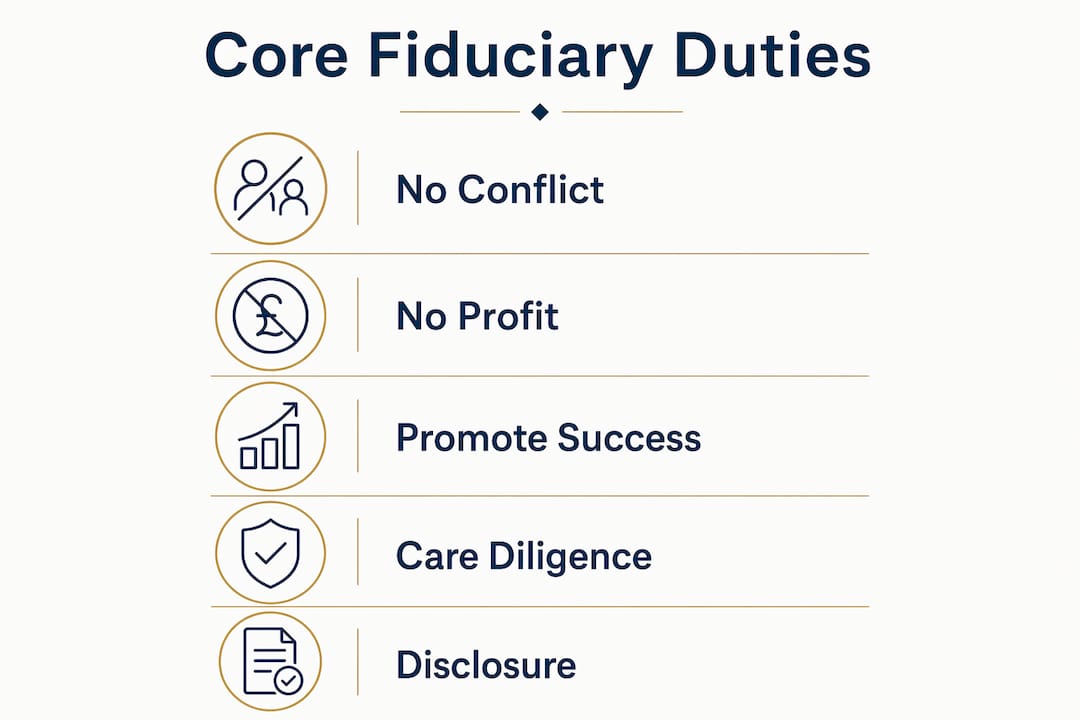
One distinction matters enormously in practice: the duty to exercise reasonable care, skill, and diligence under s.174 is a statutory duty but is not classified as a fiduciary duty. This affects how breaches are pleaded and which remedies are available. A director who makes a poor business decision through negligence faces a different legal analysis than one who secretly profits from a transaction.
What do real breaches of fiduciary duty look like?
Breaches tend to cluster around three patterns in practice:
- Misuse of company funds: a director channels company money into a personal account, pays personal expenses through the business, or approves transactions that benefit themselves rather than the company.
- Undeclared conflicts of interest: a director votes on a contract with a supplier in which they hold an undisclosed financial interest. Even if the contract terms are fair, the failure to disclose is itself a breach.
- Diverting corporate opportunities: a director learns of a lucrative acquisition target through their role, then personally acquires it rather than presenting it to the board.
The leading cases make the standard vivid. In Regal (Hastings) Ltd v Gulliver, directors purchased shares in a subsidiary company because the company itself lacked the funds to do so. They acted in good faith and made no secret of it. The House of Lords still required them to account for their profits.
Boardman v Phipps [1967] 2 AC 46 went further. A solicitor acting for a trust used information acquired in that capacity to purchase shares personally, generating a profit. The House of Lords held that the information itself was trust property, and the profit had to be accounted for, despite the solicitor having acted honestly and the trust having benefited. Intention is irrelevant. Unauthorised profit from a fiduciary position must be returned to the beneficiary.
UK law: Companies Act 2006 and the cases that define the rules
| Provision / Authority | Core principle | Typical remedy or enforcement |
|---|---|---|
| CA 2006, s.171 | Act within powers; follow the company’s constitution | Injunction; damages |
| CA 2006, s.172 | Promote the success of the company in good faith | Damages; ratification by members |
| CA 2006, s.175 | Avoid conflicts of interest (including post-directorship) | Account of profits; rescission |
| CA 2006, s.176 | Do not accept benefits from third parties | Account of profits; injunction |
| CA 2006, s.177 | Declare interests in proposed transactions | Voidability of transaction |
| Regal (Hastings) v Gulliver | No-profit rule: account required even in good faith | Account of profits |
| Boardman v Phipps | Information acquired as fiduciary is trust property | Account of profits |
The Companies Act 2006 also extends general duties to shadow directors where the corresponding common law or equitable principles apply, closing the gap for those who exercise control without formal appointment. Duties under ss.175 and 176 survive the end of a directorship, meaning a former director cannot exploit information or opportunities acquired during their tenure.
What happens when a fiduciary breaches their duty?
Courts have a range of remedies, and the choice depends on what the breach involved and what loss or gain resulted.

Account of profits is the most distinctive equitable remedy: the fiduciary must hand over the profit made from the breach, whether or not the beneficiary suffered an equivalent loss. Damages compensate for actual loss where an account of profits is not available or appropriate. Rescission unwinds a transaction tainted by a conflict of interest, restoring the parties to their original positions. Injunctions prevent an ongoing or threatened breach.
For company directors, the consequences extend further. The Insolvency Service can pursue director disqualification under the Company Directors Disqualification Act 1986 where conduct falls below the standard expected. Removal by shareholders is also available under the Companies Act 2006.
Enforcement is primarily the company’s right, not individual shareholders’. Derivative claims under Part 11 of the Companies Act 2006 allow a shareholder to bring a claim on the company’s behalf, but procedural hurdles apply: the court must be satisfied that the company would not itself pursue the claim, and permission must be obtained at an early stage. This is not a quick or cheap route, and specialist advice is essential before committing to it.
What should you do if you suspect a breach?
Acting promptly and methodically protects your legal position. Work through these steps before instructing solicitors:
- Preserve documents: secure emails, board minutes, contracts, bank statements, and any communications that show the decision-making chain. Do not delete or alter anything.
- Identify the decision-makers: establish who authorised the relevant transactions and who benefited.
- Check the articles of association and any shareholders’ agreement: these define the powers granted and the approval processes required.
- Gather evidence of profit or conflict: bank records, company accounts, Companies House filings, and correspondence showing undisclosed interests.
- Note dates and actors carefully: limitation periods apply; delay can cost you the right to claim.
- Consider an independent audit or forensic accountant: where financial misappropriation is suspected, professional forensic analysis can quantify the loss and identify the flow of funds. In cases involving undeclared conflicts or misappropriation, professional investigative support can surface evidence that internal reviews miss.
- Seek specialist legal advice: a solicitor with experience in company law or civil fraud will assess whether a derivative claim, direct claim, or regulatory referral is the right route.
This guidance is general information, not legal advice. For your specific situation, consult a qualified solicitor and verify current rules with the relevant primary source.
How fiduciary duty affects family offices and high-net-worth clients
For high-net-worth families, fiduciary obligations run through almost every layer of a family office structure. Directors of the family office company owe statutory duties under the Companies Act 2006. Trustees of family trusts carry equitable fiduciary obligations. Delegated advisers, if given genuine discretion over assets, may carry implied fiduciary duties even without a formal appointment.
The risk is compounded by complexity. A family office typically involves multiple entities, overlapping roles, and long-standing relationships where informal influence can blur into shadow director territory. That is precisely where undeclared conflicts tend to take root.
Governance safeguards that reduce breach risk include:
- A formal conflict-of-interest register, reviewed at every board meeting
- Clear approval processes for related-party transactions, requiring non-conflicted sign-off
- Independent oversight, whether through a non-executive director, an external trustee, or an independent adviser who owes no loyalty to any single family member
- Regular reporting to beneficiaries on decisions made and interests declared
Independent advisers who operate without referral fees or commissions are structurally better placed to meet fiduciary standards, because the financial incentive to favour one product or provider over another is removed from the outset.
Pro Tip: Capture conduct standards contractually. An engagement letter or advisory agreement that specifies disclosure obligations, conflict management procedures, and reporting frequency does two things: it sets a clear standard the adviser must meet, and it creates contemporaneous evidence of what was agreed if a dispute arises later.
Key takeaways
Fiduciary duty in UK law is a strict obligation of loyalty and trust: breach it and courts will require the return of any profit made, irrespective of good faith.
| Point | Details |
|---|---|
| Core definition | A fiduciary must act solely in the beneficiary’s interests, avoiding conflicts and unauthorised profit. |
| Who owes the duty | Directors, trustees, solicitors, agents, partners, executors, and shadow directors all carry fiduciary obligations. |
| Statutory anchor | Companies Act 2006 ss.170–177 codify directors’ duties; equitable principles still apply alongside statute. |
| Breach consequences | Remedies include account of profits, damages, rescission, injunctions, and director disqualification. |
| First steps | Preserve documents, identify decision-makers, gather evidence, and instruct a specialist solicitor promptly. |
Why fiduciary duty is the standard that actually protects clients
The law of fiduciary duty exists because trust, once abused, is almost impossible to quantify in money. Courts developed the no-profit and no-conflict rules precisely because they recognised that a fiduciary’s position gives them access to information, relationships, and opportunities that the beneficiary cannot monitor in real time. Waiting until loss is provable is often too late.
What strikes me about the cases, from Regal (Hastings) to Boardman v Phipps, is how little comfort good intentions provide. The law does not ask whether the fiduciary meant well. It asks whether they acted with complete loyalty and full transparency. That is a high standard, and rightly so. For high-net-worth families navigating complex structures, the practical lesson is this: governance is not bureaucracy. A conflict register, an independent adviser, a properly drafted engagement letter — these are not formalities. They are the difference between a relationship that holds up under scrutiny and one that unravels at the worst possible moment.
NXD Family Office operates on exactly this principle: unbiased advice, no referral fees, no commissions, and a structure designed so that the adviser’s interests and the client’s interests point in the same direction. If you want wealth management services built around genuine fiduciary standards, that alignment is where to start.
Useful sources
| Source | What it covers | Why it matters |
|---|---|---|
| Companies Act 2006, ss.170–177 | General duties of directors, including loyalty, conflict avoidance, and disclosure | Primary statute; the definitive legal reference for directors’ duties in the UK |
| GOV.UK — Being a company director | Plain-English summary of directors’ statutory duties | Official government guidance; accessible starting point for non-lawyers |
| Companies House blog — 7 duties of a director | Practical explanation of each of the seven statutory duties | Useful for understanding how duties apply day-to-day |
| ICAEW — General directors’ duties | Professional body guidance including shadow directors and no-conflict/no-profit rules | Authoritative professional guidance; covers shadow director exposure |
| Regal (Hastings) Ltd v Gulliver [1967] 2 AC 134 | House of Lords authority on the no-profit rule | Leading case; establishes that good faith does not excuse unauthorised profit |
| Boardman v Phipps [1967] 2 AC 46 | House of Lords authority on information as trust property | Extends no-profit rule to information acquired in a fiduciary capacity |
| Rahman Ravelli — Fiduciary duties guide | Practitioner overview of fiduciary duties and leading cases | Useful for understanding how courts apply the rules in civil fraud contexts |
FAQ
What is the meaning of fiduciary duty?
A fiduciary duty is a legal obligation of loyalty and trust owed by one person to another, requiring the fiduciary to act solely in the beneficiary’s interests, avoid conflicts, and not profit from their position without authorisation. In the UK, the duty arises in equity and, for company directors, is codified in the Companies Act 2006.
What are three examples of breaches of fiduciary duty?
Three common breaches are: a director misappropriating company funds for personal use; a trustee or director failing to disclose a financial interest in a transaction they vote on; and a director diverting a business opportunity to themselves rather than presenting it to the company.
What is a fiduciary duty in the UK specifically?
In the UK, fiduciary duties for company directors are set out in ss.170–177 of the Companies Act 2006, supplemented by equitable principles developed through case law. The duties include promoting the company’s success (s.172), avoiding conflicts of interest (s.175), and not accepting benefits from third parties (s.176).
What are the two main types of fiduciary duties?
The two core fiduciary duties are the no-conflict rule, which prohibits placing personal interests in conflict with the beneficiary’s interests, and the no-profit rule, which prohibits making unauthorised gains from a fiduciary position. Both apply regardless of good faith or honest belief.