

A lasting power of attorney (LPA) is a legal document that lets you appoint one or more trusted people to make decisions on your behalf if you lose the mental capacity to do so yourself. Governed by the Mental Capacity Act 2005 and administered by the Office of the Public Guardian (OPG), an LPA only becomes usable once it is formally registered. The Court of Protection steps in when no LPA exists and capacity has already been lost.
If you need an LPA, the immediate steps are straightforward:
- Choose your attorney or attorneys (and consider replacement attorneys).
- Complete the correct LPA form or forms — one for property and financial affairs, one for health and welfare, or both.
- Register with the OPG and pay the registration fee before you need to use it.
Practitioners consistently advise making an LPA while you are well and healthy. Waiting until a health crisis removes the option entirely.
Table of Contents
- What does a lasting power of attorney actually cover?
- The two types of LPA and what each one covers
- Who can make an LPA and who can act as attorney?
- How to make and register an LPA: steps, costs, and timescales
- How to choose attorneys and build in sensible safeguards
- What attorneys must do and what they cannot do
- How to end, replace, or cancel an LPA
- What happens if you do not have an LPA?
- Risks and disadvantages of LPAs and how to reduce them
- Practitioner insights and commonly missed issues
- Key takeaways
- Why early LPA planning matters more than most people realise
- Bespoke LPA support for complex estates
- Useful sources and further reading
- FAQ
What does a lasting power of attorney actually cover?
An LPA is a creature of statute. The Mental Capacity Act 2005 created the modern LPA framework, replacing the older enduring power of attorney, and it sets out exactly what attorneys can and cannot do, how capacity is assessed, and what “best interests” means in practice.
The document names a donor (the person granting authority), one or more attorneys (the people receiving it), and is overseen by the Office of the Public Guardian, the government body responsible for registering LPAs and investigating concerns about attorney conduct. The Court of Protection sits above the OPG and can intervene when an attorney acts improperly or when no LPA exists and someone needs a decision made for them.
Geographically, LPAs made under the Mental Capacity Act 2005 apply in England and Wales. Scotland has its own equivalent (continuing and welfare powers of attorney under the Adults with Incapacity (Scotland) Act 2000), and Northern Ireland has a separate regime. If you live in England or Wales, the OPG is your registration authority.
An LPA is legally binding once registered. Before registration, it is simply a document — it carries no legal weight and cannot be used.
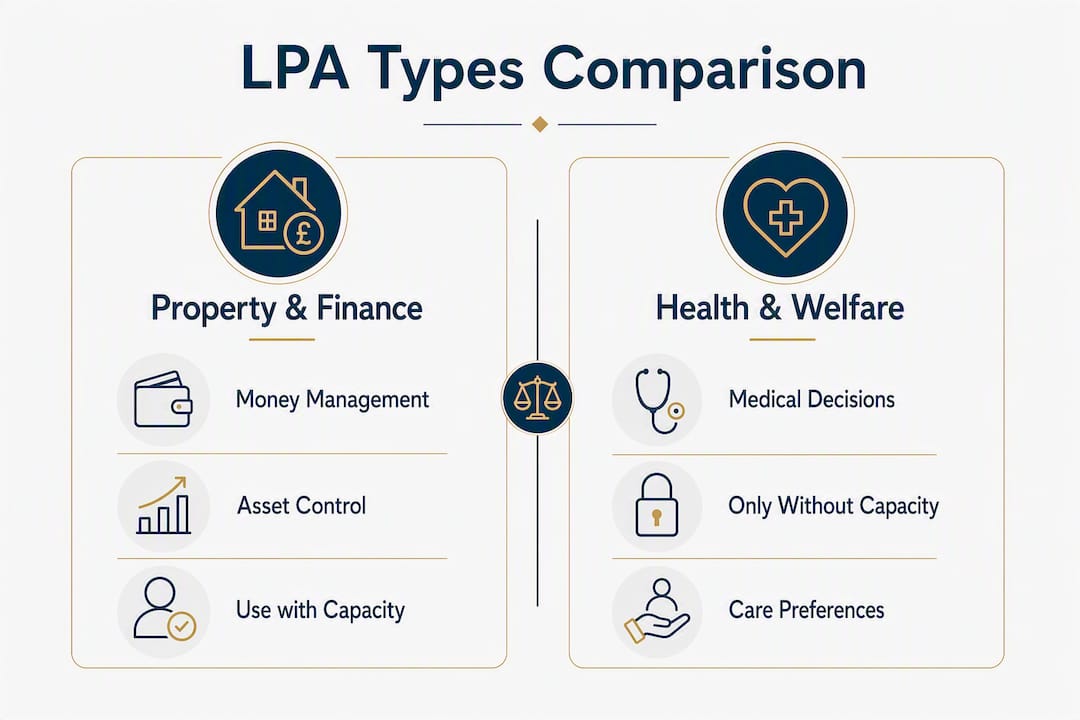
The two types of LPA and what each one covers
There are exactly two types of LPA, and they cover entirely different ground. You can make one or both, depending on your circumstances.
Property and financial affairs LPA
This type authorises your attorney to manage your financial life. Concrete examples include:
- Accessing and managing bank and building society accounts.
- Paying bills, mortgage payments, and household expenses.
- Collecting income, benefits, or pension payments.
- Buying or selling property on your behalf.
- Making investment decisions within any instructions you set.
Crucially, a property and financial affairs LPA can be used while you still have mental capacity, if you choose to allow it. Some donors grant this authority early so a trusted person can handle day-to-day finances during illness or travel.
Health and welfare LPA
This type covers decisions about your personal wellbeing. Examples include:
- Decisions about medical treatment, including consenting to or refusing specific procedures.
- Choosing where you live, including care home placement.
- Day-to-day care decisions: diet, daily routine, social activities.
- Life-sustaining treatment decisions, but only if you explicitly grant this power within the LPA.
The health and welfare LPA works differently from the financial one in one important respect: it can only be used once you have lost mental capacity. Your attorney cannot override your own decisions while you are capable of making them.
The Social Care Institute for Excellence (SCIE) provides practical guidance on how health and welfare decisions should be made in a social care context, complementing the legal framework set by the Mental Capacity Act 2005.
Who can make an LPA and who can act as attorney?
Eligibility for the donor
To make an LPA, you must be at least 18 years old and have mental capacity at the time of signing. This is the point that catches many families off guard: if capacity is already lost, an LPA cannot be created, and the only route is a Court of Protection deputyship application. The capacity test under the Mental Capacity Act 2005 asks whether you can understand, retain, weigh up, and communicate the decision — not whether you are in perfect health.
Who can be an attorney?
An attorney must be at least 18 years old and must not be bankrupt or subject to a debt relief order (this restriction applies specifically to property and financial affairs LPAs). Beyond that, the choice is yours. Attorneys are commonly:
- A spouse, partner, or adult child.
- A close friend or sibling.
- A professional, such as a solicitor or accountant, for complex financial matters.
You can appoint more than one attorney. You can also name replacement attorneys who step in if a primary attorney dies, loses capacity, or can no longer act.
Pro Tip: The certificate provider — the independent person who signs the LPA to confirm you understand it and are not being pressured — must be someone who knows you personally or is a professional (such as a GP or solicitor). They cannot be a family member or anyone who would benefit from the LPA. Choosing a genuinely independent certificate provider is one of the most important safeguards in the whole document.
How to make and register an LPA: steps, costs, and timescales
The registration process
- Complete the correct LPA form — The OPG provides two forms: LP1F (property and financial affairs) and LP1H (health and welfare). Both are available on GOV.UK and can be completed online or on paper.
Fees and timescales
| Item | Detail |
|---|---|
| Registration fee | £92 per LPA (each type is a separate document and charged separately) |
| Fee exemption | Available if the donor receives certain means-tested benefits; a reduction may apply depending on circumstances |
| Typical processing time | 8–10 weeks if the form contains no errors |
| When an LPA can be used | Only after registration is confirmed by the OPG |

The registration process typically takes several weeks assuming a smooth application. Errors in signing order, missing signatures, or incomplete sections cause the OPG to return the form, adding weeks to the process.
Pro Tip: Before posting your LPA to the OPG, read through the entire form against the OPG’s own checklist. The most common rejection reasons are: attorneys signing before the donor, the certificate provider section left incomplete, and the wrong continuation sheets used. A single error restarts the clock.
How to choose attorneys and build in sensible safeguards
Choosing an attorney is not simply a matter of picking someone you trust. The right attorney also needs to be available, willing, and practically capable of handling the decisions the LPA covers.
Qualities to look for
For a property and financial affairs LPA, financial competence matters. Your attorney will be managing bank accounts, paying bills, and potentially selling property. For a health and welfare LPA, the priority shifts to someone who knows your values, understands your medical preferences, and can hold firm under pressure from medical professionals or other family members.
Appointment styles and their consequences
The choice between joint and joint and several appointment has real strategic consequences. Joint appointment means all attorneys must agree on every decision — this reduces the risk of unilateral action but can create deadlock if attorneys disagree. Joint and several means any attorney can act independently, which provides flexibility but requires a high degree of mutual trust and oversight to prevent misuse.
Many solicitors recommend joint and several for day-to-day financial decisions (so one attorney can pay a bill without convening a meeting) while reserving joint appointment for major decisions such as selling a property.
Instructions and conditions
The LPA allows you to include specific instructions (which attorneys must follow) and preferences (which they should consider). Specificity matters here. Vague wording — “act in my best interests” without further guidance — leaves attorneys exposed to challenge and can make banks or care providers reluctant to accept their authority.
What attorneys must do and what they cannot do
Attorneys operate under a clear legal framework. The Mental Capacity Act 2005 sets out the duties, and breaching them can lead to OPG investigation, Court of Protection proceedings, or criminal liability.
Core duties every attorney must follow:
- Act in the donor’s best interests at all times, not their own.
- Follow any instructions set out in the LPA.
- Consider the donor’s past and present wishes, feelings, and values.
- Keep the donor’s money and property entirely separate from their own.
- Maintain clear records and accounts of all decisions and transactions.
- Avoid any conflict of interest between their own interests and the donor’s.
What attorneys are prohibited from doing:
- Making gifts beyond modest, customary amounts (such as birthday or Christmas gifts of reasonable value) unless the LPA explicitly grants wider gifting powers.
- Lending themselves money from the donor’s funds or purchasing the donor’s assets at below market value.
- Delegating their authority to someone else without explicit permission.
- Making or changing a will on the donor’s behalf (only the Court of Protection can authorise a statutory will).
A practical example of correct behaviour: an attorney who pays the donor’s care home fees from the donor’s account and keeps receipts is acting properly. An attorney who transfers funds into their own account “for safekeeping” without a clear paper trail is not — and the OPG takes such cases seriously.
How to end, replace, or cancel an LPA
Revoking an LPA while you have capacity
A donor who still has mental capacity can revoke an LPA at any time. The formal process involves signing a deed of revocation and notifying the OPG and all attorneys in writing. The OPG will cancel the registration. Attorneys must stop acting immediately upon receiving notice of revocation.
When an LPA ends automatically
An LPA ends automatically on the death of the donor. At that point, the estate passes to the executors named in the will, and the attorney’s authority ceases entirely. An LPA also ends if the Court of Protection makes an order terminating it, or if the sole attorney loses capacity or dies and no replacement attorney has been named.
When an attorney can no longer act
If an attorney becomes unable or unwilling to act, what happens next depends on how the LPA was drafted. If replacement attorneys were named, they step in automatically. If not, and if there are no remaining joint and several attorneys, the LPA may become unworkable and a Court of Protection application may be necessary. This is precisely why naming replacement attorneys at the outset is so strongly recommended.
What happens if you do not have an LPA?
Without a registered LPA, no one has automatic legal authority to manage your finances or make health decisions for you if you lose capacity — not even a spouse or adult child. The only route is a Court of Protection deputyship application.
The deputyship process involves:
- Applying to the Court of Protection, with supporting medical evidence of incapacity.
- The court assessing the application and appointing a deputy (who may or may not be the person the family wanted).
- The appointed deputy operating under ongoing court supervision, filing annual reports and accounts.
- Renewing the deputyship order as required.
The contrast with an LPA is stark. Deputyship is typically more expensive, takes considerably longer, and imposes ongoing administrative burdens that an LPA avoids entirely. Court fees, solicitor costs for the application, and the annual supervision fee all accumulate over time. The family has no control over which deputy the court appoints, and the donor’s own previously expressed wishes carry less formal weight than they would in a properly drafted LPA.
The most important point: creating an LPA while you are well and healthy keeps the decision in your hands. Waiting until a health crisis removes that choice.
Risks and disadvantages of LPAs and how to reduce them
An LPA is not without risk. Understanding the downsides is part of making an informed decision.
The main disadvantages include the upfront registration cost (£92 per LPA), the registration delay that can last several weeks, and the potential for attorney abuse if the wrong person is appointed. Templated or DIY LPAs carry a specific risk: small omissions in wording can prevent banks or care providers from accepting an attorney’s authority, leaving the document registered but functionally useless.
Practical mitigations:
- Choose attorneys carefully and consider appointing two to provide mutual oversight.
- Name replacement attorneys so the LPA does not collapse if a primary attorney becomes unable to act.
- Include clear, specific instructions rather than relying on general “best interests” language.
- Seek professional advice for complex estates, business interests, or where family dynamics are complicated.
The OPG has powers to investigate attorney conduct and can apply to the Court of Protection to have an attorney removed. If you have concerns about an existing attorney’s behaviour, contacting the OPG directly is the right first step.
Practitioner insights and commonly missed issues
The gap between a registered LPA and a functional one is wider than most people expect. Solicitors who work in this area regularly see documents that pass the OPG’s registration checks but fail in practice.
“An LPA is not merely form-filling. Selecting the right attorneys and drafting precise instructions are critical to preventing exploitation and ensuring the document actually works when it is needed. Vague wording, no replacement attorneys, and unclear gifting powers are the three issues we see most often causing real-world failures.”
Three issues practitioners flag most consistently:
Gifting powers. The default LPA permits only modest customary gifts. If you want your attorney to be able to make larger gifts — to family members, to charity, or as part of inheritance tax planning — this must be explicitly stated in the document. Without it, attorneys who make such gifts are technically acting outside their authority, even when the donor would clearly have approved.
The joint versus joint and several trade-off. Joint appointments protect against unilateral decisions but create practical problems for routine transactions. Joint and several appointments offer flexibility but require genuine trust and, ideally, a mechanism for oversight. There is no universally correct answer; the right choice depends on the number of attorneys, their relationship, and the complexity of the estate.
Hidden functional failures. Estate planners note that templated LPAs often contain omissions that cause banks or professionals to refuse to accept an attorney’s authority. A document that looks complete on its face may lack the specific wording a particular institution requires. For anyone with significant assets, business interests, or cross-border holdings, specialist drafting is not optional — it is the difference between an LPA that works and one that sits in a drawer.
Key takeaways
A lasting power of attorney must be registered with the Office of the Public Guardian before it can be used, and it can only be created while the donor has mental capacity.
| Point | Details |
|---|---|
| Two types, distinct purposes | Property and financial affairs LPAs cover money and assets; health and welfare LPAs cover care and medical decisions. |
| Registration is mandatory | An unregistered LPA has no legal force; registration costs £92 per LPA and takes 8–10 weeks without errors. |
| Act before capacity is lost | Once mental capacity is gone, an LPA cannot be created and Court of Protection deputyship becomes the only route. |
| Deputyship is the costly alternative | Court of Protection deputyship is slower, more expensive, and imposes ongoing supervision compared with a pre-registered LPA. |
| NXD Family Office can coordinate the process | For complex estates or those with business interests, NXD Family Office connects clients with specialist legal partners who draft and integrate LPAs with broader estate planning. |
Why early LPA planning matters more than most people realise
The conventional wisdom treats an LPA as something to sort out “eventually” — a document for the elderly or the seriously ill. That framing is wrong, and it costs families dearly.
The families who face the most difficulty are not those who made an LPA too early. They are the ones who delayed until a diagnosis arrived, a fall happened, or a cognitive decline became undeniable — and then discovered that the window had closed. At that point, the Court of Protection becomes the only option, the family loses control of who is appointed, and the costs mount in ways that the standard registration fee would have prevented entirely.
For individuals with complex assets — business interests, investment portfolios, property held in multiple names, or cross-border holdings — the stakes are higher still. A generic LPA drafted without reference to those assets may be registered and technically valid, yet still fail when an attorney tries to act on a specific account or transaction. The institution asks for wording that is not there. The attorney cannot proceed. The donor, if incapacitated, cannot fix it.
The right time to make an LPA is when you are well, unhurried, and able to think clearly about who you trust and what you want. That is not a counsel of pessimism. It is the same logic that applies to estate planning for families at every stage of wealth.
Bespoke LPA support for complex estates
For straightforward situations, the OPG’s online service is a reasonable starting point. For anyone with significant assets, a business, or a family structure that does not fit a standard template, the drafting decisions inside an LPA carry real financial and personal consequences.

NXD Family Office works with a vetted network of specialist legal partners who draft LPAs with precision — not as a form-fill exercise, but as part of a coordinated estate and succession plan that accounts for your assets, your family dynamics, and your wider wealth strategy. There are no referral fee uplifts and no commissions: clients pay the partner’s standard fee, and NXD Family Office takes a share of that. The advice is unbiased because the incentive structure demands it.
If your estate includes business interests, investment assets, or property held across multiple structures, speak to NXD Family Office about a bespoke legal review. Contact the team directly to arrange an initial conversation with a specialist legal partner.
Useful sources and further reading
The following official and authoritative sources cover the topics addressed in this guide. Fees and processing times do change, so checking the OPG directly before submitting an application is always advisable.
- Make, register or end a lasting power of attorney — GOV.UK: the primary official source for registration steps, eligibility, and forms.
- LPA online service guide — GOV.UK: step-by-step guidance on completing an LPA online, including attorney duties.
- LP12 guide (web version) — GOV.UK: the official guide to making and registering an LPA using paper forms.
- Lasting power of attorney forms — GOV.UK: download LP1F and LP1H forms directly.
- Office of the Public Guardian — GOV.UK: the OPG’s home page for current fees, processing times, and safeguarding guidance.
- Lasting power of attorney — NHS: practical NHS guidance on LPAs in the context of health and end-of-life planning.
- Mental Capacity Act 2005 — GOV.UK: guidance on assessing mental capacity, relevant to both donors and attorneys.
FAQ
What is the difference between a power of attorney and a lasting power of attorney?
A general power of attorney is a temporary document used when someone has capacity but wants another person to act for them — it becomes invalid if the donor loses mental capacity. A lasting power of attorney is specifically designed to continue (or come into force) after capacity is lost, and must be registered with the OPG to be valid.
Do I need a solicitor to set up a lasting power of attorney?
No — you can complete and register an LPA yourself using the OPG’s online service or paper forms. However, for complex estates, business interests, or where family dynamics are complicated, specialist legal drafting significantly reduces the risk of an LPA that is registered but functionally inadequate.
What are the main disadvantages of having a lasting power of attorney?
The principal disadvantages are the upfront cost (£92 per LPA), the 8–10 week registration period, and the risk of attorney abuse if the wrong person is appointed. These risks are manageable with careful attorney selection, clear instructions, and named replacement attorneys.
What happens if I lose capacity without a lasting power of attorney in place?
No one — including a spouse or adult child — has automatic legal authority to manage your finances or make health decisions for you. The only route is a Court of Protection deputyship application, which is typically slower, more expensive, and imposes ongoing court supervision compared with a pre-registered LPA.
Can a lasting power of attorney be used while I still have capacity?
A property and financial affairs LPA can be used while the donor still has capacity, if the donor permits this. A health and welfare LPA can only be used once the donor has lost mental capacity — attorneys cannot override the donor’s own decisions while they are capable of making them.
This article provides general information about lasting powers of attorney in England and Wales. It is not legal advice. Fees, forms, and processing times can change; always verify current details with the Office of the Public Guardian at GOV.UK or consult a qualified solicitor before making decisions.