

Affluent UK families with multi-generational wealth, cross-border assets, or significant lifestyle holdings should adopt an integrated lifestyle financial service without delay. The case is clear: siloed advisers cannot coordinate the tax, succession, governance, and concierge demands that arrive simultaneously when wealth is complex. Verify any provider’s FCA registration before a first meeting, and note that NXD Family Office operates on a fee-sharing model with no commission uplift, meaning the advice you receive is genuinely independent.
Before your first provider meeting, do three things:
- Verify the adviser’s FCA registration at the FCA Register
- Request a written fee schedule and ask specifically whether any referral fees or commissions are paid
- Ask for a documented case study or outcome summary from a family with a comparable asset profile
Pro Tip: Map your succession obligations and liquidity positions before you change a single investment mandate. Families that reverse this order often trigger unnecessary tax events during transition.
Table of Contents
- What do integrated lifestyle financial services actually cover?
- Which services should an integrated provider cover?
- Which families benefit most from an integrated approach?
- How do you choose the right integrated adviser or family office?
- What do integrated advisory services cost, and when do fees pay off?
- Single-family office, multi-family office, or integrated adviser: which model fits?
- How do you move from siloed advice to an integrated service?
- How NXD Family Office delivers integrated financial and lifestyle services
- Key takeaways
- Why the sequencing of integrated advice matters more than the model
- What to expect when you engage NXD Family Office
- Useful sources and further reading
- FAQ
What do integrated lifestyle financial services actually cover?
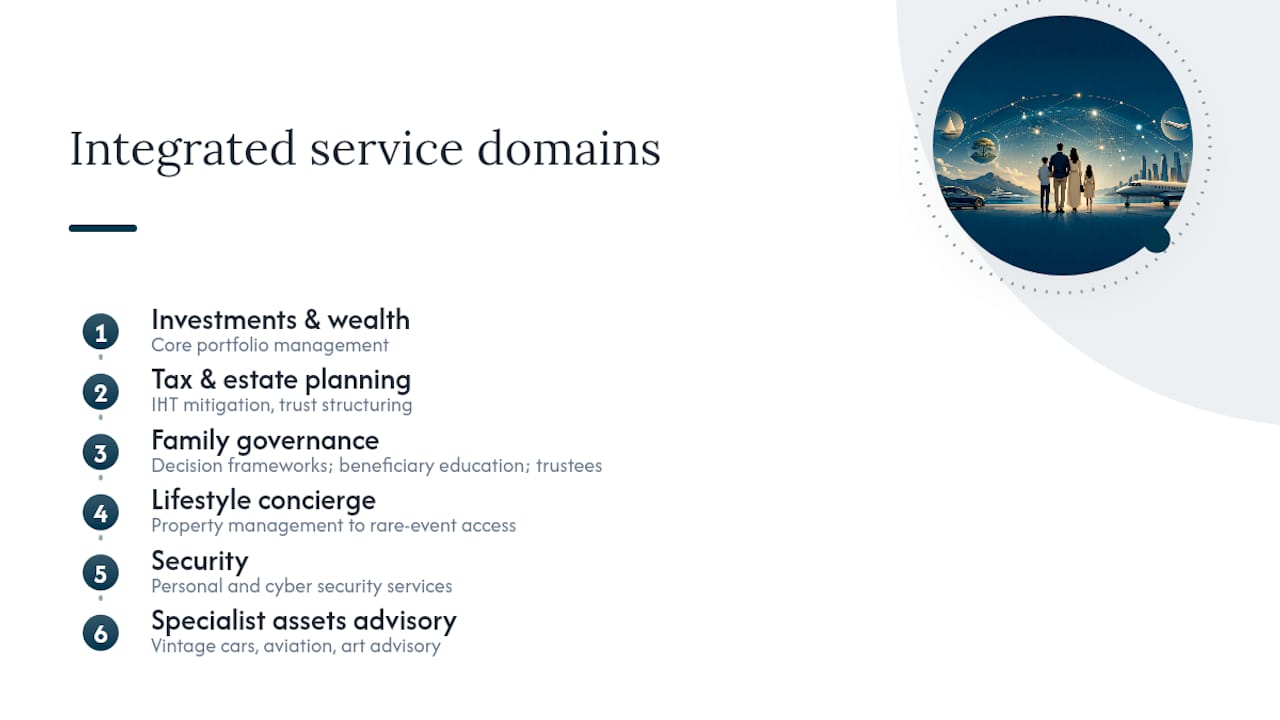
The industry term for this model is holistic family office advisory, and it means a single coordinated service that manages investments, tax and estate planning, family governance, lifestyle concierge, security, and specialist assets under one engagement. The key word is coordinated: not a referral list, but a team of vetted specialists working collaboratively from a shared understanding of your family’s full picture.
In practical terms, this model covers six domains. Investments and wealth management sit at the core. Tax and estate planning, including inheritance tax mitigation and trust structuring, run alongside. Family governance addresses decision-making frameworks, beneficiary education, and trustee responsibilities. Lifestyle and concierge services handle everything from property management to rare event access. Security, both personal and digital, forms a growing part of the brief. And specialist or lifestyle assets — vintage cars, aviation, art, asset watches — require advisory that most traditional wealth managers cannot provide.
The contrast with a full single-family office is cost and scale. A single-family office employs a permanent in-house team, typically viable only for families with assets well above £100 million. An integrated adviser or multi-family office delivers most of the same coordination at a fraction of the overhead. According to Boodle Hatfield, family office services scale from administrative support to large multi-disciplinary teams, and Deloitte estimates family offices globally manage approximately £3 trillion in assets, reflecting the breadth of the model.
A family with a business exit pending, two overseas properties, a collection of classic cars, and adult children in different jurisdictions sits squarely inside this definition. So does a family navigating a defined benefit pension transfer alongside an IHT liability and a desire to fund a charitable foundation.
Which services should an integrated provider cover?
The service set matters because gaps are where things go wrong. A provider that handles investments but not succession, or lifestyle concierge but not tax, leaves families exposed at precisely the moments when coordination is most valuable. Wealth solutions beyond investment management is a useful frame: the non-investment elements are often where the greatest complexity and the greatest risk sit.
Core service domains to expect from a credible integrated provider:
- Wealth management: — portfolio construction, asset allocation, investment manager selection and oversight
- Business exit and succession planning: pre-sale structuring, earn-out management, reinvestment strategy, and estate and business exit legal services
- Lifestyle asset advisory: specialist guidance on asset watches, classic cars, aviation, art, and collectibles as part of the family’s overall balance sheet
Within a single-family office, these roles are filled by permanent employees: a family executive, investment manager, tax counsel, and lifestyle manager. In a multi-family office or integrated adviser model, the same functions are delivered by a coordinated network of vetted external specialists. The practical difference for most families is negligible in day-to-day experience, but significant in cost. The critical test is whether the coordinating firm holds accountability for outcomes, or merely makes introductions.
Which families benefit most from an integrated approach?
Families with more than one of the following characteristics benefit most: multi-generational wealth, cross-border tax exposure, illiquid or specialist assets, a pending or recent liquidity event, or significant lifestyle complexity.
The triggers that most reliably justify moving to an integrated model are:
Business sale or liquidity event. The period immediately before and after a business exit is the highest-risk window for tax leakage and poor reinvestment decisions. Pre-sale structuring, reinvestment strategy, and IHT planning must run simultaneously.
Multi-jurisdictional assets. Families with property, investments, or business interests in more than one country face overlapping tax regimes. An adviser without cross-border experience will miss interactions between UK and overseas obligations.
Succession complexity. When wealth is passing between generations, or when a family trust is being established or restructured, the governance, legal, and tax dimensions must be coordinated. Passing wealth between generations without a coordinated plan is one of the most common causes of wealth erosion across generations.
Significant lifestyle assets. A collection of classic cars, a private aircraft, or a portfolio of art requires specialist insurance, storage, maintenance, and periodic valuation. These assets sit outside most standard wealth management mandates.

How do you choose the right integrated adviser or family office?
The most important selection criterion is verifiable experience with families whose complexity matches yours. A firm that manages straightforward investment portfolios is not the same as one that has navigated a business exit, a cross-border estate, and a family governance dispute simultaneously.
The FCA’s ongoing scrutiny of advice fees makes fee transparency a non-negotiable starting point. Any adviser providing regulated financial advice in the UK must be registered with the FCA. Check the register before any substantive conversation.
Vetting checklist for initial and technical meetings:
- Confirm FCA registration and the specific permissions held (investment advice, pension transfer, mortgage advice)
- Request a written fee schedule covering initial, ongoing, and any third-party or specialist fees
- Ask for a sample engagement scope document from a comparable client mandate
- Understand how the firm coordinates external specialists: do they hold accountability, or simply refer?
- Ask about reporting technology: can you see your full consolidated position, including lifestyle assets, in one place?
- Request references or anonymised case studies from families with similar asset profiles
Red flags to walk away from:
- Promises of guaranteed investment returns
- Opaque fee structures or reluctance to confirm whether referral fees are received
- No cross-border or multi-jurisdictional experience when your situation requires it
- Inability to demonstrate how specialists are coordinated rather than simply introduced
- Pressure to sign a mandate before a full discovery process is complete
For a deeper look at private client vetting criteria, the questions to ask go beyond credentials to culture and accountability.
What do integrated advisory services cost, and when do fees pay off?
Typical ongoing fees for full-service integrated advice in the UK are commonly around 1% of assets under management per year, according to Unbiased. Most providers also charge an initial setup or discovery fee. Digital-only or lighter-touch services may cost less; in-person, multi-specialist integrated services sit at the higher end.
Ark Wealth Management’s fee guide illustrates a common transparent structure: a 1% ongoing fee covering investment management, full financial planning, and regular review meetings. That clarity is itself a trust signal.
UK research cited by ChatIFA shows that ongoing regulated advice produces the strongest measurable payback around retirement and pension decisions, with ongoing-advised clients potentially materially better off over a decade compared with those who received only one-off advice.
| Trigger event | Typical fee (ongoing) | Where value is most likely recovered |
|---|---|---|
| Business exit / reinvestment | 1% of assets | Pre-sale tax structuring, reinvestment strategy |
| Pension drawdown or DB transfer | 1% of assets | Sequencing risk management, tax-efficient withdrawal |
| Estate and IHT planning | Initial fee + 1% | IHT mitigation, trust structuring, succession |
| Multi-jurisdictional property | 1% of assets | Cross-border tax coordination, compliance |
| Lifestyle asset management | Specialist fee varies | Insurance, valuation, maintenance coordination |
A worked example: a family with substantial investable assets paying a typical ongoing fee that avoids a significant inheritance tax liability through timely estate planning can recover multiple years of fees in one decision. The maths shifts further when pension drawdown sequencing, business exit structuring, and cross-border compliance are added.
Single-family office, multi-family office, or integrated adviser: which model fits?
The right model depends primarily on asset scale and complexity, not preference.
A single-family office employs a permanent, dedicated team serving one family. The control and privacy are unmatched, but the cost is substantial: running an SFO typically requires assets well above £100 million to be economically rational. For families below that threshold, the overhead consumes a disproportionate share of returns.
A multi-family office shares infrastructure and specialist resource across a group of families. Economies of scale reduce cost without sacrificing much in the way of bespoke service. The trade-off is that your family is one of several, and the depth of attention may vary. According to Boodle Hatfield, MFOs offer shared resources and economies of scale that make professional family office services accessible to a broader range of families.
An integrated adviser coordinates a network of external specialists under a single engagement framework, without the overhead of a permanent team. This model suits families whose complexity is real but whose asset scale does not justify SFO costs. The coordinating firm holds accountability for outcomes and manages the relationships with lawyers, accountants, and lifestyle specialists on the family’s behalf.
The distinction between a family office and a wealth manager is worth understanding before committing to any model. Hybrid arrangements, where an integrated adviser white-labels specialist services, are increasingly common and can offer the best of both approaches.
How do you move from siloed advice to an integrated service?
The single first operational step is a comprehensive map of all assets, obligations, and existing adviser relationships. Without this, any transition risks duplicating mandates, triggering unnecessary tax events, or leaving coverage gaps.
Onboarding roadmap:
- Discovery (weeks 1–4): Compile a full asset map including investments, property, business interests, lifestyle assets, pensions, and liabilities. List all existing advisers, mandates, and platform credentials.
- Technical due diligence (weeks 4–8): The integrated provider reviews existing arrangements, identifies gaps, overlaps, and immediate risks (tax deadlines, insurance lapses, succession gaps).
- Transition of mandates (weeks 8–16): Existing adviser relationships are reviewed. Some may be retained and coordinated; others may be replaced. Mandate transitions are sequenced to avoid triggering capital gains or breaking pension protections.
- Governance setup (weeks 12–20): Family governance framework established, including decision-making protocols, beneficiary communication plan, and trustee briefings.
- Review cadence (ongoing): Quarterly reporting, annual strategic review, and event-triggered reviews (business sale, birth, death, divorce, significant market movement).
Documents and stakeholders to assemble before onboarding:
- Full asset schedule with current valuations
- Beneficiary and trustee lists for all trusts and pension arrangements
- Existing adviser contacts and mandate terms
- Platform login credentials and account numbers
- Recent tax returns and any outstanding HMRC correspondence
- Insurance schedules for all assets and personal cover
How NXD Family Office delivers integrated financial and lifestyle services
NXD Family Office provides bespoke, integrated advisory and concierge services for high-net-worth families, coordinating a vetted network of specialists across wealth management, tax, legal, insurance, lifestyle, and security without charging referral fees or commissions to clients.
The firm’s wealth management services cover investment oversight, financial planning, business exit structuring, property advisory, private banking, and philanthropy. Crucially, NXD operates on a fee-sharing model with partner advisers: clients pay the partner’s standard fee, and NXD receives a share of that fee. There is no markup, no hidden referral payment, and no conflict of interest embedded in the recommendation.
The lifestyle and concierge dimension is equally substantive. NXD’s lifestyle asset advisory covers specialist guidance on asset watches, classic cars, aviation, and collectibles as part of the family’s overall balance sheet. Beyond asset management, NXD secures access to experiences that are genuinely rare: Wimbledon tickets, behind-the-scenes tours of the Northern Ballet, and private meetings with current Formula 1 drivers. These are not add-ons. They are part of a proposition built around the full life of a family, not just its balance sheet.
The engagement model is straightforward. NXD coordinates all external specialists, holds accountability for outcomes, and ensures that the family’s lawyers, accountants, and investment managers are working from the same brief. Families retain full independence and ownership of all assets and relationships.
Key takeaways
Integrated lifestyle financial services deliver the most value when a family’s wealth, obligations, and lifestyle are too complex for any single adviser to manage in isolation.
| Point | Details |
|---|---|
| Verify FCA registration first | Any UK adviser providing regulated financial advice must appear on the FCA Register before you proceed. |
| Expect fees around 1% ongoing | Typical UK full-service ongoing fees are around 1% per year; always request a written fee schedule upfront. |
| Map assets before transitioning | A comprehensive asset and obligations map is the essential first step before changing any existing mandate. |
| Integrated advice pays off at trigger events | Business exits, pension drawdown, IHT planning, and cross-border tax are the scenarios where coordinated advice most clearly recovers its cost. |
| NXD Family Office | Provides bespoke integrated advisory and concierge services with no commission uplift, coordinating vetted specialists across wealth, lifestyle, and security. |
Why the sequencing of integrated advice matters more than the model
The conventional wisdom says: choose the right provider model first, then let them sort out the rest. In practice, that gets it backwards. The families who extract the most value from integrated services are those who arrive with a clear picture of their own complexity before they sign anything.
Most advisers, even good ones, will naturally gravitate towards the parts of your brief they know best. An investment manager will start with the portfolio. A tax adviser will start with the liability. Neither will volunteer that the other’s work is creating a problem. The integration only happens when someone is explicitly accountable for the whole picture, and that accountability needs to be established before the first mandate is signed, not after.
Pro Tip: Before engaging any integrated provider, run a simple liquidity map: list every asset, its approximate realisable value, and the tax consequence of realising it. This single document will expose more planning gaps than any adviser’s initial questionnaire.
The other thing families consistently underestimate is the governance dimension. Succession disputes, beneficiary conflicts, and trustee disagreements are not rare edge cases. They are the most common cause of wealth erosion across generations, and they are almost entirely preventable with a governance framework established early. The families who treat governance as an afterthought tend to discover its importance at the worst possible moment.
What to expect when you engage NXD Family Office
NXD Family Office offers something the traditional advisory market rarely does: a genuinely independent coordinating function that holds no financial incentive to favour one specialist over another. For families who have spent years managing a fragmented panel of advisers, each with their own agenda, that independence is the most valuable thing on the table.
A first engagement with NXD typically delivers three things: a consolidated asset map covering investments, property, lifestyle assets, and liabilities; a written fee proposal with full transparency on how partner advisers are compensated; and an initial governance plan identifying succession, IHT, and liquidity priorities. There are no long-term lock-ins and no pressure to move existing mandates until the family is satisfied the transition is right.
To understand the full scope of what NXD coordinates, the wealth management services page sets out the engagement model in detail. Families who want to explore the lifestyle and concierge dimension first can start with the lifestyle assets advisory overview. Contact NXD directly to request an initial discovery conversation, with no obligation and no fee at that stage.
This article provides general information about integrated financial advisory services and does not constitute regulated financial advice. Confirm your specific circumstances with an FCA-authorised adviser or qualified professional before making any financial decisions.
Useful sources and further reading
The following primary sources and authority references were used in this article. Families and their advisers are encouraged to verify any claim directly with the relevant institution.
- Ongoing advice fees under scrutiny from the FCA | Grant Thornton UK
- What is a family office? – Boodle Hatfield
- Is financial advice worth it? The UK evidence in 2026 | ChatIFA
- Financial adviser fees | How much does a financial adviser cost? | Unbiased
- The rise of the integrated adviser for wealthy families | PWMnet
- Financial Adviser Fees UK: A Clear 2026 Cost Guide | Ark Wealth Management
- Wealth Management Services – NXD Family Office
- Lifestyle Assets for High-Net-Worth Clients – NXD Family Office
When speaking to any adviser you are considering, ask them to provide primary-source references for any claim they make about fees, returns, or regulatory compliance.
FAQ
What is the best IFA network for UK families with complex wealth?
No single IFA network is universally best for complex family wealth. The right choice depends on whether the firm holds FCA authorisation for all relevant permissions, demonstrates verifiable experience with multi-generational or cross-border mandates, and operates with full fee transparency. NXD Family Office coordinates vetted specialists across these disciplines without charging referral fees.
What are the top financial services for high-net-worth families?
The most valued services for high-net-worth families combine wealth management, tax and estate planning, family governance, lifestyle concierge, and specialist asset advisory under one coordinated engagement. Integrated advisory models are growing in prominence precisely because families demand this breadth from a single accountable relationship.
What is a red flag when evaluating a financial adviser?
The clearest red flags are promises of guaranteed investment returns, opaque fee structures, and inability to confirm whether referral fees are received. The FCA’s scrutiny of ongoing advice fees makes fee transparency a regulatory expectation, not merely a courtesy.
Is paying 1% to a financial adviser worth it for an affluent family?
For families at trigger events such as a business exit, pension drawdown, or active IHT planning, a 1% ongoing fee is typically recovered through a single well-timed decision. UK evidence cited by ChatIFA shows ongoing-advised clients can be materially better off over a decade compared with those who received only one-off advice. The fee is harder to justify for families with straightforward, static portfolios and no active planning needs.