

Effective inheritance tax planning in the UK means reducing your estate’s IHT exposure within the law, protecting family liquidity, and ensuring your wealth reaches the people you intend. With the nil-rate band fixed at £325,000 and the residence nil-rate band at £175,000 until 5 April 2028, the thresholds are known. What changes is how much of your estate sits above them. Three things to do this week: gather your will, deeds, and any gift records from the last seven years; check whether your estate’s net value exceeds the combined allowance thresholds for individuals or couples using both allowances; and book a professional valuation if you own property, unlisted shares, or significant personal assets. Understanding why estate planning protects families is the first step toward acting on it.
Key takeaways
Effective inheritance tax planning in the UK requires acting before thresholds are breached, keeping detailed records, and reviewing your position regularly as your estate changes.
| Point | Details |
|---|---|
| Thresholds are fixed to 2028 | NRB is £325,000 and RNRB is £175,000, fixed by legislation to 5 April 2028. |
| Seven-year rule is time-critical | Lifetime gifts only fall fully outside the estate if the donor survives seven years from the date of the gift. |
| Records protect exemptions | Normal expenditure out of income and annual gift exemptions require contemporaneous documentation to withstand HMRC scrutiny. |
| Trusts and insurance add flexibility | Discretionary trusts and whole-of-life policies written in trust can reduce the taxable estate and provide liquidity for the IHT bill. |
| NXD Family Office coordinates specialist advice | NXD provides fee-transparent, commission-free coordination of Chartered Tax Advisers and STEP solicitors for bespoke IHT planning. |
Table of Contents
- How does inheritance tax work in the UK?
- How do you value your estate for IHT?
- Which exemptions and reliefs reduce your IHT bill?
- What are the practical options for reducing IHT?
- When should you use a specialist adviser?
- How NXD Family Office supports IHT planning
- Your IHT planning checklist for this week
- An editorial perspective on IHT planning
- Bespoke IHT planning, without the conflicts
- Sources
- FAQ
How does inheritance tax work in the UK?
Inheritance Tax is charged on the estate of someone who has died, not on the beneficiaries. The estate pays the tax before assets are distributed. The standard rate is 40% on the value above the available nil-rate band. That rate drops to 36% when at least 10% of the net estate is left to charity.
Gifts made in the seven years before death are added back into the estate for IHT purposes. These are called potentially exempt transfers (PETs). If the donor survives seven years, the gift falls outside the estate entirely. If not, taper relief may reduce the tax owed on gifts made between three and seven years before death, though it reduces the tax rate rather than the value of the gift itself.
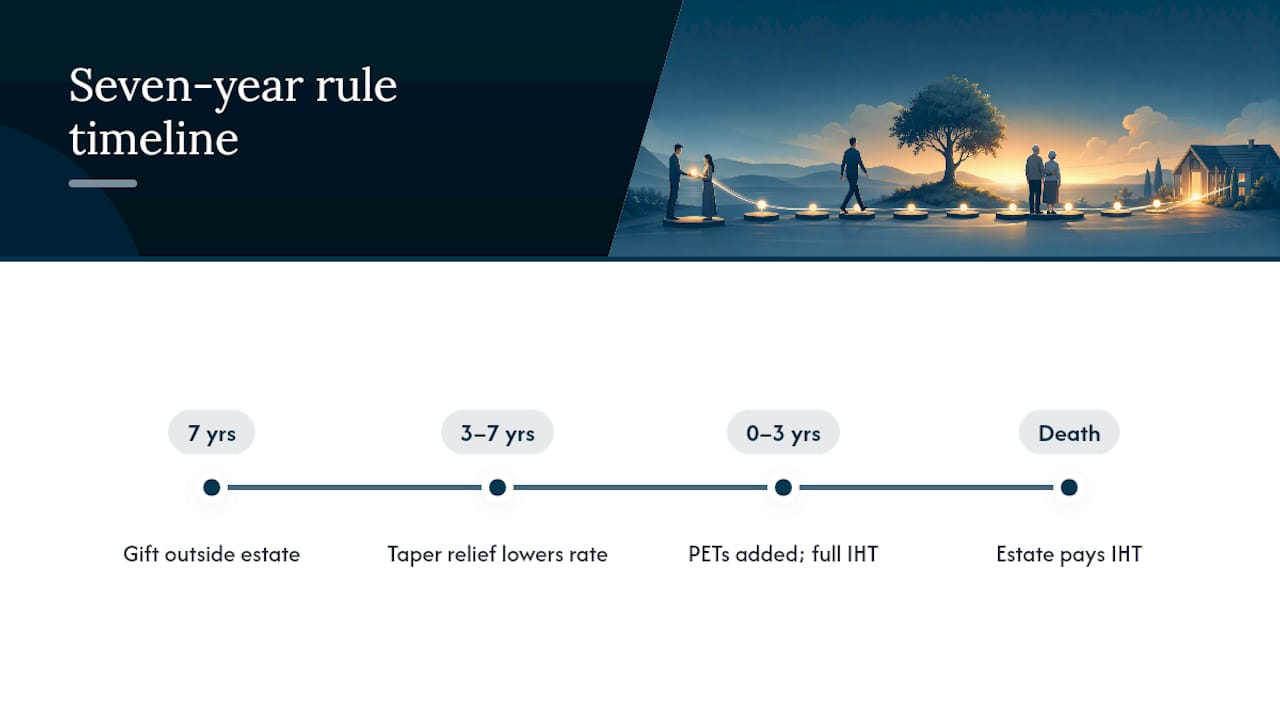
A chargeable lifetime transfer (CLT) is a gift into most types of trust and is taxed at 20% at the time of transfer if it exceeds the available NRB, with a further charge possible on death within seven years.
Key thresholds for 2026–2028
These thresholds are fixed by legislation for the period 6 April 2026 to 5 April 2028. A married couple or civil partners can combine allowances, potentially sheltering up to £1 million from IHT, but the unused NRB and RNRB from the first death must be claimed by the executor of the second estate, as the transfer is not automatic. It is not automatic, and missing documentation can create real administrative difficulty.
The main rules that affect IHT liability:
- Gifts made within seven years of death are included in the estate calculation
- Trusts can remove assets from the estate but carry their own tax charges
- Spouse and civil partner transfers are fully exempt
- Charitable gifts reduce the taxable estate and may reduce the rate to 36%
- Business Relief (BPR) and Agricultural Relief (APR) can reduce or eliminate IHT on qualifying assets
How do you value your estate for IHT?
Working out whether IHT is likely starts with an honest total of everything you own. The GOV.UK valuation guidance sets out a clear method.
- Total all assets at market value. Include your main home, other property, savings, investments, personal possessions, vehicles, and business interests.
- Add jointly owned assets. Your share of jointly held property counts. Tenants in common hold defined shares; joint tenants pass automatically to the survivor but the deceased’s share still forms part of the estate for IHT.
- Include foreign assets and cryptoassets. GOV.UK guidance confirms that overseas property, foreign bank accounts, and cryptoassets all count. UK domicile determines whether worldwide assets are in scope.
- Deduct liabilities. Mortgages, loans, and funeral expenses reduce the gross estate to a net figure.
- Apply reliefs. Deduct BPR, APR, and any exempt gifts (spouse, charity).
- Compare with available NRB and RNRB. What remains above the combined allowances is the taxable estate.
Assets to include in your estimate:
- Residential and investment property (at current market value)
- Joint assets (your proportionate share)
- Foreign property and overseas bank accounts
- Cryptoassets and digital investments
- Pensions paid as lump sums outside a discretionary trust (death benefits can be in scope depending on scheme rules)
- Personal possessions, jewellery, art, and collectibles
Pro Tip: Get a formal RICS valuation for property, a specialist appraisal for antiques or art, and an accountant’s report for unlisted shares. HMRC can challenge informal estimates, and an under-valuation can attract penalties.
Which exemptions and reliefs reduce your IHT bill?
Several reliefs and exemptions commonly reduce IHT for individuals, and some are straightforward to use. Others require careful structuring well in advance.
Common exemptions:
- Spouse/civil partner exemption. Transfers between spouses or civil partners are fully exempt, regardless of value.
- Charity exemption. Gifts to registered charities are exempt and, if the legacy exceeds 10% of the net estate, reduce the rate on the remainder to 36%. Philanthropic wealth planning can be structured to maximise this benefit.
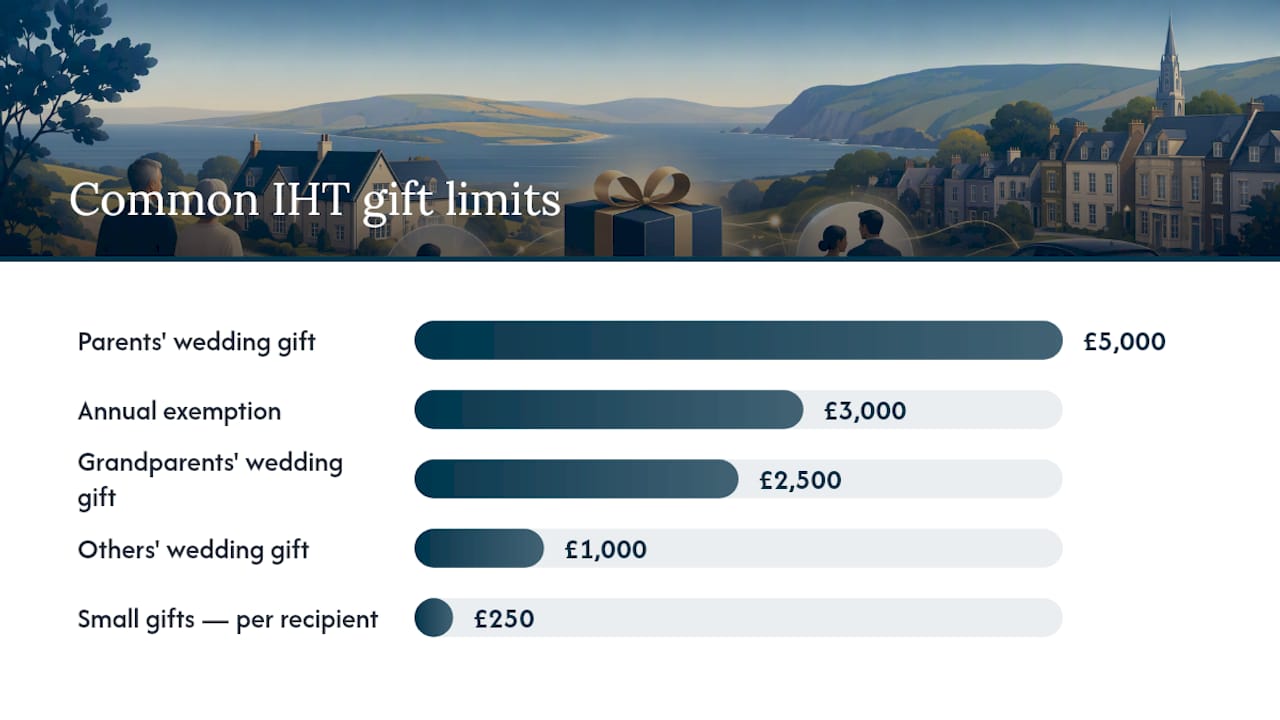
- Annual exemption. Each individual can give away £3,000 per tax year free of IHT. Any unused allowance carries forward one year only.
- Small gifts exemption. Gifts of up to £250 per recipient per tax year are exempt, provided no other exemption applies to the same recipient.
- Wedding and civil partnership gifts. Parents can give £5,000; grandparents £2,500; others £1,000, free of IHT.
- Normal expenditure out of income. Regular gifts from surplus income, not capital, can be fully exempt. HMRC requires contemporaneous records showing the payments were habitual and left the donor with sufficient income to maintain their standard of living.
Business Relief and Agricultural Relief can reduce IHT by 50% or 100% on qualifying assets, but eligibility is conditional. BPR requires the asset to be a qualifying trading business or unquoted shares held for at least two years. APR requires the land to be used for agriculture. Both reliefs are frequently challenged by HMRC and need to be established, and maintained, well before death.
Pro Tip: Keep a dedicated spreadsheet or folder recording every regular gift: date, amount, recipient, and the income source it came from. HMRC expects habitual payments evidenced by contemporaneous records, not reconstructed from memory after death.
What are the practical options for reducing IHT?
Most effective estate plans use a combination of tools rather than a single strategy. The right mix depends on the size of the estate, the donor’s age and health, and how much control they want to retain.
- Make or update your will. A will directs how assets pass and can use NRB and RNRB efficiently. Without one, intestacy rules apply and the opportunity to use exemptions may be lost.
- Lifetime gifting (PETs). Gifts to individuals start the seven-year clock immediately. Older donors in good health can make significant gifts early; the full gift falls outside the estate if they survive seven years. Map gifts against available NRB carefully, because gifts consume NRB in chronological order and earlier gifts can leave later ones unexpectedly exposed.
- Trusts. Discretionary trusts, bare trusts, and interest-in-possession trusts each serve different purposes. A discretionary trust removes assets from the estate after seven years and gives trustees flexibility over distributions. Understanding trust structures is worth doing before committing to one.
- Normal expenditure out of income. For those with surplus income, regular gifts to children or grandchildren can be exempt immediately, with no seven-year wait, provided records are kept.
- Life insurance in trust. A whole-of-life policy written in trust pays out outside the estate, providing liquidity to meet an IHT bill without forcing a property sale. The premiums themselves may qualify as normal expenditure out of income.
- BPR and APR assets. For business owners and farmers, structuring assets to qualify for relief can remove significant value from the taxable estate, but requires specialist legal and tax advice well in advance.
Timeline matters. Making a will and starting annual gifting can happen within weeks. Establishing a trust or restructuring a business for BPR takes months. Starting the seven-year clock on a large PET requires years of good health to pay off. For a fuller view of passing wealth between generations, the timing of each decision is as important as the decision itself.
When should you use a specialist adviser?
Use a specialist where the estate is complex, where BPR or APR is involved, where there are cross-border assets, or where trust or business structuring is needed. The administrative burden alone, such as claiming a transferred NRB from a first spouse’s estate, can create costly errors without professional support.
Credentials to look for:
- Chartered Tax Adviser (CTA) from the Chartered Institute of Taxation
- STEP member (Society of Trust and Estate Practitioners) for trust and estate work
- Solicitor with private client experience, regulated by the Solicitors Regulation Authority
Questions to ask at a first meeting: How do you charge, and is there any fee-sharing with product providers? Have you handled estates of similar size and complexity? Do you work alongside family offices or other advisers? How do you handle conflicts of interest?
Red flags: guaranteed results on BPR or APR claims, undocumented offshore structures, pressure to sign documents quickly, or advisers who cannot explain clearly how they are remunerated.
How NXD Family Office supports IHT planning
NXD Family Office coordinates a vetted network of Chartered Tax Advisers, STEP-qualified solicitors, and private client specialists to deliver bespoke IHT strategies for high-net-worth families. The engagement is fee-transparent: NXD operates a fee-sharing model with its partner advisers, meaning clients pay no commission or referral uplift. Every recommendation is made in the client’s interest, not the adviser’s.
The process:
- Initial review of the estate, existing wills, and gift history
- Professional valuations arranged for property, unlisted shares, and specialist assets
- Design of a coordinated plan covering gifting, trusts, reliefs, and insurance
- Implementation with partnered legal, tax, and financial advisers
- Ongoing governance and record-keeping support
For estates involving business interests, agricultural land, or cross-border assets, NXD’s legal services for estate and business exit planning bring the right specialists together under a single coordinated mandate.
Your IHT planning checklist for this week
- Locate your current will and check it reflects your wishes and uses NRB/RNRB efficiently.
- List all assets at current market value, including property, investments, foreign assets, and cryptoassets.
- Record every gift made in the last seven years: date, amount, recipient, and whether any exemption applied.
- Run a quick threshold check: does your net estate exceed £325,000 (single) or £650,000 (couple, before RNRB)?
- Arrange professional valuations for property, unlisted shares, or specialist assets where informal estimates exist.
- If thresholds are exceeded, book an appointment with a Chartered Tax Adviser or STEP-qualified solicitor.
Pro Tip: Create a single estate file, physical or digital, containing your will, property deeds, gift records, valuation reports, and any trust documents. Executors who can find everything quickly save the estate time and money.
IHT must generally be paid within six months of the end of the month of death. Probate cannot usually be granted until at least some IHT is paid, which means the estate may need to fund the tax before assets are released. Planning for this liquidity requirement, often through a life insurance policy in trust, is one of the most overlooked steps in UK estate planning.
An editorial perspective on IHT planning
The most common mistake families make is treating IHT planning as a one-off event rather than an ongoing discipline. A will drafted ten years ago, before a property purchase or a business sale, may now expose the estate to a six-figure tax bill that a few straightforward steps could have reduced. The seven-year clock on lifetime gifts is unforgiving: a gift made at 75 in good health has a reasonable chance of falling outside the estate; the same gift made at 82 after a health scare is a gamble.
What practitioners see repeatedly is families who understood the rules but delayed acting on them. The thresholds are fixed to 5 April 2028, which means the planning window is known. There is no strategic reason to wait. The families who manage IHT well are not necessarily those with the most sophisticated structures; they are the ones who started early, kept records, and reviewed their position every two or three years.
Bespoke IHT planning, without the conflicts
For high-net-worth families who want coordinated, independent advice rather than a product sale, NXD Family Office offers a different starting point. The focus is on your estate, your family’s intentions, and the most efficient lawful path between the two.
NXD’s advisers do not earn commissions. The fee-sharing model means the cost of specialist advice is transparent from the first conversation, and every recommendation is made on merit. Whether your estate involves a family business, agricultural land, a trust structure, or simply a property portfolio that has grown beyond the nil-rate bands, NXD coordinates the right specialists around a single, coherent plan.
To arrange an initial review of your estate and IHT position, visit NXD Family Office’s wealth management services and request a consultation.
Sources
The following GOV.UK pages are the authoritative starting points for IHT planning and reporting:
This article is general information, not a substitute for advice from a qualified financial advisor. Consult a qualified financial professional about your own circumstances before acting on anything here.
FAQ
What is the nil-rate band for inheritance tax in 2026?
The nil-rate band is £325,000 and the residence nil-rate band is £175,000, both fixed by legislation to 5 April 2028. A married couple or civil partners can combine allowances, potentially sheltering up to £1 million from IHT when both allowances from each partner are used.
How does the seven-year rule work for gifts?
Gifts to individuals are potentially exempt transfers and fall outside the estate if the donor survives seven years from the date of the gift. If the donor dies within seven years, the gift may become chargeable, though taper relief can reduce the tax owed on gifts made between three and seven years before death.
Do beneficiaries pay inheritance tax in the UK?
No. IHT is charged on the deceased’s estate before assets are distributed, so the estate pays the tax, not the beneficiaries. Executors are responsible for calculating, reporting, and paying IHT to HMRC, usually within six months of the end of the month of death.
When does Business Relief reduce inheritance tax?
Business Relief can reduce IHT by 50% or 100% on qualifying trading business assets or unquoted shares held for at least two years. Eligibility is conditional and frequently reviewed by HMRC, so structuring assets to qualify requires specialist advice well before death.
How can NXD Family Office help with estate planning?
NXD Family Office coordinates Chartered Tax Advisers, STEP-qualified solicitors, and private client specialists under a single, fee-transparent mandate, with no commission or referral uplift charged to the client. An initial review covers the estate’s current IHT position, existing wills, gift history, and the most appropriate planning options.