

A private wealth ecosystem is an integrated, multi-disciplinary network of professionals, financial institutions, governance structures, and service providers that work under a unified strategy to grow, protect, and transfer family wealth. The critical distinction from siloed advice is coordination: instead of a tax adviser, an investment manager, and a solicitor each working in isolation, every function connects through a single point of oversight.
Three things matter immediately:
- Access: an ecosystem opens doors to private markets, specialist advisers, and curated services that are not available through standard retail channels.
- Coordination: decisions in one discipline (a business sale, a trust restructure) flow through to every other function without the client having to relay information repeatedly.
- Governance: clear accountability structures protect family wealth across generations and reduce the risk of conflicting advice.
The coordinator role typically sits with one of three parties:
- A single-family office (built around one family’s needs)
- A multi-family office or private bank (shared infrastructure, broader specialist access)
- A lead adviser (a trusted professional who orchestrates a curated panel)
Key takeaways
A private wealth ecosystem delivers its value through coordination, not through any single component: the lead coordinator who holds a unified view of your wealth is the most consequential appointment you will make.
| Point | Details |
|---|---|
| Ecosystem vs siloed advice | Coordination through a single point of oversight eliminates duplication and conflicting recommendations across disciplines. |
| Scale of intergenerational transfer | Over USD 74 trillion is projected to transfer between generations in the next 20–25 years, making governance structures urgent. |
| Tax management priority | Tax planning often has a greater impact on after-tax wealth than portfolio cost reduction, per CFA Institute research. |
| Conflict-of-interest governance | Insist on a written conflict-of-interest policy and full fee disclosure from every ecosystem coordinator before engagement. |
| NXD Family Office | NXD coordinates wealth management, tax, legal, lifestyle, and estate services under one strategy, with no referral fee uplift for clients. |
Table of Contents
- What does a private wealth ecosystem actually do?
- What are the core components of a private wealth ecosystem?
- How does the digital layer work within an ecosystem?
- What value does a coordinated ecosystem deliver?
- What risks and conflicts should you watch for?
- How do you assess, build, or transition to a private wealth ecosystem?
- How a family-office-led ecosystem works in practice
- What most families get wrong about ecosystem design
- NXD Family Office: coordinating your private wealth ecosystem
- Sources
- FAQ
What does a private wealth ecosystem actually do?
The term “wealth ecosystem” is not yet standard industry vocabulary. The recognised professional term is private wealth management, which the CFA Institute defines as a multidisciplinary service integrating investment, tax, and estate advice into a single strategy tailored to high-net-worth and ultra-high-net-worth individuals. The ecosystem concept extends that definition to include the full organisational design: the people, platforms, governance rules, and service providers that make coordinated delivery possible.
The difference from siloed advice is structural. When advisers operate independently, the client becomes the integration layer. They carry information between their accountant, solicitor, and investment manager, and inconsistencies accumulate. In an ecosystem, the lead coordinator holds a single view of the client’s wealth, ensures that decisions in one discipline inform the others, and takes responsibility for the overall strategy.
Consider a business sale. A founder selling a company simultaneously triggers capital gains tax planning, trust structuring for the proceeds, a review of existing insurance, a property acquisition strategy, and potentially a philanthropy mandate. Handled in silos, each adviser optimises for their own brief. Coordinated through an ecosystem, the tax adviser, trust counsel, investment manager, and property adviser work from the same brief, the same timeline, and the same post-sale financial picture. The complexity of that profile is precisely what triggers the need for an ecosystem rather than a collection of separate engagements.
What are the core components of a private wealth ecosystem?
A well-constructed wealth management ecosystem typically includes the following participants. Each serves a distinct function; the coordinator ensures they operate as a system rather than a series of independent relationships.
| Component | Primary role | Typical coordinator |
|---|---|---|
| Single-family office | Full-service management for one family | Family principal or CEO |
| Multi-family office | Shared infrastructure across several families | MFO managing partner |
| Private bank | Custody, lending, and specialist network access | Relationship director |
| Discretionary investment manager | Portfolio construction and ongoing management | CIO or lead manager |
| Tax adviser | Income, capital gains, and cross-border tax planning | Lead tax partner |
| Trust and estate counsel | Trust structures, wills, and succession documents | Lead solicitor |
| Trustees | Fiduciary oversight of trust assets | Professional trustee firm |
| Insurance and risk adviser | Life, liability, and asset protection | Risk specialist |
| Property advisory | Acquisition, management, and disposal of real estate | Property director |
| Philanthropy and governance | Charitable structures, family governance, and constitutions | Philanthropy adviser |
| Lifestyle and security services | Concierge, personal security, and lifestyle management | Lifestyle director |
The private banking network effect is worth understanding clearly. The visible perks — event access, concierge services — are not the real value. The real value is the gatekeeper function: vetted referrals to tax, legal, and property specialists that a client would otherwise spend years assembling independently. A family office performs the same gatekeeper role, often with greater independence from product distribution.
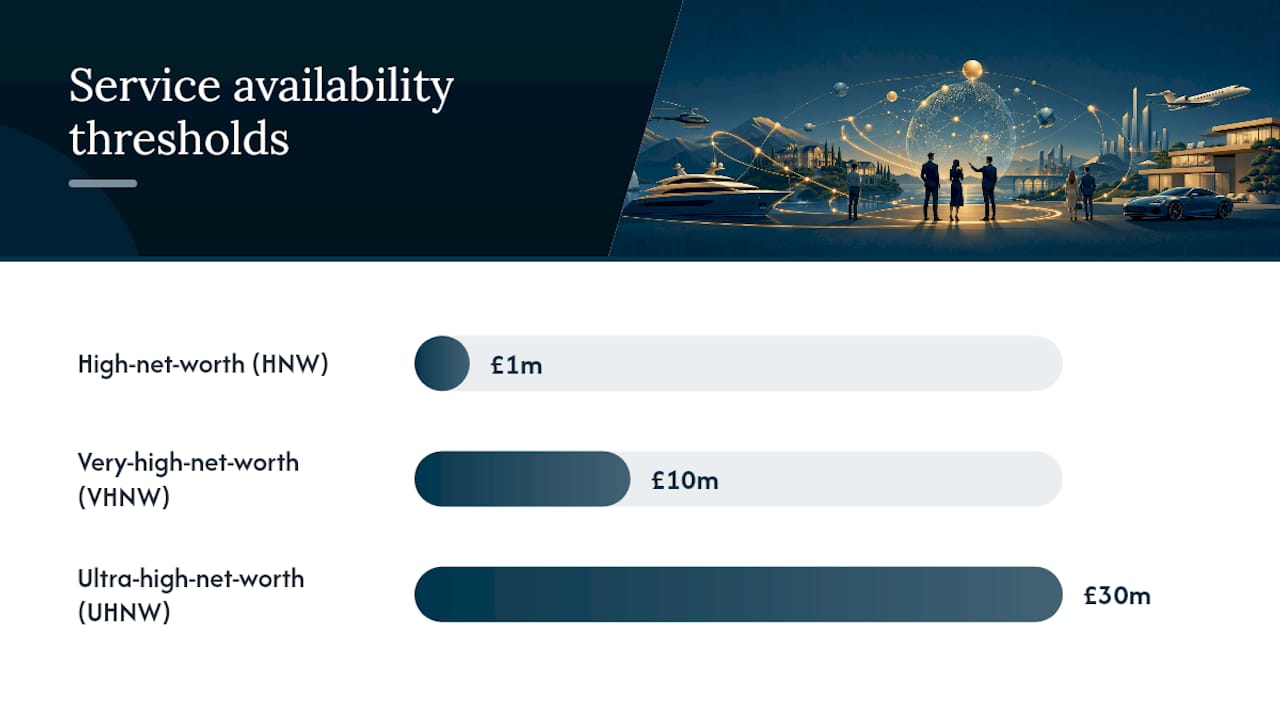
In the UK, industry conventions typically segment service availability by investable assets: around £1m for high-net-worth, £10m for very-high-net-worth, and £30m or above for ultra-high-net-worth. These thresholds shape which components are accessible and at what cost, though complexity of financial life often matters more than asset size alone.
How does the digital layer work within an ecosystem?
Technology is what makes a modern wealth ecosystem operationally coherent rather than merely conceptually appealing. Digital open ecosystems in wealth management aggregate data across custodians, advisers, and asset classes, presenting a single consolidated view through a client portal. The practical features that matter are:
- Single-view reporting: all assets, liabilities, and cash flows visible in one dashboard, regardless of where they are held.
- Secure document vaults: encrypted storage for wills, trust deeds, insurance schedules, and property documents, with controlled access for each adviser.
- Portfolio aggregation: real-time or near-real-time consolidation across multiple custodians and asset classes, including private market holdings.
- API connectivity: open application programming interfaces that allow third-party tools (accounting software, tax platforms, property management systems) to connect without manual data re-entry.
- Onboarding and KYC: digital identity verification and know-your-client processes that reduce friction when adding new advisers or service providers to the ecosystem.
Vendor neutrality matters. A platform that locks data into a proprietary format creates dependency and makes it difficult to switch advisers or custodians without losing reporting continuity. Open architecture, where the platform connects to any custodian or adviser rather than a captive panel, is the standard to insist upon.
Pro Tip: Before committing to any digital platform, ask three questions: Where is client data physically stored (UK data residency or offshore)? What are the vendor’s service-level agreements for uptime and breach notification? And can you export your full data history in a portable format if you change provider? The answers reveal whether the platform is genuinely client-centric or primarily designed to retain assets.
What value does a coordinated ecosystem deliver?
The wealth ecosystem benefits that matter most to HNWIs and their advisers fall into four areas.
Access to private markets and specialist deal flow. Private market investments — private equity, venture capital, direct lending, infrastructure — are a key value driver for HNW portfolios and are rarely accessible through standard retail channels. An ecosystem with the right investment manager and custodian relationships can source, conduct due diligence on, and administer private market exposures that would otherwise be unavailable.
Efficiency and cost control. Duplicated work across independent advisers is expensive. When a tax adviser and an investment manager both commission the same valuation, or when a solicitor drafts a trust deed without input from the tax team, the client pays twice and the outcome is often suboptimal. Coordination eliminates that duplication.
Tax and estate outcomes. The CFA Institute notes that tax management frequently has a larger impact on after-tax returns for HNWIs than portfolio cost reduction. Cross-discipline planning, where the investment manager, tax adviser, and trust counsel work from the same strategy, is the mechanism that captures that advantage. Passing wealth between generations without a coordinated plan routinely costs families more in tax and legal fees than the cost of the ecosystem itself.
Governance and succession. Multigenerational families benefit from formal governance structures: family constitutions, investment policy statements, and trustee oversight.
What risks and conflicts should you watch for?
No ecosystem is without trade-offs, and the UK regulatory environment adds specific considerations.
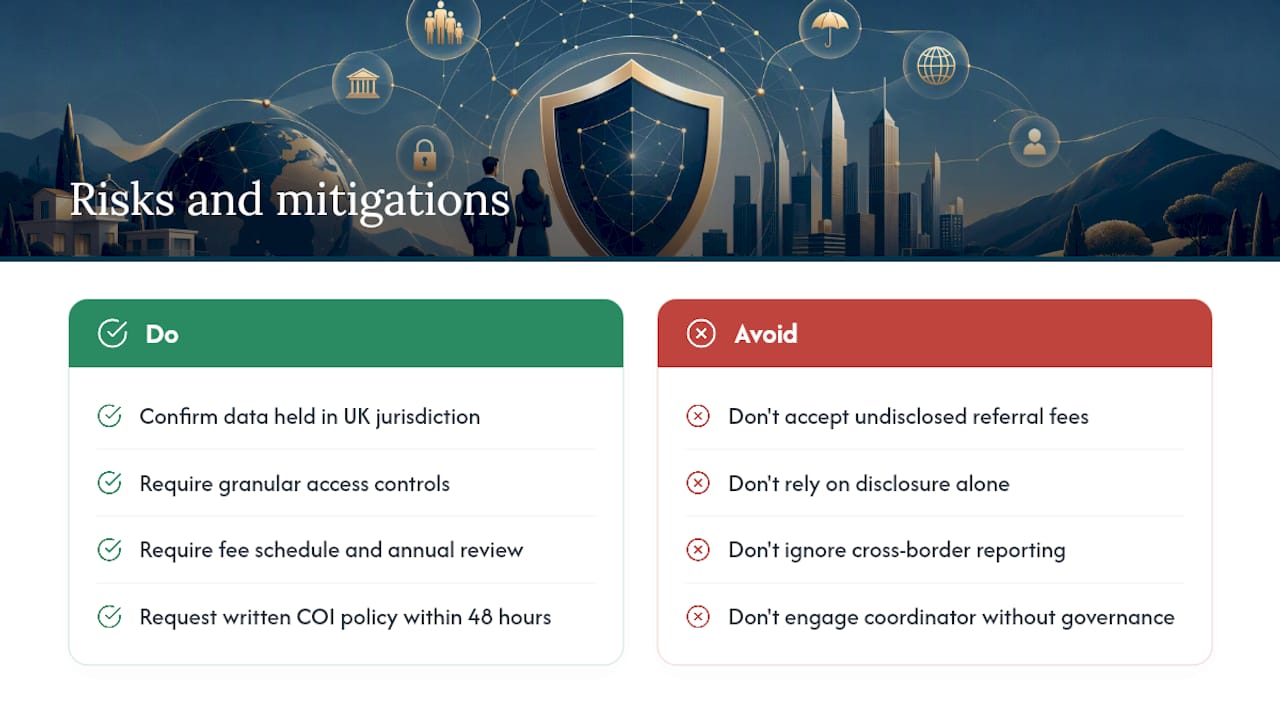
Privacy and data residency. Consolidating wealth data onto a single platform creates a concentrated target. Clients should confirm that data is held within UK jurisdiction, that access controls are granular (each adviser sees only what they need), and that consent frameworks are documented.
Conflicts of interest. The most common conflict in ecosystem arrangements is referral-fee routing: a coordinator who earns undisclosed fees for directing clients to specific providers has an incentive that is not aligned with the client’s best interests. The FCA’s conduct rules require advisers to disclose material conflicts, but disclosure alone does not eliminate the problem. Governance mitigation means insisting on a written conflict-of-interest policy, a fee schedule that shows exactly what each party earns, and an independent review of provider selection at least annually.
UK regulatory touchpoints. The Financial Conduct Authority regulates investment advice, discretionary management, and certain insurance activities. Trust law in England and Wales governs trustee duties and beneficiary rights. Cross-border arrangements trigger additional reporting obligations under the Common Reporting Standard and, for US-connected clients, FATCA. Each of these creates compliance obligations that the ecosystem coordinator must track.
The scale of what is at stake is not abstract. Global private wealth exceeds USD 471 trillion, and more than USD 74 trillion is projected to transfer between generations over the next 20–25 years. Families without a coordinated governance structure are navigating that transfer without a map.
Pro Tip: Ask every prospective ecosystem coordinator to provide a written statement of their conflict-of-interest policy before signing any engagement letter. If they cannot produce one within 48 hours, that is itself a governance signal.
How do you assess, build, or transition to a private wealth ecosystem?
The first decision is structural: build, partner, or assemble.
- Build (single-family office): appropriate for families with £30m or more in assets and sufficient complexity to justify dedicated infrastructure. High control, high cost.
- Partner (multi-family office or private bank): shared infrastructure reduces cost while retaining access to specialist networks. Less bespoke but operationally proven.
- Assemble (adviser-led coordination): a lead adviser curates and coordinates a panel of independent specialists. Flexible and cost-efficient; quality depends heavily on the lead adviser’s network and discipline.
A practical transition follows four stages: discovery (mapping existing advisers, assets, and gaps), design (agreeing the coordinator, the platform, and the governance framework), migration (onboarding advisers and data to the new structure), and governance (establishing reporting cadence, review cycles, and conflict policies). A realistic timeline for a family moving from siloed advice to a functioning ecosystem is six to twelve months, depending on complexity.
Immediate next steps for HNWIs and advisers:
- Audit existing arrangements. List every current adviser, the services they provide, and whether they are aware of each other’s work.
- Identify the coordinator. Decide who holds the single view of wealth and is accountable for cross-discipline coherence.
- Assess the digital layer. Confirm whether you have consolidated reporting across all assets, or whether you are still reconciling multiple statements manually.
- Review conflict policies. Request written conflict-of-interest disclosures from every current adviser.
- Map governance gaps. Check whether you have a current will, trust deeds, an investment policy statement, and a succession plan in place.
How a family-office-led ecosystem works in practice
The following anonymised case notes illustrate how coordination functions in real engagements.
Case A: Cross-border business sale. A UK-based entrepreneur sold a technology business with operations in the UK and Germany. The transaction triggered UK capital gains tax, German trade tax considerations, and a significant liquidity event that needed to be deployed across private markets, property, and a charitable foundation. Without ecosystem coordination, each adviser would have received the same brief independently and optimised for their own discipline. With a lead family office coordinating the engagement, the tax adviser, M&A counsel, investment manager, and philanthropy adviser worked from a single post-sale financial model. The result was a coherent deployment plan agreed before completion, rather than a reactive scramble after funds landed.
Case B: Estate planning for a multigenerational family. A family with property in three jurisdictions and beneficiaries in two countries needed a trust structure that satisfied UK trust law, minimised cross-border reporting obligations, and aligned with the family’s succession intentions. The ecosystem coordinator engaged trust counsel, a cross-border tax specialist, and a property adviser simultaneously, producing a consolidated structure rather than three separate recommendations that would have conflicted.
The schematic below shows how NXD Family Office organises the advisory layer for a typical client engagement.
| Function | NXD role | Partner type |
|---|---|---|
| Lead coordination | Single point of contact; strategy oversight | NXD Family Office |
| Investment management | Curated discretionary manager selection | Independent DFM |
| Tax advisory | Tax planning and compliance | Specialist tax partner |
| Trust and estate | Structuring and documentation | Independent solicitor |
| Lifestyle and concierge | Discreet family wealth management | NXD lifestyle network |
| Property advisory | Acquisition, disposal, and management | Property specialist |
| Philanthropy | Charitable structure and governance | Philanthropy adviser |
NXD Family Office operates on a fee-sharing model with its partner advisers. Clients pay the partner’s standard fee; NXD receives a share of that fee. There is no commission uplift or referral fee added to the client’s cost.
What most families get wrong about ecosystem design
The conventional wisdom is that a private wealth ecosystem is primarily an investment problem. Get the right portfolio, the thinking goes, and everything else follows. That framing is wrong, and it costs families money.
The investment portfolio is one component of a much larger system. Tax management, as the CFA Institute’s own research makes clear, often has a greater impact on after-tax wealth than portfolio construction. Trust structures, succession planning, and governance frameworks determine whether wealth survives to the next generation at all. Families that treat the investment manager as the de facto ecosystem coordinator frequently discover, too late, that their tax and estate arrangements were never properly integrated with their investment strategy.
The second common error is conflating access to a private bank with having an ecosystem. A private bank provides custody, lending, and a network. It does not, by default, coordinate your tax adviser, your solicitor, and your property manager. The network effect is real, but it requires active coordination to deliver its value. Many families pay private banking fees and receive private banking products without ever accessing the coordination function that justifies those fees.
The third pitfall is digital fragmentation. Families with assets across multiple custodians, jurisdictions, and asset classes who lack a single consolidated reporting view are, in practice, flying blind. The wealth solutions available beyond investment management are only as useful as the reporting infrastructure that makes them visible.
NXD Family Office: coordinating your private wealth ecosystem
NXD Family Office is the alternative to assembling a private wealth ecosystem yourself, adviser by adviser, with no single point of accountability. Where most advisory relationships optimise for their own discipline, NXD coordinates the full picture: wealth management, tax advisory, legal and estate planning, property, insurance, and lifestyle services, all under one coordinated strategy with no referral fee uplift for the client.
An initial engagement begins with a discovery conversation: mapping your existing advisers, assets, and gaps. From there, NXD designs a coordinated structure, introduces the right specialist partners from its vetted network, and takes responsibility for ongoing oversight. For families who want access to rare experiences alongside their financial planning, NXD’s lifestyle network extends to VIP event access, private travel, and rare cultural experiences that sit outside the standard advisory brief.
To discuss your current arrangements and where coordination could add value, contact NXD Family Office directly through the wealth management services page.
Sources
The following sources are worth consulting directly for advisers and HNWIs who want to deepen their understanding of private wealth ecosystems.
- Overview of Private Wealth Management | CFA Institute
- How High‑Net‑Worth Individuals Manage Wealth in the UK: A 2026 Perspective
- What Is Private Wealth Management? A Complete Guide – FMU University
- The Guardian: coverage of private banking perks and network effects
This article is general information, not a substitute for advice from a qualified financial advisor. Consult a qualified financial professional about your own circumstances before acting on anything here.
FAQ
What is a private wealth ecosystem?
A private wealth ecosystem is an integrated network of advisers, financial institutions, governance structures, and service providers that manage a family’s wealth under a single coordinated strategy, covering investment, tax, legal, estate, and lifestyle functions.
What is the concept of private wealth management?
Private wealth management, as defined by the CFA Institute, is a multidisciplinary service that integrates investment, tax, and estate advice into a unified strategy tailored to high-net-worth and ultra-high-net-worth individuals, typically triggered by the complexity of a client’s financial life rather than asset size alone.
Which banks do high-net-worth individuals use in the UK?
UK HNWIs commonly use private banks alongside wealth managers and family offices; industry conventions typically apply the private banking threshold at around £1m in investable assets, with very-high-net-worth and ultra-high-net-worth services available from £10m and £30m respectively.
Why do wealthy clients value private banking networks over standard accounts?
The real value of private banking is not the visible perks but the gatekeeper function: access to a vetted network of tax, legal, and property specialists that reduces the burden of finding and coordinating qualified advisers independently.
How does NXD Family Office coordinate a private wealth ecosystem?
NXD Family Office acts as the lead coordinator, connecting clients to a vetted panel of specialist advisers across wealth management, tax, legal, estate, and lifestyle services, operating on a fee-sharing model with no referral fee uplift for the client.