

Teaching children about family wealth is defined as the structured process of imparting financial literacy, responsibility, and stewardship so children develop the understanding, skills, and attitudes to manage family resources effectively. For parents in high-net-worth families, this is not a single conversation. It is a deliberate, phased education that begins in early childhood and evolves through adolescence. Tools like the FDIC’s Money Smart curricula and modern allowance apps give parents a practical starting point. The goal is straightforward: children who understand family finances grow into adults who respect, protect, and grow what they inherit.
What financial concepts should children learn at different ages?
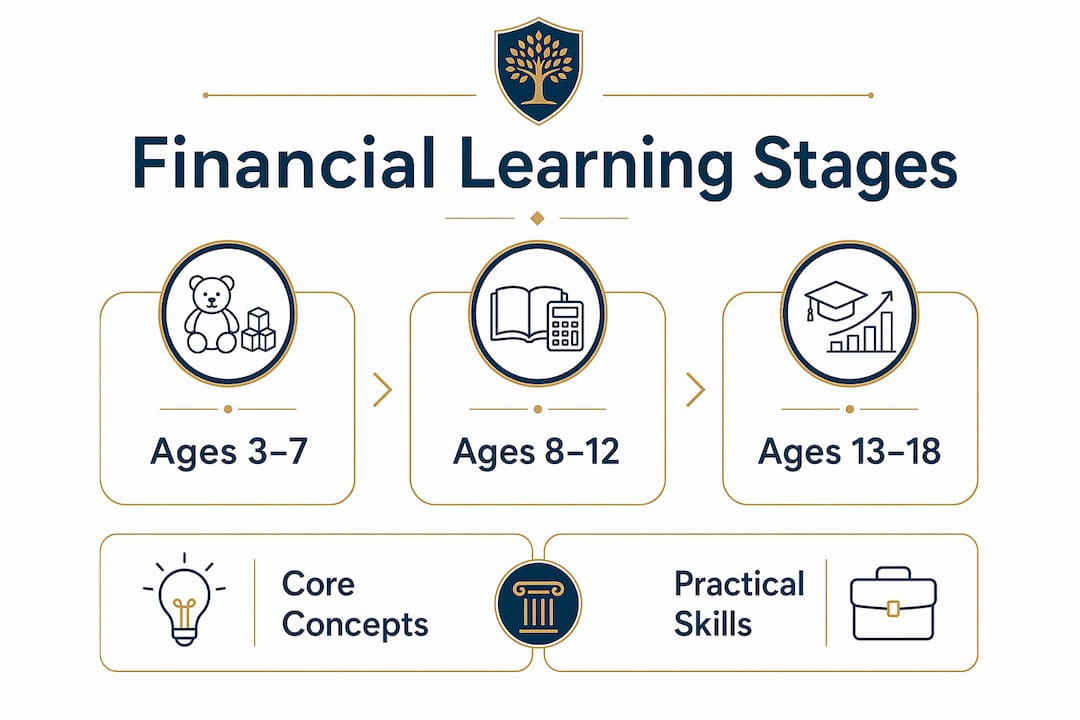
The most effective framework for wealth education for children is age-banded. The Family Office Advisory age band guide structures financial learning from early childhood through to age 18, with each stage building on the last. This approach prevents the common mistake of overwhelming young children with complexity before they have the foundations in place.
Ages 3–7: money is earned, not given
Children at this stage learn that money comes from effort. Simple activities like earning a small amount for completing household tasks teach the connection between work and reward. The concept of saving for a desired item introduces delayed gratification, one of the most transferable financial habits a child can develop. Charitable giving, even in small amounts, plants the seed of responsible stewardship early.
Ages 8–12: budgeting and decision-making
By age 12, children should grasp budgeting mechanics and delayed gratification alongside basic charitable allocations. At this stage, parents can introduce simple budgeting exercises, such as planning a purchase within a set amount. Discussions about family spending choices, framed around values rather than figures, help children internalise money as a tool rather than a status symbol.

Ages 13–18: credit, investing, and wealth planning
Teenagers are ready for introductory credit, debt management, investing basics, and an overview of wealth planning. The FDIC Money Smart curricula cover these topics in age-appropriate formats across four free programmes spanning pre-K to 12th grade. At this level, conversations can include family-specific topics such as how the family’s wealth was built, what values guide financial decisions, and what responsibilities come with inheritance.
Pro Tip: Frame wealth conversations around values, not numbers. Asking “What matters to our family when we spend money?” teaches decision-making far more effectively than showing a bank balance.
Which practical tools and activities teach family wealth effectively?
Teaching kids money management works best when it uses real money with real consequences. Research confirms that children learn better from autonomy and genuine decision-making than from permission-controlled spending where every choice requires parental approval. The following tools give children bounded financial freedom within a safe structure.
- Allowance systems: Tie allowances to responsibility and goals, not just chores. Allowance linked to responsibility teaches children that income reflects contribution, a principle that scales directly into adult financial life.
- Debit card tools and allowance apps: Debit card tools with parental oversight allow children to manage spending and saving independently while parents monitor progress. Many apps include chore tracking, savings goals, and giving allocations in one place.
- Savings goal setting: Ask children to identify something they want and work backwards to a savings plan. This single exercise teaches budgeting, patience, and the trade-off between immediate and future spending.
- Charitable giving decisions: Giving children a portion of their allowance designated for charity and letting them choose the cause builds philanthropic habits and connects wealth to community responsibility.
- Live financial literacy classes: Platforms like Outschool offer age-targeted classes covering budgeting, saving, entrepreneurship, and investing. These supplement family teaching with qualified educators and peer interaction.
The FDIC’s Money Smart programme is free and covers every age group from pre-school through to secondary school. It requires no specialist knowledge to use and is structured for parents to deliver at home.
Pro Tip: Give children a fixed amount for a family outing or a specific purchase and let them manage it entirely. The experience of running short, or having money left over, teaches more than any worksheet.
How should parents phase wealth education to avoid common pitfalls?
A phased approach to family wealth planning for kids follows a clear progression: foundational literacy first, then participation in family financial discussions, then genuine decision authority. Skipping stages is the most common mistake parents make.
- Build foundational literacy first. Before a child understands investing, they must understand earning, saving, and spending. Rushing to advanced topics without this base creates confusion and disengagement.
- Make earning visible. In high-net-worth families, children rarely see the connection between effort and income. Earning visibility via allowances linked to chores or small entrepreneurial projects prevents entitlement and builds stewardship. A child who earns money for a service rendered understands its value in a way that a child who simply receives it does not.
- Introduce participation before authority. Invite children to observe and discuss family financial decisions before they are asked to make any. Attending a conversation about a charitable donation, for example, teaches the reasoning process behind financial choices.
- Increase autonomy gradually. Start with small, low-stakes decisions and expand the scope as competence grows. A teenager managing a monthly clothing budget independently is far better prepared for adult financial life than one who has only ever had spending approved by a parent.
- Hold regular family money conversations. Financial education integrated into everyday life and linked to family values produces children who internalise money habits rather than simply following rules. A monthly family discussion about spending, saving, and giving normalises financial dialogue.
The critical pitfall to avoid is focusing on wealth amounts before children have any decision-making experience. Telling a child they will inherit a significant sum without first teaching them how to manage a weekly allowance is counterproductive. Responsibility must precede knowledge of scale.
What are effective ways to reinforce children’s wealth education over time?
Building financial habits early is not a one-time effort. As children mature, the conversations must deepen and the topics must evolve. The table below outlines how the focus of wealth education shifts across key life stages.
| Life Stage | Focus Area | Example Activity |
|---|---|---|
| Early childhood (3–7) | Earning and saving basics | Chore-linked allowance, piggy bank savings |
| Primary school (8–12) | Budgeting and giving | Purchase planning, charity allocation |
| Early teens (13–15) | Credit and investing basics | Discussing family investments, mock portfolios |
| Later teens (16–18) | Wealth stewardship and planning | Estate planning overview, tax advisory introduction |
Ongoing reinforcement works best when it is woven into real family decisions. Discussing the reasoning behind a significant purchase, explaining why the family supports a particular charity, or involving older teenagers in a conversation about tax advisory considerations all serve as live teaching moments.
Professional advisory support becomes relevant as topics grow more complex. A family office or wealth management adviser can introduce concepts like estate planning, investment strategy, and philanthropy in ways that are accurate, age-appropriate, and aligned with the family’s specific circumstances. Money management as a lifestyle skill requires parents to model the trade-offs and mindset they want their children to adopt. Children watch what parents do far more closely than they listen to what parents say.
The most effective curricula evolve with the child. What works at age eight will not engage a sixteen-year-old. Revisiting and updating the approach annually, ideally with professional input, keeps the education relevant and the child engaged.
Key takeaways
Teaching children about family wealth requires a phased, age-appropriate approach that connects effort to income, builds decision-making skills progressively, and embeds financial values into everyday family life.
| Point | Details |
|---|---|
| Start with age-banded frameworks | Use structured guides covering ages 3–18 to match financial concepts to developmental readiness. |
| Make earning visible | Link allowances to effort and responsibility to prevent entitlement and build genuine stewardship. |
| Give real financial autonomy | Children learn from actual decisions with real consequences, not permission-controlled spending. |
| Integrate values into money talks | Frame financial discussions around family values, not just figures, to build lasting habits. |
| Evolve the curriculum over time | Revisit and deepen the education annually, introducing investing, tax, and estate topics as children mature. |
What working with families has taught me about wealth education
The families who get this right share one trait: they treat financial education as part of their culture, not a task on a list. I have seen parents hand a teenager a credit card with no prior context and expect responsibility to follow. It never does. Responsibility is built in stages, over years, through small decisions that carry real weight.
The most overlooked step is making earning visible. In affluent families, money appears to arrive without effort. Children who never see the connection between work and income develop a distorted relationship with wealth. Something as simple as paying a child for a genuine service, whether that is organising a cupboard or researching a family decision, reframes money as something earned rather than something owed.
I also think parents underestimate the power of modelling. Children absorb the financial attitudes of the adults around them long before any formal lesson begins. If parents discuss trade-offs openly, give to causes they believe in, and talk honestly about financial decisions, children internalise those habits without being taught them explicitly.
Professional support is not a shortcut. It is a resource for the moments when the topics outgrow the parent’s expertise. Introducing an adviser into the conversation at the right stage, particularly around investing, estate planning, or philanthropy, signals to children that financial stewardship is serious and worth taking seriously.
— Alex
How Nxdfamilyoffice supports families with wealth education
Preparing children to manage inherited wealth is one of the most consequential decisions a family can make. Nxdfamilyoffice works with high-net-worth families to build the frameworks, conversations, and professional support structures that make that preparation real.

From bespoke wealth management services that align with long-term family goals to advisory support across lifestyle assets, philanthropy, and tax planning, Nxdfamilyoffice provides unbiased guidance with no referral fees and no commissions. The focus is always on the client’s best interests. If you are ready to build a structured approach to intergenerational wealth education for your family, Nxdfamilyoffice is the place to start.
FAQ
What age should children start learning about family wealth?
Financial education for children can begin as early as age three with simple concepts like earning and saving. By age twelve, children should understand budgeting, delayed gratification, and charitable giving, according to the Family Office Advisory age band framework.
What is the best tool for teaching kids money management at home?
An allowance tied to responsibility and goals is the most research-backed starting point. Combining this with a debit card app that offers parental visibility gives children real financial autonomy within a safe structure.
How do high-net-worth families avoid raising entitled children?
Making earning visible is the most effective safeguard. Linking income to effort, even through small tasks or entrepreneurial projects, ensures children understand that wealth requires stewardship, not just inheritance.
Should parents discuss actual family finances with their children?
Yes, but progressively. Begin with values-based conversations about spending and giving, then introduce more specific financial topics as children demonstrate readiness and decision-making competence.
When should professional advisers be involved in children’s wealth education?
Professional input becomes valuable when topics move beyond basic budgeting into investing, estate planning, and tax considerations. A family office adviser can introduce these subjects accurately and in a way that is tailored to the family’s specific wealth structure.