

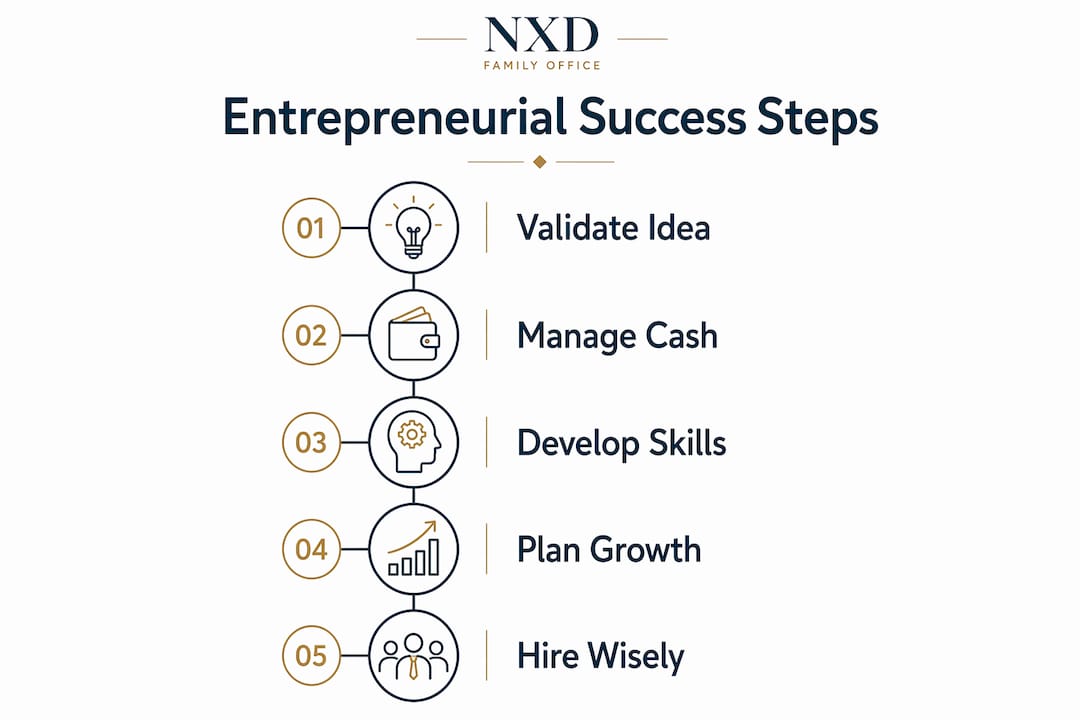
Entrepreneur advice is a collection of practical strategies and skills that enable business founders to validate, grow, and sustain successful ventures. The difference between a business that thrives and one that collapses within two years rarely comes down to the idea itself. It comes down to decisions: how you validate, how you manage money, who you hire, and how you price. This guide delivers the clearest, most evidence-backed guidance available for first-time and early-stage founders who want to build something that lasts.
What is the best entrepreneur advice for validating your idea?
Validation is the single most important step before you spend a pound or quit your job. Billion-dollar entrepreneurs succeed because they choose among multiple ideas based on market size, customer value, and real demand, not passion alone. Passion is not a business model. Demand is.
The most effective validation method is direct customer contact. Conducting 10–20 customer interviews or running a landing page test within a 60–90 day window, while still employed, costs as little as £80–£400 and can save you up to 12 months of wasted effort on a product nobody wants. That is not a minor saving. That is the difference between a business and an expensive hobby.
Here is a practical sequence to follow:
- Write down the specific problem your product solves and who suffers from it most.
- Identify 10–20 people who match that profile and request a 20-minute conversation.
- Ask about their current behaviour, not their opinion of your idea.
- Build a simple landing page describing your solution and measure sign-up rates.
- Only proceed if real people express willingness to pay, not just interest.
Most first-time founders delay leaving employment until they have validated their idea, secured paying customers, and built at least 12 months of financial runway. That is not timidity. That is discipline.
Pro Tip: Treat every piece of mentor guidance as a hypothesis. Before applying it, check whether the mentor’s market, business model, and growth stage actually match yours.
How should entrepreneurs manage cash flow and finances?
Cash flow kills more businesses than bad ideas do. The fix is not complicated, but it requires consistency.

The gold standard for early-stage financial management is a weekly updated 13-week cash flow forecast. This gives you a rolling view of exactly where your money is going and when gaps will appear. Pair that with a tax savings discipline of setting aside 20–30% of every profit into a dedicated account, and you remove the two most common financial shocks founders face.
Key financial practices for new business owners:
- Require upfront deposits. Ask for 50% upfront on large contracts. This protects your cash position and filters out clients who are not serious.
- Hire only when funded. Save 4–6 months of an employee’s salary before making your first hire. Payroll is your largest fixed cost and the hardest to reverse.
- Separate accounts. Keep business and personal finances in entirely separate accounts from day one. Mixing them creates tax headaches and obscures your true financial position.
- Review weekly, not monthly. Monthly reviews are too slow to catch problems before they become crises.
| Financial practice | Why it matters |
|---|---|
| 13-week cash flow forecast | Reveals gaps before they become emergencies |
| 20–30% tax savings account | Prevents year-end tax shock |
| 50% upfront deposits | Protects working capital on large projects |
| 4–6 months salary saved before hiring | Removes payroll risk from early growth |
For founders building towards significant personal wealth, financial independence planning should sit alongside business financial management from the start, not as an afterthought once the business is profitable.
Pro Tip: Open a dedicated tax account the same week you register your business. Move money into it every time a payment arrives. Never touch it for anything else.
Which soft skills determine long-term entrepreneurial success?
Technical ability gets a business started. Soft skills determine whether it survives. Emotional intelligence, resilience, and the ability to delegate are the three capabilities that most consistently separate thriving ventures from struggling ones.
Emotional intelligence matters because entrepreneurship is relentless. You will face rejection from investors, difficult conversations with clients, and months where nothing goes to plan. Founders who can manage their own stress and read the emotions of the people around them make better decisions under pressure. They also build stronger teams, because people want to work for someone who listens.
Resilience is not about ignoring failure. It is about processing setbacks quickly and returning to productive action. The founders who last are not the ones who never struggle. They are the ones who do not stay down.
Delegation is where many founders lose years of growth. The instinct to control everything is understandable, but it is a ceiling. A business that depends entirely on its founder is not a business. It is a job with extra risk. Learning to delegate, and to trust the people you delegate to, is the skill that turns a sole trader into a company.
Emotional intelligence helps entrepreneurs manage stress and remain resilient across the long arc of building a business. That is not a soft observation. It is a measurable determinant of whether founders stay in the game long enough to win.
What is the role of a business plan and how should you use it?
A business plan is not a document you write once to impress a bank manager. It is a working tool that forces you to think clearly about where you are, where you are going, and what decisions will get you there.
Blindly “just starting” without a structured plan is genuinely risky. A plan clarifies your starting point, your growth trajectory, and the long-term impact of the choices you make today. Without it, you are making decisions in the dark and hoping the results are good.
A useful business plan answers four questions clearly. What problem does this business solve? Who pays for the solution and why? How does money flow in and out? What does success look like in 12 months, 24 months, and five years? If you cannot answer those four questions in plain language, you are not ready to launch.
Plans should be revised regularly. A business plan written in january and never touched again is not a plan. It is a historical document. Treat it as a living reference that you update when the market changes, when customers give you new information, or when your assumptions prove wrong.
Pro Tip: Write your business plan before you need investment, not because you need investment. The thinking process is the value, not the document itself.
What are the best practices for hiring and pricing?
Under-pricing and over-hiring are the two most common early-stage founder mistakes. Both stem from the same problem: a lack of confidence in your own value and judgement.
Getting hiring right from the start
Hire contractors first for a 3–6 month period before committing to permanent employment. This tests the working relationship, validates whether the role genuinely needs to be full-time, and gives you an exit if the fit is wrong. First-time founders who skip this step frequently regret it.
When you do hire permanently, be specific about what the role requires in the first 90 days. Vague job descriptions attract vague candidates. Clarity in hiring produces clarity in performance.
Pricing with confidence
Testing 2–3 price points across your first 15 customers is the most reliable way to find your optimal price. The target acceptance rate is 30–50%. If 80% of customers accept without hesitation, your price is too low. If only 10% accept, it is too high. Pricing is not guesswork. It is a test you run with real data.
The instinct to price low to win customers is almost always wrong. Low prices attract price-sensitive customers who leave the moment a cheaper option appears. Confident pricing attracts customers who value what you do.
| Acceptance rate | What it signals |
|---|---|
| 80%+ acceptance | Price is too low; raise it |
| 30–50% acceptance | Price is at the right level |
| Under 10% acceptance | Price is too high; test a lower point |
For founders seeking expert guidance on venture capital and investment as their business scales, independent advisory makes a material difference to the terms you secure.
Key takeaways
The most effective entrepreneurship strategies combine early validation, disciplined financial management, and confident decision-making in hiring and pricing.
| Point | Details |
|---|---|
| Validate before you launch | Run 10–20 customer interviews or a landing page test within 60–90 days while still employed. |
| Forecast cash flow weekly | A 13-week rolling forecast reveals financial gaps before they become crises. |
| Build soft skills deliberately | Emotional intelligence and delegation ability determine long-term survival more than technical skill. |
| Plan before you need to | A business plan is a decision-making tool, not a document written for investors. |
| Test your pricing | Aim for a 30–50% acceptance rate across 2–3 price points with your first 15 customers. |
What I have learned about early-stage entrepreneurship
The most damaging advice I see given to new founders is “just start.” It sounds bold. It is actually reckless.
The founders I have watched build genuinely durable businesses share one trait: they treated the early stage as a research phase, not a launch phase. They talked to customers before they built anything. They kept their income while they tested their assumptions. They did not confuse movement with progress.
The other pattern I notice is how badly founders underestimate the financial discipline required. Not the complexity of it. The discipline. Knowing you should set aside 20–30% for tax is not the same as actually doing it every single month, without exception. The gap between knowing and doing is where most businesses quietly fail.
Pricing is the area where I see the most unnecessary self-sabotage. Founders price low because they are afraid of rejection. But a low price does not prevent rejection. It just means that when rejection comes, you have also given away your margin. Price with confidence. Test it properly. The data will tell you what the market will bear.
The best entrepreneurship strategies are not secret. They are simply the ones that require consistency over a long period, which is harder than it sounds and rarer than it should be.
— Alex Goldstein
How NXD Family Office supports entrepreneurial financial success
Founders who build profitable businesses face a new challenge: protecting and growing what they have created. That requires advice that is genuinely independent, not shaped by commissions or referral fees.
NXD Family Office works with entrepreneurs and high-net-worth individuals to provide exactly that. From wealth management services and tax advisory to property advisory and lifestyle management, every recommendation is made in the client’s interest alone. There are no hidden incentives. No hand in the till. If you have built something worth protecting, NXD Family Office provides the network of expert advisors to help you do it properly. Consider it done.
FAQ
What is the most important entrepreneur advice for beginners?
Validate your idea before you invest significant time or money. Conduct 10–20 customer interviews within your first 60–90 days to confirm real demand exists before building anything.
How do I manage cash flow as a new business owner?
Run a weekly 13-week cash flow forecast and set aside 20–30% of profits into a dedicated tax savings account from your first month of trading.
When should an entrepreneur hire their first employee?
Hire a contractor first for 3–6 months to test the working relationship. Only move to permanent employment after saving 4–6 months of that employee’s salary.
How do I know if my pricing is correct?
Test 2–3 price points with your first 15 customers. A 30–50% acceptance rate indicates the right level. Above 80% means you are pricing too low.
Why do so many startups fail in the first two years?
The most common causes are poor cash flow management, launching without validating demand, and pricing too low to sustain the business. All three are preventable with the right planning and independent financial guidance.