

A health care entrepreneur is a healthcare professional or innovator who creates business ventures that improve patient outcomes and system efficiency. In the UK, this means navigating a tightly regulated environment governed by bodies including the Medicines and Healthcare products Regulatory Agency (MHRA), the National Institute for Health and Care Excellence (NICE), and NHS procurement frameworks. The path from clinical idea to commercial product is rarely short. Expect a minimum of 2–3 years from product development to live NHS deployment. This article covers the regulatory gates, funding programmes, procurement realities, and business model decisions that determine whether a healthcare venture succeeds or stalls.
What does a health care entrepreneur need to know about UK regulation?
The regulatory sequence is the single most important thing a medical startup founder must understand before spending a penny on development. Three assessment gates stand between a product and NHS adoption: MHRA market authorisation, the NICE Evidence Standards Framework (ESF), and the Digital Technology Assessment Criteria (DTAC). Each gate is distinct and none substitutes for another.
Most founders make the same mistake. They prioritise MHRA classification first because it feels like the obvious starting point. NICE ESF tier assessment should guide initial strategy because it dictates evidence requirements and adoption pathways before MHRA classification even becomes relevant. Getting this sequence wrong costs years.

The NICE ESF operates on a tiered system. Tier 3b is the most demanding level, requiring randomised controlled trials that typically run for one to two years. A product that lands in Tier 3b without adequate capital or a clinical trial partner will stall. Understanding your tier before committing to a development roadmap is not optional. It is the foundation of your entire market entry strategy.
DTAC sits alongside MHRA and NICE as the NHS’s internal procurement readiness check. It covers clinical safety, data protection, technical security, and interoperability. A product can hold MHRA authorisation and a positive NICE recommendation and still fail DTAC. All three gates must be cleared in sequence.
Pro Tip: Engage a NICE ESF specialist before writing your first regulatory submission. Knowing your tier early shapes your evidence plan, your funding requirements, and your investor pitch.
Key regulatory milestones at a glance:
- NICE ESF tier determination: sets evidence requirements and adoption pathway
- MHRA market authorisation: confirms product safety and legal market entry
- DTAC assessment: confirms NHS procurement readiness across clinical, data, and technical criteria
- Procurement cycle: typically 12–18 months after regulatory clearances are secured
How can health care entrepreneurs secure funding and training support?
Funding for healthcare entrepreneurship in the UK is more structured than most founders realise. The challenge is not a shortage of programmes. It is knowing which programmes to combine and in what order.
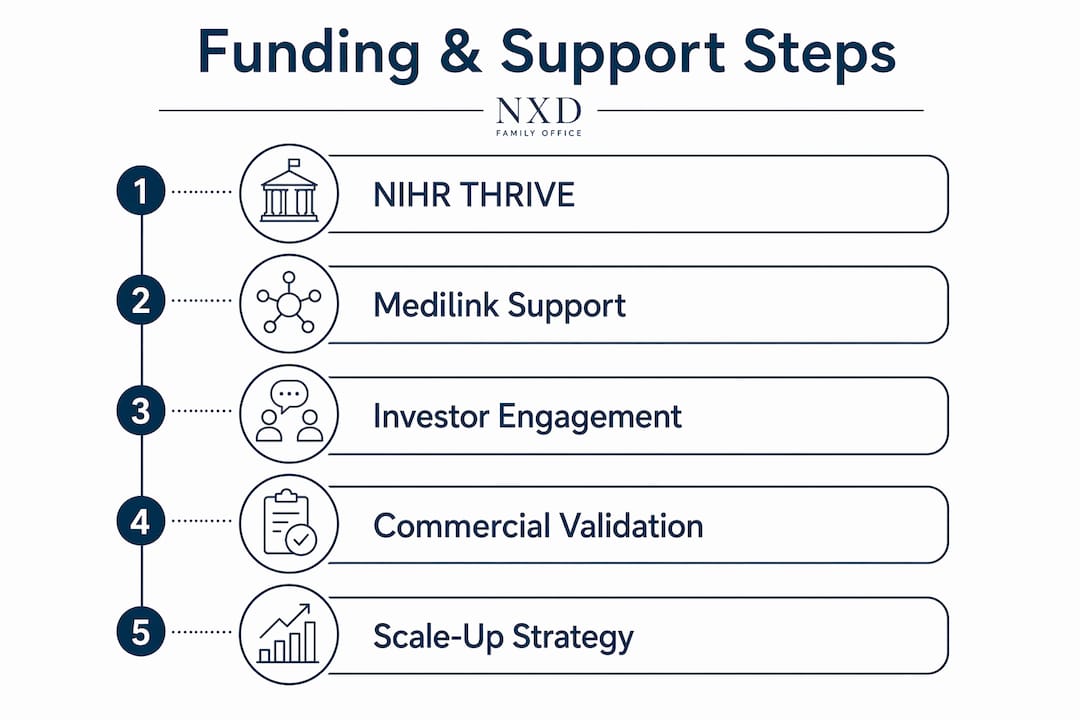
The NIHR THRIVE programme is the most direct route for academic and clinical entrepreneurs at an early stage. NIHR THRIVE offers up to £150,000 over nine months to support technology development and entrepreneurial training. Eligibility targets innovations at Technology Readiness Level 3 or above. That figure is significant because it covers the cost of early clinical validation work, which is precisely where most health tech entrepreneur ventures run out of money.
NIHR THRIVE also actively encourages applications from innovators in underserved communities. This is not a token gesture. The programme recognises that clinical insight often comes from practitioners working in under-resourced settings, and those practitioners rarely have access to commercial networks.
For founders who need hands-on commercialisation support alongside capital, Medilink Midlands Innovation Builder provides a different model. Subsidised support valued at over £15,000 covers technical evaluation, market insights, investor readiness, and pitching opportunities. Membership costs £250 per month after a free initial evaluation. That structure suits founders who need structured mentorship rather than a lump sum grant.
The most effective approach combines both. Use NIHR THRIVE for capital and validation. Use Medilink for commercial strategy and investor access. Neither programme alone covers the full journey from bench to market.
Pro Tip: Apply to NIHR THRIVE for funding and simultaneously join Medilink’s Innovation Builder for commercial coaching. The two programmes address different gaps and are not mutually exclusive.
Key funding options for healthcare startup founders:
- NIHR THRIVE: up to £150,000 over nine months, targeting Technology Readiness Level 3 and above
- Medilink Midlands Innovation Builder: subsidised support worth over £15,000, with structured investor readiness coaching
- NHS Innovation Accelerator: national programme supporting adoption of proven innovations across the NHS
- Innovate UK: grant funding for health and life sciences research with commercial potential
For founders building an online presence and authority alongside their clinical credibility, specialist consultancy support can accelerate visibility with commissioners and procurement teams.
What are the challenges of NHS procurement for a medical startup founder?
NHS procurement operates at three levels: local trust purchasing, regional frameworks, and national contracts. Each level has different rules, different decision-makers, and different timelines. Most founders underestimate how much this structure matters.
SMEs represent 85% of NHS suppliers, which is a fact that surprises most people outside the sector. The NHS is not a closed shop for large corporates. The Procurement Act 2023 requires public buyers to actively consider SME participation. The door is open. The challenge is knowing how to walk through it.
Low-value contracts offer the fastest entry point. Purchases under £12,000 often use an expedited three-quote approach, with fewer documentation requirements and faster contracting. For a startup with a proven pilot, this is the most practical route to a first NHS contract. It builds a reference site, generates real-world evidence, and strengthens the case for larger framework agreements.
The strategic steps for NHS procurement success follow a clear sequence:
- Secure regulatory clearances first. No procurement conversation is credible without MHRA, NICE, and DTAC in place.
- Map your procurement level. Identify whether your product fits local, regional, or national purchasing.
- Target low-value entry contracts. Use the three-quote route to build NHS reference sites quickly.
- Align with NHS priorities. Frame your product around NHS Long Term Plan goals and integrated care system priorities.
- Engage procurement teams early. Attend NHS supplier events and request pre-market engagement meetings before formal tender processes open.
“The largest challenge is aligning incentives and navigating procurement pathways within the large NHS system. There is significant energy from startups in the health sector, but incentive misalignments pose real challenges that require strategic navigation rather than persistence alone.”
The 12–18 month procurement cycle after regulatory clearances is the figure that catches most founders off guard. Combined with the 2–3 year development timeline, a realistic path to revenue from a standing start is four to five years. Founders who plan for this survive. Those who do not run out of capital at the worst possible moment.
How do you build a viable healthcare business model and scale innovation?
A viable healthcare business model rests on three components: a clear value proposition tied to measurable patient outcomes, a reimbursement pathway, and an adoption strategy that accounts for NHS decision-making culture. Missing any one of these makes the other two irrelevant.
NICE recommendations function as commercial assets, not just regulatory stamps. A positive NICE recommendation gives a health tech entrepreneur credibility with commissioners, facilitates national funding access, and differentiates a product in a market where around 2 million healthtech products are registered for UK use. Achieving one is not the end of the commercial process. It is the beginning of the serious commercial conversation.
The National HealthTech Access Programme (NHAP) changes the reimbursement picture significantly. Under NHAP, high-impact health technologies will be reimbursed and made consistently available across the NHS, replacing the postcode lottery that has historically blocked equitable access. The programme launched in early 2026 and signals a genuine policy shift. Products that qualify will move from local adoption battles to national reimbursement, which transforms the commercial model entirely.
Scaling pathways vary by founder profile and product type:
| Scaling route | Best suited to | Key consideration |
|---|---|---|
| Spin-out company | Academic or clinical researchers | Requires IP assignment and investor readiness |
| Licensing | Founders preferring royalty income | Depends on strength of IP and partner appetite |
| Intrapreneurship | NHS employees developing internal tools | Governed by NHS employment and IP policies |
| Direct commercialisation | Founders with clinical and business experience | Requires full regulatory and procurement navigation |
Early market validation is not optional. Commissioners and investors both require evidence of real-world impact before committing. Pilot studies within NHS trusts, even at the three-quote contract level, generate the data that makes the next conversation possible.
Pro Tip: Engage your venture capital and investment advisory network before you need capital. Investor readiness takes months to build, and the best terms go to founders who approach investors from a position of strength, not urgency.
What I have learned from watching healthcare entrepreneurs navigate the NHS
The founders who succeed in UK healthcare entrepreneurship share one quality above all others: they treat the NHS as a system to understand, not an obstacle to overcome. That distinction sounds small. In practice, it determines everything.
The timeline reality is the hardest lesson. I have seen technically brilliant products fail because the founder modelled a two-year path to revenue and ran out of capital in year three. The 2–3 year development to deployment figure is a minimum, not a target. Build your financial model around five years and treat anything faster as a bonus.
The hybrid role question comes up constantly. Should a clinician leave their NHS post to pursue a venture full-time, or maintain a clinical role while building? The honest answer is that most successful founders maintain some clinical connection, at least in the early years. It preserves credibility with NHS buyers, keeps real-world insight sharp, and provides income stability during the long regulatory phase.
Programmes like NIHR THRIVE and Medilink are genuinely useful, but only for founders who engage with them actively. The founders who extract the most value treat these programmes as networks, not just funding sources. The relationships built during a nine-month NIHR THRIVE cohort often matter more than the £150,000.
The NHAP launch in early 2026 is the most significant policy development for health tech entrepreneurs in a decade. It does not guarantee commercial success, but it removes the single biggest structural barrier to scale: inconsistent local adoption. Founders building products today should be designing their evidence plans with NHAP eligibility in mind from day one.
— Alex Goldstein
How NXD Family Office supports healthcare entrepreneurs with financial planning
Healthcare entrepreneurship generates complex financial needs that standard advisory services rarely address well. Regulatory costs, long development timelines, equity structuring, and eventual exit planning all require specialist guidance.
NXD Family Office works with high-net-worth founders and clinician entrepreneurs to provide bespoke wealth management that reflects the realities of building a healthcare business. Advice is free from referral fees and commissions, which means clients receive guidance aligned with their interests rather than a product provider’s margin. From structuring early-stage investment to managing the personal wealth created by a successful exit, NXD Family Office covers the full financial picture. For founders who want to understand how business advisory services can support NHS pathway navigation and commercial scaling, the conversation starts with a direct, no-obligation discussion.
Key takeaways
Successful healthcare entrepreneurship in the UK requires clearing MHRA, NICE ESF, and DTAC gates in the correct sequence, securing targeted funding through programmes like NIHR THRIVE, and planning for a realistic 4–5 year path to NHS revenue.
| Point | Details |
|---|---|
| Regulatory sequence matters | Assess NICE ESF tier before MHRA classification to set the right evidence and funding plan. |
| NIHR THRIVE funds early-stage work | Up to £150,000 over nine months covers validation costs where most ventures run short. |
| NHS procurement favours SMEs | 85% of NHS suppliers are SMEs; the three-quote route under £12,000 is the fastest entry point. |
| NHAP changes the reimbursement model | High-impact products approved under NHAP gain consistent national reimbursement from 2026. |
| Financial planning cannot wait | Equity structuring, investor readiness, and personal wealth management need specialist advice from the outset. |
FAQ
What is a health care entrepreneur?
A health care entrepreneur is a clinician, researcher, or innovator who creates and commercialises new products, services, or business models to improve patient outcomes or healthcare system efficiency. The term covers medical startup founders, health tech entrepreneurs, and NHS intrapreneurs.
How long does it take to get a product into the NHS?
Expect a minimum of 2–3 years from product development to NHS deployment, with procurement adding a further 12–18 months after regulatory clearances. A realistic total timeline from concept to revenue is four to five years.
What funding is available for healthcare startup founders in the UK?
NIHR THRIVE offers up to £150,000 over nine months for academic and clinical entrepreneurs. Medilink Midlands Innovation Builder provides subsidised commercialisation support worth over £15,000. Innovate UK and the NHS Innovation Accelerator offer additional grant and adoption support.
What is the NICE Evidence Standards Framework?
The NICE ESF is a tiered framework that sets evidence requirements for healthtech products seeking NHS adoption. Tier 3b, the most demanding level, requires randomised controlled trials. Determining your tier early shapes your entire evidence strategy and funding needs.
What is the National HealthTech Access Programme?
NHAP is a programme launched in early 2026 that provides consistent national reimbursement for high-impact health technologies across the NHS. It replaces the previous system of variable local adoption and is designed to reduce geographic disparities in access to proven innovations.