

What houses are for sale in London right now?
London’s property market in 2026 offers buyers genuine choice across every borough, from Victorian terraces in Hackney and townhouses in Islington to detached family homes in Richmond and new-build flats in Canary Wharf. The range is wide, and so are the prices. Understanding where to look and what to expect before you start is what separates a confident buyer from one who wastes months on the wrong properties.
Your first step is fixing a realistic budget. That means speaking to a mortgage broker before you fall in love with a property, not after. Get an Agreement in Principle in writing so you know exactly what a lender will offer. Then define your criteria: borough, property type, freehold or leasehold, minimum bedrooms, and whether a garden matters. Properties with gardens in London command a premium, particularly in south-west and outer-east boroughs, so factor that in early.
For London real estate listings, the main search portals are Rightmove, Zoopla, and OnTheMarket. Each aggregates stock from estate agents across every borough. Set up alerts for your criteria and check them daily; well-priced properties in competitive areas move within days. Alongside portals, register directly with estate agents in your target area, as some properties are offered to registered buyers before they appear online.
Professional valuation matters more in London than almost anywhere else in England. Asking prices vary considerably from actual achieved prices, and a surveyor or independent valuer can tell you whether a property is priced at, above, or below market. Never rely solely on the estate agent’s opinion of value; their primary legal duty runs to the seller, not to you.
- Decide your maximum budget and obtain a mortgage Agreement in Principle before viewing
- Choose your priority boroughs and property type (freehold house, leasehold flat, new build)
- Register on Rightmove, Zoopla, and OnTheMarket with saved searches and daily alerts
- Register directly with local estate agents for off-market and early access to stock
- Commission an independent valuation before making any offer
Which estate agencies offer the best London property listings?
Three agencies dominate the conversation when buyers search for properties for sale in London: Foxtons, Marsh & Parsons, and Knight Frank. Each serves a distinct segment of the market, and choosing the right one to work with depends entirely on what you are buying and where.

| Agency | Property types | Mortgage support | Conveyancing services | Buyer support | Price range | New homes | Best for |
|---|---|---|---|---|---|---|---|
| Foxtons | Flats, houses, all types | In-house mortgage advisers | Referral to panel solicitors | Digital tools, viewing scheduling | Entry to upper mid-market | Yes, across boroughs | Broad search across all London boroughs |
| Marsh & Parsons | Mid to high-end residential | Mortgage introductions | Referral to trusted solicitors | Personalised agent guidance | Mid to prime London | Limited | Expert service in prime London areas |
| Knight Frank | Luxury, new developments, exclusive homes | Specialist finance introductions | Referral to premium solicitors | Bespoke buyer services | Prime to ultra-prime | Extensive new build portfolio | Discerning buyers seeking high-value or new build homes |
Foxtons operates across virtually every London borough, which makes it the practical starting point for buyers who want broad market coverage. Its integrated mortgage advisers and digital viewing tools reduce friction in the early search stages, and its listings span everything from one-bedroom flats to larger family houses.
Marsh & Parsons concentrates on prime and near-prime London, with particular strength in areas such as Notting Hill, Chelsea, Fulham, and Kensington. The agency’s reputation rests on personalised service rather than volume, and buyers working in those postcodes often find the guidance genuinely useful rather than transactional.
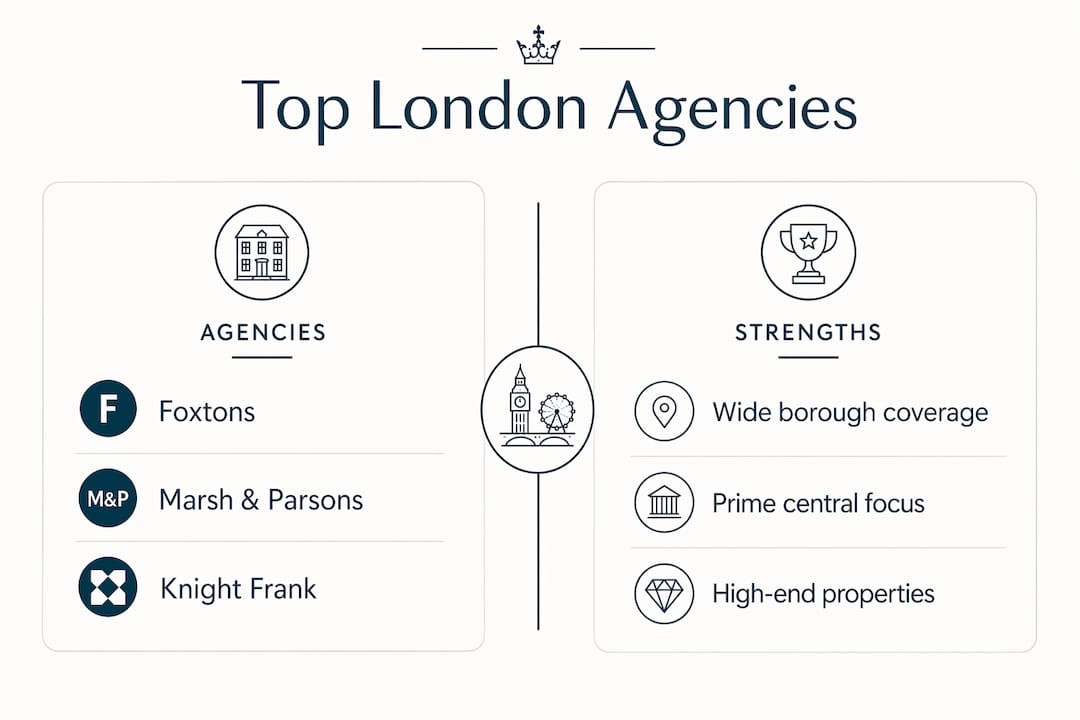
Knight Frank is the natural choice for buyers at the top of the market, including those considering new developments in Nine Elms, White City, or the City of London fringe. Its new homes division is one of the most active in the capital, and the agency’s international reach means it can also assist buyers relocating from overseas.
Pro Tip: Register with all three agencies simultaneously rather than committing to one. Each holds different stock, and there is no obligation to use any agency’s recommended solicitor or mortgage broker, regardless of how the introduction is framed.
How to buy a house in London: a step-by-step guide
Buying a home in England takes approximately five months on average, though London transactions in competitive areas or complex chains can run longer. Following a clear sequence reduces delays and protects your position.
- Obtain a mortgage Agreement in Principle. Speak to an independent mortgage broker and get a written AIP before viewing any property. Sellers and agents take offers more seriously from buyers with confirmed borrowing capacity.
- Define your search criteria and register with agents. Fix your borough shortlist, property type, and non-negotiables. Register on the main portals and directly with local agents.
- View properties and research comparables. Check what similar properties in the same street or postcode have actually sold for, using the Land Registry’s price paid data. Never rely on asking prices alone.
- Make an offer subject to contract. An accepted offer is not legally binding until contracts are exchanged. Either party can withdraw before exchange without financial penalty, which is why instructing a solicitor promptly after acceptance matters.
- Instruct a solicitor or licensed conveyancer. Your legal representative will conduct searches, raise enquiries, review the contract pack, and advise on any issues found. Do not use a solicitor recommended by the estate agent without first checking whether a referral fee is involved.
- Commission a survey. A mortgage valuation is not a survey. A HomeBuyer Report or full structural survey gives you an independent assessment of the property’s condition and can support price renegotiation if problems are found.
- Exchange contracts. Once searches are clear, mortgage formally approved, and both parties satisfied with the contract, you exchange. At this point the transaction becomes legally binding and you pay your deposit.
- Complete. On completion day your solicitor transfers the purchase funds to the seller. You collect the keys and the property is yours.
Pro Tip: Instruct your solicitor on the day your offer is accepted, not a week later. In London chains, delays at the legal stage are the single most common reason transactions collapse. Early instruction keeps you ahead of the chain.
Understanding costs: mortgages, Stamp Duty, and additional expenses
The purchase price is only part of what buying a London property costs. A larger deposit consistently unlocks better mortgage rates, so the deposit decision is also a rate decision. Beyond the mortgage, Stamp Duty Land Tax (SDLT) is the largest additional cost for most buyers.

The 2026/27 SDLT bands for residential property in England are:
| Purchase price band | Standard rate |
|---|---|
| Up to £125,000 | 0% |
| £125,001 to £250,000 | 2% |
| £250,001 to £925,000 | 5% |
| £925,001 to £1,500,000 | 10% |
| Above £1,500,000 | 12% |
At a typical mid-market London price, the SDLT bill is calculated according to standard rates for that price band. At a higher purchase price, the SDLT bill increases accordingly based on standard rates. Buyers purchasing an additional property pay a 5% surcharge on top of every band, raised from 3% in October 2024. Non-resident buyers face a further 2% surcharge on top of that.
First-time buyers receive relief: 0% on the first £300,000 and 5% on the portion from £300,001 to £500,000. The relief disappears entirely if the purchase price exceeds £500,000, at which point the full standard rates apply with no tapering. Given that many entry-level London homes sit above that threshold, this cliff matters.
Beyond SDLT, budget for solicitor’s fees, local authority and environmental searches, a survey, mortgage arrangement fees, and ongoing property maintenance such as pest control on your new home. Ongoing costs after purchase include Council Tax, service charges and ground rent on leasehold properties, and building insurance.
Key figure: The average home buying process in England takes approximately five months, and legal commitment only arises at contract exchange, not at offer acceptance.
How do you protect yourself when buying a London property?
Surveys and EWS1 requirements
A HomeBuyer Report suits most standard properties. A full structural survey is worth the additional cost on older buildings, extended properties, or anything with visible defects. For London flats in buildings over 11 metres, the Building Safety Act 2022 requires an EWS1 fire safety certificate, which many mortgage lenders now mandate before they will lend. Verify whether an EWS1 exists and whether any remediation costs could fall to the leaseholder before you exchange.
Leasehold considerations and the LPE1 form
Flats in London are almost always leasehold. Check the remaining lease length before making an offer; lenders typically will not lend on properties with fewer than 80 years remaining. Once the lease falls below that threshold, extending it becomes significantly more expensive. The LPE1 Leasehold Property Enquiries form reveals service charges, planned major works, and building insurance details. Delays in receiving it from the landlord or managing agent are one of the most common bottlenecks in London leasehold transactions. Request it the day your offer is accepted.
Protecting against property fraud
- Register your property with HM Land Registry’s Property Alert service to receive notifications of any activity on your title
- Use a solicitor regulated by the Solicitors Regulation Authority or the Council for Licensed Conveyancers
- Never transfer funds based on email instructions alone; always verify bank details by telephone using a number you have independently sourced
- Check that your solicitor’s details match the SRA register before sending any money
Pro Tip: Estate agents’ recommended professionals may receive referral fees from the firms they suggest. You have the right to appoint your own solicitor and surveyor. Exercise it.
What are the benefits of buying a new build home in London?
New build homes in London are concentrated in growth areas including Nine Elms, Stratford, Wembley, Barking Riverside, and the Royal Docks. Developers such as Berkeley Group, Barratt London, and Taylor Wimpey maintain active pipelines across these boroughs, and Knight Frank’s new homes division lists many of these developments directly.
The practical advantages of buying new are real. Modern building standards mean better insulation, lower energy bills, and no immediate maintenance costs. Buyers can often specify finishes before construction completes. New builds also come with a 10-year NHBC Buildmark warranty or equivalent, which covers structural defects and gives lenders confidence.
Key buyer benefits specific to new builds:
- No chain: new builds complete on a fixed date, removing the chain risk that derails so many London resale transactions
- Energy efficiency: modern construction meets current building regulations, typically achieving EPC ratings of B or above
- Warranty protection: NHBC Buildmark or similar covers structural defects for 10 years from completion
- Specification choices: buyers who reserve early can often choose kitchen finishes, flooring, and bathroom fittings
- Potential government schemes: check current availability of shared ownership or other affordable home ownership programmes through Homes England
The trade-off is the new-build premium. New properties in London often cost more per square foot than comparable resale homes in the same postcode. Factor that into your valuation and do not assume the developer’s asking price reflects independent market value.
Expert advice for London property buyers from NXD Family Office
The London property market rewards buyers who take independent advice seriously and penalises those who rely entirely on parties with a financial interest in the transaction. Estate agents owe their primary legal duty to the seller, not to you. That is not a criticism of any individual agent; it is simply how the law works, and buyers who understand it make better decisions.
For high-net-worth buyers, the total cost of ownership extends well beyond the purchase price and SDLT. Service charges on prime London flats can run to tens of thousands of pounds annually. Ground rent terms vary widely and some historical leases contain escalating clauses that affect both liveability and resaleability. A tax adviser who understands property-specific implications, including capital gains exposure and inheritance tax planning, is not a luxury at this level of transaction.
Checklist for discerning London buyers in 2026:
- Appoint an independent solicitor before your offer is accepted, not after
- Commission a survey appropriate to the property type and age, not the cheapest option available
- Request the LPE1 form immediately on offer acceptance for any leasehold purchase
- Verify EWS1 status on any flat in a building over 11 metres before committing
- Calculate the full SDLT liability including any applicable surcharges before agreeing a price
- Check service charge history and any planned major works in the last three years
- Confirm your solicitor and surveyor have no referral arrangement with the selling agent
- Register with HM Land Registry’s Property Alert service on completion
Independent property advisory at this level is not about adding cost. It is about ensuring that every professional in your transaction is working for you, not for a commission arrangement you were never told about.
How long does selling a house in London take?
The timeline for selling a London property typically runs from eight to twelve weeks from instruction to exchange, though completion often follows two to four weeks after that. The full process from first instructing an agent to receiving funds can therefore stretch to about five months in a straightforward chain, and longer when complications arise.
The sequence runs: instruct an agent and agree marketing strategy, accept an offer, instruct solicitors on both sides, conduct searches and enquiries, exchange contracts, then complete. Each stage has its own potential delays. Searches can take two to six weeks depending on the local authority. Leasehold transactions add time because the LPE1 form must be obtained from the freeholder or managing agent, and some are slow to respond.
Buyers pulling out before exchange is common in London and costs sellers time without compensation. Sellers who have their legal paperwork prepared before going to market, including title documents, planning permissions for any works, and building regulations certificates, move through the conveyancing stage faster and reduce the risk of a buyer withdrawing over a documentation gap.
What does it cost to sell a property in London?
Selling costs in London are predictable once you know what to include. Estate agent fees are the largest single item, typically ranging from 1% to 3% of the sale price plus VAT, depending on whether you use a sole or multi-agency arrangement. On a £1,000,000 property, that is between £10,000 and £30,000 before VAT.
Solicitor’s fees for the sale side typically run from £1,500 to £3,000 plus VAT and disbursements, though complex leasehold transactions cost more. If you have a mortgage, your lender will charge a redemption fee on early repayment. Removal costs, Energy Performance Certificate preparation, and any pre-sale repairs or staging add further to the total.
Sellers do not pay SDLT; that falls to the buyer. However, if you are selling a property that is not your main residence, capital gains tax may apply on the profit above your annual exempt amount. Take advice on this before you accept an offer, not after completion.
What marketing strategies work best for selling London properties?
Pricing accurately from day one is the most effective marketing decision a London seller can make. Properties that launch at the right price generate early viewings and competitive offers. Those that launch too high sit on the market, accumulate days-on-market data visible to every buyer on Rightmove, and typically sell for less than they would have achieved with a correct opening price.
Professional photography is non-negotiable at any price point. Floorplans, virtual tours, and drone footage for larger homes have become standard expectations among London buyers. Agents who offer these as standard rather than optional extras tend to generate more viewing requests in the first two weeks, when a listing’s momentum is highest.
Beyond the portals, targeted social media promotion and direct outreach to registered buyers on an agent’s database can accelerate a sale. For prime and super-prime properties, off-market marketing through agencies like Knight Frank or Marsh & Parsons reaches buyers who are not browsing Rightmove at all.
How do you choose the right estate agent to sell your London home?
The right agent is not necessarily the one who quotes the highest valuation or the lowest fee. Both are negotiating tactics, and neither tells you how effectively the agent will actually sell your property.
Ask each agent you interview how many properties they have sold in your specific postcode in the last six months, what the average achieved price was as a percentage of asking price, and how long their listings typically take to sell. These three figures reveal more than any glossy brochure. Also ask whether they operate sole agency or multi-agency, and what their tie-in period is. A long tie-in with a high fee and a vague answer about comparable sales is a red flag.
Check whether the agent is a member of a redress scheme, either The Property Ombudsman or the Property Redress Scheme. Membership is a legal requirement, and an agent who cannot confirm it immediately should not be instructed.
Common pitfalls and red flags when selling property in London
Overpricing is the most costly mistake London sellers make. An inflated asking price deters serious buyers, and the longer a property sits unsold, the more negotiating power shifts to whoever eventually makes an offer.
Accepting the first offer without understanding the buyer’s position is another common error. A cash buyer with no chain is worth more than a higher offer from someone with an unconfirmed mortgage and a property still to sell. Always ask the agent to verify the buyer’s financial position before accepting.
Watch for agents who recommend their own conveyancers or mortgage brokers without disclosing referral fees. Under UK law, referral fees must be disclosed to both parties, but disclosure does not mean the recommended professional is the best choice for your transaction. Sellers, like buyers, have the right to appoint their own solicitor independently.
Finally, do not skip the Energy Performance Certificate. It is a legal requirement before marketing, and an unexpectedly low rating can affect both buyer interest and mortgage availability for the purchaser.
NXD Family Office: a different approach to London property
Buying or selling a prime London property through a traditional estate agent gets you access to listings. What it rarely gets you is someone whose only obligation is to you.

NXD Family Office offers a genuinely different route for high-net-worth buyers and sellers. Rather than placing you with professionals who have referral arrangements with the agent, NXD Family Office builds a bespoke network of independent solicitors, surveyors, tax advisers, and mortgage specialists, each selected for your specific transaction with no commission arrangement in the background. The wealth management services extend beyond the transaction itself, covering the tax planning, insurance, and ongoing asset management that a significant London property acquisition requires. For buyers who want every professional in their corner working exclusively for them, that distinction is the one that matters.
FAQ
How long does buying a house in London take?
The average home buying process in England takes approximately five months, though London transactions in competitive chains can take longer. Legal commitment only arises at contract exchange, not when an offer is accepted.
What is Stamp Duty on a £500,000 London property?
First-time buyers receive relief: 0% on the first £300,000 and 5% on the portion from £300,001 to £500,000. The relief disappears entirely if the purchase price exceeds £500,000, at which point the full standard rates apply with no tapering.
Do I need a survey when buying a London flat?
A mortgage valuation is not a survey. For London flats, a HomeBuyer Report is the minimum recommended, and for buildings over 11 metres an EWS1 fire safety certificate is often required by lenders under the Building Safety Act 2022.
What is an LPE1 form and why does it matter?
The LPE1 Leasehold Property Enquiries form reveals service charges, planned major works, and building insurance details for leasehold properties. Delays in receiving it are a leading cause of slow conveyancing in London; request it the day your offer is accepted.
Can I appoint my own solicitor rather than the agent’s recommendation?
Yes. You have the right to appoint any regulated solicitor or licensed conveyancer independently. If an estate agent or mortgage lender recommends a professional, they must disclose any referral fee they receive, but you are under no obligation to use that firm.
Key takeaways
London property buyers who appoint independent solicitors, commission proper surveys, and calculate the full SDLT liability before agreeing a price consistently achieve better outcomes than those who rely on agent-recommended professionals.
| Point | Details |
|---|---|
| Budget beyond the asking price | SDLT, legal fees, surveys, and searches add materially to the total cost of any London purchase. |
| SDLT cliff for first-time buyers | First-time buyer relief is lost entirely above £500,000, a threshold many London entry-level homes exceed. |
| LPE1 delays cost time | Request the LPE1 form immediately on offer acceptance for any leasehold property to avoid conveyancing bottlenecks. |
| Independent professionals matter | Estate agents owe their duty to the seller; appoint your own solicitor and surveyor without referral arrangements. |
| NXD Family Office | Provides a bespoke network of independent advisers for high-net-worth London buyers, with no referral fees or commissions. |