

A trust structure is a legal relationship in which one person, the settlor, transfers assets to trustees who hold and manage those assets for the benefit of named or defined beneficiaries. Critically, a trust is not a legal person; it is a relationship governed by a document called the trust deed, which sets out exactly how the trustees must act. The assets held can include money, investments, land, or buildings.
The core elements of any trust are:
- Settlor: the person who provides the assets and sets the terms
- Trustees: the legal owners of the trust assets, responsible for managing them according to the deed
- Beneficiaries: those who hold equitable interest and receive the benefit of the assets
- Trust deed: the governing document that defines the terms, conditions, and purposes of the arrangement
- Trust property (corpus): the actual assets placed into the trust
Trustees hold legal title. Beneficiaries hold equitable interest. Those two things are never the same, and that separation is the entire point of the trust structure fundamentals and legal frameworks for advisers and clients.
What are the main types of trust used in the UK?
GOV.UK identifies seven principal trust types used in the UK, each taxed differently and suited to different planning objectives.
- Bare trusts: The beneficiary has an absolute right to all capital and income once they reach 18 in England and Wales, or 16 in Scotland. Assets set aside by the settlor will always pass directly to that beneficiary. Simple and transparent, these are often used for gifts to children.
- Interest in possession trusts: Trustees must pass all trust income to the beneficiary as it arises, less any expenses. The beneficiary has no automatic right to the underlying capital, only the income stream.
- Discretionary trusts: Trustees decide what gets paid out, to which beneficiary, how often, and on what conditions. This flexibility makes discretionary trusts the most widely used structure for family wealth planning, particularly where circumstances may change.
- Accumulation trusts: Trustees can accumulate income within the trust and add it to the capital rather than distributing it. They may also pay income out, functioning similarly to a discretionary trust.
- Mixed trusts: A combination of more than one trust type within a single arrangement. Each part is taxed according to the rules that apply to it individually.
- Settlor-interested trusts: These arise where the settlor or their spouse or civil partner can benefit from the trust. They can take the form of an interest in possession, accumulation, or discretionary trust, but carry specific income tax consequences for the settlor.
- Non-resident trusts: Where the trustees are not resident in the UK for tax purposes. The tax rules here are particularly complex, and professional advice is not optional.
Pro Tip: Discretionary trusts offer the greatest flexibility for families whose circumstances are likely to evolve, but that flexibility comes with the most demanding tax and reporting obligations. Get specialist advice before choosing this route.
Understanding which type fits your situation is the first real decision in private wealth structuring. The wrong structure can create tax liabilities that outweigh any benefit.

Who does what inside a trust?
Every trust involves three distinct roles, and confusing them is one of the most common and costly mistakes in trust administration.
- The settlor creates the trust, provides the assets, and sets the terms through the trust deed. Once the trust is established, the settlor’s formal role largely ends, though they may retain certain powers if the deed allows. Critically, retaining too much control risks HMRC treating the trust as ineffective for tax purposes, or challenging it on insolvency grounds.
- The trustees are the legal owners of the trust assets. Their role is to manage those assets day to day, deal with them according to the settlor’s wishes as set out in the deed, pay any tax due, and decide how to invest or use the assets. Trustees bear significant legal and financial responsibilities and must act as fiduciaries at all times, meaning they must prioritise the beneficiaries’ interests above their own.
- The beneficiaries hold equitable interest in the trust assets. Depending on the trust type and the terms of the deed, beneficiaries may receive income only, capital only, or both. They have legal rights to information about the trust and can, in certain circumstances, bring a claim against trustees who act improperly.
One nuance worth knowing: the settlor can also serve as a trustee, but must act with genuine fiduciary independence and must not treat trust assets as their own. Where that independence is not demonstrable, the trust risks being challenged. If trustees change, the trust continues, provided at least one trustee remains in place at all times.
How are trusts taxed in the UK?

Trust taxation in the UK is not straightforward, and the idea that trusts are primarily tax avoidance vehicles is outdated. Legislative changes have progressively aligned trust tax treatment with individual tax rates, specifically to reduce avoidance opportunities.
The key tax obligations trustees face are:
- Income tax: Trustees pay income tax on trust income. The rate depends on the trust type; discretionary trusts pay at the additional rate on income above a small standard rate band.
- Capital gains tax: Trustees are liable for capital gains tax when trust assets are disposed of. The annual exempt amount for trusts is lower than for individuals.
- Inheritance tax on entry: Transfers of assets into most trusts are treated as chargeable lifetime transfers and may attract inheritance tax at the time of settlement.
- Periodic charges: Inheritance tax is charged on every 10-year anniversary of the trust’s creation if the trust contains relevant property above the inheritance tax threshold. The charge is calculated on the net value of that property.
- Exit charges: Inheritance tax is charged at up to 6% on assets transferred out of a trust. This is the exit charge, and it applies to all transfers of relevant property.
Key figure: Inheritance tax periodic charges apply at each 10-year anniversary, and exit charges are capped at 6% of the value of assets leaving the trust.
Administrative costs add further weight. HMRC requires trustees to comply with stringent reporting and tax payment duties, and mistakes carry real financial consequences. Professional advice is not a luxury here; it is the difference between a well-run trust and a costly liability. For tailored guidance on the tax dimension, NXD Family Office’s tax advisory team works directly with trustees and settlors to keep obligations in order.
What makes a trust legally valid in the UK?
A trust that fails to meet the legal requirements is not merely ineffective; it is void. Where a trust is invalid, the transferred property is typically held on a resulting trust back to the settlor, which can create its own tax and legal complications.
For a trust to be valid under UK law, it must satisfy three certainties:
- Certainty of intention: There must be a clear indication that the settlor intends to create a trust, not merely a moral obligation or a wish. Vague or precatory language (“I hope you will use this for my children”) is not sufficient.
- Certainty of subject matter: The property being placed into the trust must be identifiable with precision. Uncertainty about what is actually held on trust will invalidate the arrangement.
- Certainty of objects: The beneficiaries must be identifiable. For fixed trusts, each beneficiary must be individually ascertainable. For discretionary trusts, the class of potential beneficiaries must be defined clearly enough that a court could determine whether any given person falls within it.
Beyond the three certainties, formalities matter. Trusts involving land must be evidenced in writing. Testamentary trusts, those created by will, must comply with the Wills Act 1837. Most express trusts are created by a formal trust deed, signed and often witnessed. The deed sets out the trustees’ powers, the beneficiaries’ entitlements, and the duration of the trust.
On duration: the rule against perpetuities limits how long a trust can run. Under the Perpetuities and Accumulations Act 2009, most new trusts are subject to a maximum period of 125 years. A trust can be terminated earlier if all beneficiaries are of full legal capacity and collectively agree, under the rule in Saunders v Vautier.
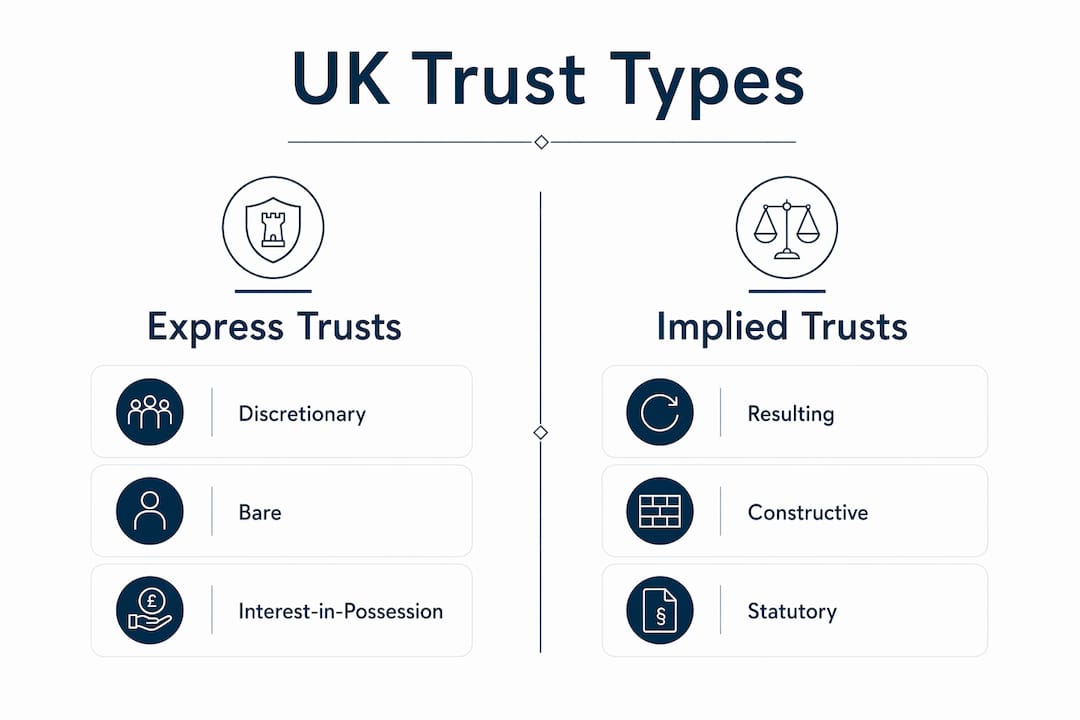
It is also worth distinguishing express trusts from resulting and constructive trusts. Express trusts are deliberately created by the settlor. Resulting trusts arise by operation of law, typically where a transfer fails or where the beneficial interest is not fully disposed of. Constructive trusts are imposed by courts to prevent unconscionable conduct, such as where someone acquires property through fraud or breach of fiduciary duty. Neither resulting nor constructive trusts require the formalities of an express trust.
How NXD Family Office supports clients with trust planning
For high-net-worth individuals and families, getting a trust structure right from the outset is the kind of decision that shapes wealth for generations. The complexity of UK trust law, the tax obligations, and the fiduciary responsibilities involved mean that the quality of advice you receive matters enormously.
NXD Family Office works with a curated network of specialist advisers across legal, tax, and financial disciplines, all operating without referral fees or commissions. That means the guidance you receive is genuinely in your interest, not shaped by what earns the adviser a fee. Whether you are considering a discretionary trust for family succession, reviewing an existing arrangement, or navigating the tax implications of a trust holding property or investments, the team brings the right expertise to your specific situation. Explore bespoke wealth management services or speak directly with the team about your trust planning needs.
Key takeaways
A trust structure separates legal ownership from beneficial interest, placing assets under trustee control for beneficiaries according to terms set by the settlor in a trust deed.
| Point | Details |
|---|---|
| Core definition | A trust is a legal relationship, not a legal person, involving a settlor, trustees, and beneficiaries. |
| Seven UK trust types | Bare, interest in possession, discretionary, accumulation, mixed, settlor-interested, and non-resident trusts each carry distinct tax treatment. |
| Trustee duties | Trustees hold legal title and bear fiduciary responsibilities including tax compliance and day-to-day asset management. |
| Tax obligations | Periodic inheritance tax charges apply at each 10-year anniversary; exit charges are capped at 6% of the value of assets leaving the trust. |
| NXD Family Office | Provides commission-free specialist advice on trust planning, tax obligations, and wealth structuring for high-net-worth clients. |
FAQ
What is the basic structure of a trust?
A trust involves three parties: a settlor who provides the assets, trustees who hold legal ownership and manage the assets, and beneficiaries who hold equitable interest and receive the benefit. The terms are set out in a trust deed.
What are the three requirements for a trust to be valid?
Under UK law, a trust must satisfy three certainties: certainty of intention, certainty of subject matter, and certainty of objects. Without all three, the trust is void.
Who legally owns the assets held in a trust?
The trustees are the legal owners of trust assets. Beneficiaries hold equitable interest, meaning they benefit from the assets but do not hold legal title.
What are the disadvantages of using a trust?
Trusts carry setup costs, ongoing administrative burdens, complex tax reporting obligations, and potential periodic inheritance tax charges every 10 years, with exit charges capped at 6% of the value of assets transferred out.