

The most reliable way for affluent UK families to pass wealth between generations smoothly is a staged, governance-led plan that combines lifetime gifting, tailored trust structures, and coordinated adviser support. One-off tax fixes rarely hold. What works is a sustained programme, reviewed annually, that moves assets deliberately and prepares the people who will receive them.
Three things you can do right now:
- Call a chartered tax adviser or solicitor to review your current will, any existing trusts, and whether your Lasting Power of Attorney is in place and up to date.
- Check your annual gifting allowances. HMRC permits a £3,000 annual exemption per donor, plus small gifts of up to £250 per recipient. If you have not used last year’s allowance, you can carry it forward once.
- Open a conversation with your heirs. Not about numbers, but about purpose. What is the wealth for? What responsibilities come with it? That conversation, started early, prevents more disputes than any legal document.
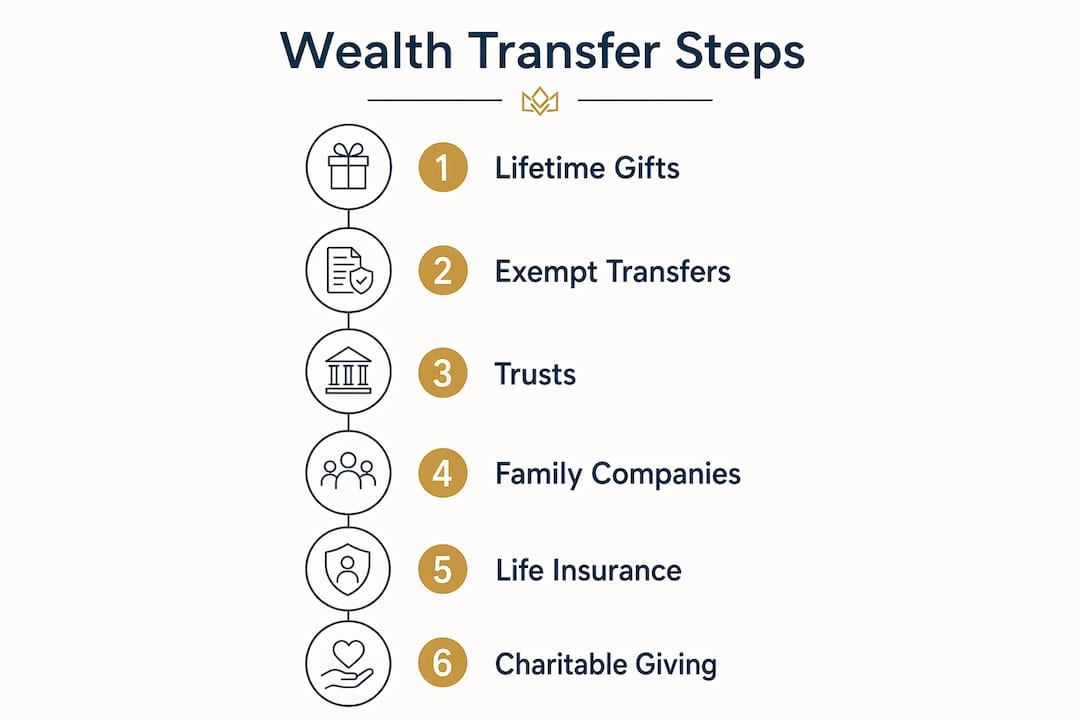
The most effective levers for intergenerational wealth transfer in the UK are:
- Lifetime outright gifts and potentially exempt transfers (PETs)
- Discretionary and bare trusts
- Life insurance written in trust for Inheritance Tax (IHT) liquidity
- Family investment companies (FICs)
- Updated wills and Lasting Powers of Attorney
- Business succession planning and relief structures
- Charitable giving and philanthropic legacies
- Pension planning, particularly given the post-2027 IHT changes
Pro Tip: Treat estate planning as an annual financial review item, not a one-off event. Tax rules change, family circumstances shift, and allowances lapse if unused.
Table of Contents
- What the ‘Great Wealth Transfer’ means for UK families
- Practical strategies that actually work for passing wealth in the UK
- UK tax rules that materially affect your transfer plan
- Family governance and preparing your beneficiaries
- When to act: lifetime gifts versus leaving assets in the estate
- Who to involve and the questions to ask
- How NXD Family Office coordinates a managed approach for HNW families
- Key takeaways
- Why governance beats one-off tax fixes every time
- A professionally managed route to passing wealth smoothly
- Useful sources and further reading
- FAQ
What the ‘Great Wealth Transfer’ means for UK families
The Great Wealth Transfer refers to the largest intergenerational movement of private assets in recorded history, as the post-war generation passes accumulated property, investments, and business interests to their children and grandchildren. For UK families with significant estates, this is not an abstract trend. It is a live planning challenge with a ticking clock.
Frozen nil-rate bands are a central pressure point. The standard nil-rate band has been fixed at £325,000 since 2009, and the residence nil-rate band (RNRB) has been fixed at £175,000 since 2020. As asset values rise with inflation, more estates are pulled into IHT exposure without any change in the law. This is fiscal drag in practice, and it is quietly eroding the value of estates that have never been formally planned.
Statistic: Late estate planning costs UK families billions in avoidable IHT. Families who start planning earlier can pass on materially more value than those who wait, because time is a more powerful lever than complex tax engineering.
The policy environment is also shifting. Business and agricultural reliefs are being reformed from 6 April 2026, pension assets are due to become IHT-exposed from 2027, and HMRC’s scrutiny of trust arrangements has intensified. Waiting for a “better moment” to plan is a decision with a measurable cost.
Pro Tip: Set a diary reminder each April to review your estate position against the current nil-rate bands, any gifts made in the previous seven years, and whether your trust or FIC structure still achieves its original purpose.
Practical strategies that actually work for passing wealth in the UK
No single mechanism suits every family. The right combination depends on asset type, family structure, tax position, and how much control the transferor needs to retain. The strategies below are presented in order of complexity, from the simplest to the most structured.
1. Lifetime outright gifts
Straightforward cash or asset gifts are the starting point for most families. The annual £3,000 exemption is available to every donor each tax year, with the prior year’s unused allowance carried forward once. Small gifts of up to £250 per recipient are also exempt, as are specific marriage gifts depending on the donor’s relationship to the couple.

Larger gifts become potentially exempt transfers (PETs). They leave the estate immediately for IHT purposes if the donor survives seven years. For a property-rich couple in their early sixties with adult children, a sustained gifting programme of cash or investment assets, coordinated across both spouses, can move significant value out of the estate over a decade without complex structures.
Pro Tip: Keep a written record of every gift, including date, amount, recipient, and the exemption relied upon. HMRC can request this evidence during a probate investigation, and missing records can turn an exempt gift into a taxable one.
2. Potentially exempt transfers and the seven-year rule
A PET is any gift to an individual that exceeds the annual exemption. Gifts made less than seven years before death may be brought back into the estate for IHT purposes, though taper relief reduces the effective tax rate on gifts made between three and seven years before death. The full 40% rate applies only to gifts made within three years of death.
The practical implication: start gifting as early as possible, and keep a rolling record of the seven-year window. A gift made at 62 is fully clear by 69. A gift made at 75 carries more risk.
Pro Tip: If health is a concern, consider insuring the potential IHT liability on recent PETs with a decreasing term policy written in trust. This covers the tapering liability without adding to the estate.
3. Trusts
Trusts allow assets to be transferred out of an estate while retaining a degree of control over how and when beneficiaries receive them. Discretionary trusts are the most flexible: trustees can decide distributions among a class of beneficiaries, which is useful when children are young or when a beneficiary’s circumstances are uncertain.
The tax cost of trusts is real and must be calculated before proceeding. Transfers into discretionary trusts can trigger an immediate entry charge of up to 20% on amounts above the nil-rate band, and ten-year periodic charges of up to 6% apply to the trust’s value. Exit charges apply when assets leave the trust. For a business owner considering transferring trading company shares into trust, the interaction with business relief is critical: qualifying shares may attract 100% relief on entry, but that relief is subject to the new £2.5m cap from April 2026.
Pro Tip: Nil-rate band discretionary trusts, where assets up to the nil-rate band pass into trust on first death, can protect assets for children from a previous relationship while still providing for a surviving spouse. They are particularly useful in blended family situations.
4. Family investment companies (FICs)
A family investment company is a private limited company used to hold investments, with different share classes allocated to family members. Parents typically retain voting or preference shares, giving them control and an income stream, while growth shares are issued to children or held in trust for them. The value of the growth shares increases over time, effectively transferring wealth without a gift being made in the conventional sense.
FICs do not attract ten-year trust charges, which makes them administratively simpler than discretionary trusts for long-term holding. The trade-off is that investment-holding FICs do not qualify for business relief, so the shares held within the FIC remain IHT-exposed unless transferred out or the company is wound up. FICs work best for families with substantial investment portfolios who want to retain control while gradually shifting economic value to the next generation.
Pro Tip: A FIC requires proper corporate governance: board minutes, annual accounts, and clear documentation of share class rights. Poorly documented FICs attract HMRC scrutiny and can fail to achieve their intended purpose.
5. Life insurance written in trust for IHT liquidity
A whole-of-life policy can be used to fund an IHT liability on death, giving beneficiaries the cash to pay the tax bill without forcing a sale of the family home or business. The critical point: a policy owned personally counts as part of the estate and is itself subject to IHT. Written in trust, the payout sits outside the estate entirely and reaches beneficiaries directly.
For a couple with a combined estate of £3m and a projected IHT liability of several hundred thousand pounds, a joint life second death policy written in trust is often the most cost-effective way to protect the estate’s value for heirs.
Pro Tip: Review the sum assured on any existing life policy annually. As the estate grows, the IHT liability grows with it. A policy that was adequate five years ago may now be materially underinsured. NXD Family Office’s insurance advisory service can review this as part of a wider estate plan.
6. Charitable giving and will-based philanthropy
Gifts to registered charities are exempt from IHT. Leaving at least 10% of the net estate to charity also reduces the IHT rate on the remainder from 40% to 36%. For families with philanthropic intentions, a charitable remainder trust or a donor-advised fund can combine tax efficiency with a lasting legacy.
Charitable bequests in a will are straightforward to implement and can be updated without restructuring the wider estate plan. For families who want to involve the next generation in giving decisions, a family charitable foundation adds a governance layer that builds shared values alongside the financial transfer.
7. Business succession and relief caps
Business relief (BR) has historically allowed qualifying trading company shares to pass free of IHT. From 6 April 2026, the combined 100% relief cap is £2.5m per person, with 50% relief applying above that threshold. For business owners with estates significantly above £2.5m in qualifying assets, the reform changes the optimal transfer route.
Staged transfers using the seven-year cadence, combined with periodic resets of the nil-rate band, are the practical response for larger business estates. A business owner who transfers shares to children or into trust now, and survives seven years, removes those shares from the estate entirely, regardless of the April 2026 cap. Timing matters acutely here.
Pro Tip: If you own a trading business and have not reviewed your succession plan since 2024, do so before April 2026. The window to transfer qualifying assets under the old rules is closing.
8. Pension planning and the 2027 IHT change
Pensions have long been outside the IHT net, making them a powerful vehicle for passing wealth to the next generation. That changes from 2027, when pension assets are due to be included in IHT calculations. The practical response is withdrawal sequencing: use general investment accounts, ISAs, and other taxable assets to fund lifetime gifts first, preserving pension assets for as long as possible while the rules remain favourable.
For families with large defined contribution pension pots, the 2027 change is a material planning event. Reviewing the nomination of beneficiaries and considering whether to draw down and gift pension assets before 2027 are both worth modelling with a chartered financial planner.
| Transfer method | Key advantage | Main risk or cost | Best suited to |
|---|---|---|---|
| Outright lifetime gift | Simple, no ongoing charges | Donor must survive 7 years (PET) | Cash-rich families, early starters |
| Discretionary trust | Control, flexibility for beneficiaries | Entry charge, 10-year periodic charge | Families with minor children or uncertain beneficiaries |
| Family investment company | Control retention, no trust charges | No business relief on investments | Large investment portfolios |
| Life insurance in trust | Covers IHT liability without asset sale | Ongoing premium cost | Illiquid estates (property, business) |
| Charitable bequest | IHT exempt; reduces rate to 36% | Reduces estate for heirs | Philanthropically minded families |
| Business succession (BR) | 100% relief up to £2.5m from April 2026 | Cap applies above £2.5m | Trading business owners |
UK tax rules that materially affect your transfer plan
IHT basics and the nil-rate bands
The standard nil-rate band is £325,000, and the residence nil-rate band (RNRB) adds up to £175,000 when a main residence passes to direct descendants. Together, a married couple can shelter up to £1m from IHT by combining both allowances on second death. The RNRB tapers at £1 for every £2 of estate value above £2m, disappearing entirely for estates above £2.35m per person. For HNW families, the RNRB taper is a planning target: reducing the estate below £2m per person, through lifetime gifts or trust transfers, restores the full RNRB.
The seven-year rule and taper relief
| Years between gift and death | IHT taper relief |
|---|---|
| Less than 3 years | 0% (full rate applies) |
| 3–4 years | 20% reduction |
| 4–5 years | 40% reduction |
| 7 years or more | Fully exempt |
Taper relief reduces the tax on the gift, not the value of the gift. Gifts also use the nil-rate band first, so a large PET made close to death can exhaust the nil-rate band and leave the rest of the estate fully exposed.
Trust charges: entry, periodic and exit
Transfers into discretionary trusts can trigger an immediate entry charge of up to 20% on the amount above the available nil-rate band. Ten-year periodic charges of up to 6% then apply to the trust’s value, and exit charges apply when assets leave the trust. These costs must be weighed against the benefit of removing assets from the individual’s estate.
This is not a reason to avoid trusts. It is a reason to model the numbers before proceeding. For a trust holding £1m in qualifying business shares, the entry charge may be nil if business relief applies. For a trust holding £1m in cash or investments, the entry charge is material.
Business and agricultural relief reform from April 2026
The April 2026 reform introduces a £2.5m combined cap on 100% business and agricultural relief, with 50% relief above the cap. Some AIM and unlisted shares also fall to 50% relief. Business owners with estates above £2.5m in qualifying assets should model the post-reform IHT position now and consider whether staged transfers before April 2026 are appropriate.
CGT on lifetime transfers
Lifetime gifts of appreciated assets trigger a capital gains tax (CGT) disposal at market value. For assets with large embedded gains, the CGT cost of gifting can outweigh the IHT saving. The practical response is to gift assets with low or no embedded gain first, and to use the annual CGT exemption where available. Transfers between spouses are CGT-free, which creates an opportunity to rebalance ownership before gifting to children.
Pro Tip: Hold-over relief is available on gifts of business assets and on transfers into trust, deferring the CGT charge until the recipient disposes of the asset. This is a significant planning tool for business owners and should be considered alongside IHT planning.
Family governance and preparing your beneficiaries
Tax planning without beneficiary preparation is incomplete. Advisers consistently find that the most successful intergenerational transfers are gradual, governance-led, and focused on beneficiary readiness. Giving away too much too soon, without preparing the recipients, is one of the most common failure modes in family wealth transfer.
A practical governance framework covers:
- Stated purpose for the wealth. What is it for? Education, entrepreneurship, security, philanthropy? A written family mission statement, however brief, gives trustees and beneficiaries a shared reference point.
- Family council or assembly. A regular meeting of family members (not just the wealth holders) to discuss values, plans, and expectations. This does not need to be formal. An annual dinner with a structured agenda is enough to start.
- Documented distribution rules. For trusts and FICs, written guidance to trustees or directors on how distributions should be considered, even if the final decision remains discretionary.
- Escalation and dispute mechanisms. A named mediator or process for resolving disagreements before they become legal disputes. Family disputes over inheritance are expensive and damaging; a pre-agreed process prevents most of them.
- Succession of trustees and directors. Who replaces the founding trustee or director? This is frequently overlooked and can leave a trust or FIC without effective governance on the death of the key person.
Preparing heirs for responsibility
A family wealth education plan stages financial responsibility in line with age and demonstrated readiness. For younger beneficiaries, this might mean involvement in charitable giving decisions before they receive any capital. For adult children, it might mean a seat on the family council and access to investment reports before they become trustees.
Practical steps to open the conversation:
- Share the broad shape of the estate (not necessarily the exact numbers) with adult children.
- Ask each heir what they would do with a significant sum. The answers reveal readiness and values.
- Introduce the concept of stewardship: the wealth belongs to the family across generations, not just to the current holder.
- Involve heirs in a charitable giving decision, even a small one, to build shared decision-making habits.
- Agree a timeline for increasing responsibility, and document it.
Pro Tip: Teaching children about family wealth is not a single conversation. It is a programme that runs alongside the financial planning, not after it.
When to act: lifetime gifts versus leaving assets in the estate
The decision to transfer now or later turns on five factors: survival horizon, income needs, health and care cost risk, control preferences, and family readiness. No formula resolves all five simultaneously, but a structured checklist makes the trade-offs explicit.
Decision checklist
- Survival horizon. Are you likely to survive seven years from the date of a proposed gift? If yes, a PET is a strong option. If uncertain, insuring the tapering liability is worth modelling.
- Income needs. Will you need the income from the asset after transfer? If yes, a gift with reservation of benefit rules may apply, keeping the asset in your estate despite the transfer.
- Care cost risk. Could you need significant care funding in the next ten years? Transferring assets too aggressively can leave you without liquidity at a critical moment.
- Control preferences. Do you need to retain decision-making authority over the asset? A FIC or a trust with a retained trustee role may suit better than an outright gift.
- Family readiness. Are the intended recipients in a stable position to receive and manage the assets? A divorcing child or one with creditor exposure may need a trust rather than an outright transfer.
Lifetime gifts versus posthumous transfer
- Lifetime gifts: Remove assets from the estate immediately (subject to the seven-year rule); allow the donor to see the benefit; can be structured to avoid CGT with hold-over relief; require the donor to give up economic benefit to be effective.
- Transfers into trust during lifetime: Retain a degree of control; useful for uncertain beneficiaries; carry entry and periodic charges; can be combined with business relief for trading assets.
- Posthumous transfers via will: Simple and certain; no seven-year survival risk; assets remain in the estate and attract IHT; allow the testator to retain full use until death.
Early planning materially increases the value passed on. The fiscal drag from frozen nil-rate bands means that every year of delay increases the proportion of the estate exposed to IHT.
Who to involve and the questions to ask
Estate planning for HNW families is not a single-adviser task. Effective plans typically combine lifetime gifting, insurance wrappers, and corporate restructuring, and they require a coordinated team. The specialists you need, and what each should deliver, are:
- Will and trusts solicitor. Drafts and updates wills, trust deeds, and LPAs. Should have experience with estates above £2m and blended family structures.
- Chartered tax adviser (CTA). Models IHT, CGT, and income tax interactions; advises on trust charges, business relief, and the April 2026 reforms. Should hold the CTA qualification from the Chartered Institute of Taxation.
- Chartered financial planner. Coordinates investment strategy with the estate plan; advises on pension sequencing, ISA use, and insurance wrappers. Should hold Chartered status from the Chartered Insurance Institute or the Personal Finance Society.
- Trustee or trust company. Administers ongoing trusts, maintains records, calculates periodic charges, and files trust tax returns. Professional trustees reduce the risk of administrative failure.
- Family office or private bank. Coordinates the above specialists, manages the overall plan, and provides governance support. A bespoke wealth management service removes the burden of managing multiple advisers independently.
Questions that reveal competence
- How many estates above £2m have you advised on in the last three years?
- Have you advised on cross-border estates or non-UK domicile issues?
- How do you handle the interaction between business relief and trust entry charges?
- What is your process for reviewing a plan annually as tax rules change?
- How do you charge, and do you receive any referral fees or commissions from product providers?
Any adviser who cannot answer question five clearly and immediately is not the right choice. Commission-based advice in estate planning creates conflicts of interest that are difficult to detect and expensive to unwind.
Typical fee ranges for common tasks: will drafting for a complex estate, £1,500–£5,000; trust setup, £2,000–£8,000; ongoing professional trustee fees, 0.5%–1.5% of trust assets per annum; family office coordination, typically a fixed annual retainer or percentage of assets under oversight. Red flags include guaranteed tax savings, vague or bundled fee disclosures, and advisers who recommend complex structures without first modelling the simpler alternatives.
How NXD Family Office coordinates a managed approach for HNW families
For families who want a professionally managed route rather than assembling their own adviser team, NXD Family Office provides a coordinated, bespoke service that covers every stage of the transfer process.
The service follows a clear sequence:
- Diagnosis. A structured review of the current estate position, existing wills, trusts, LPAs, and business interests. NXD maps the IHT exposure and identifies the most material planning opportunities.
- Design. A bespoke plan combining the most appropriate mechanisms for the family’s specific position: gifting programme, trust structure, FIC, insurance, and governance framework. All recommendations are free from referral fees or commissions.
- Implementation. Coordination of solicitors, tax advisers, and financial planners to execute the plan. NXD manages the process so clients are not left chasing multiple professionals independently.
- Administration and trustee support. Ongoing trust administration, record keeping, and periodic charge calculations. NXD’s network includes professional trustee services that maintain compliance without burdening family members.
- Ongoing governance. Annual reviews, family council facilitation, and beneficiary education support. The plan evolves as the family’s circumstances and the tax rules change.
NXD Family Office’s approach is built on unbiased advice. No referral fees. No commissions. Clients receive honest guidance that reflects their interests, not a product provider’s margin.
Pro Tip: Ask any adviser, including NXD Family Office, to confirm in writing that they do not receive referral fees or commissions from any product or service they recommend. That single question separates genuine fiduciaries from those with a hand in the till.
Key takeaways
Staged, governance-led planning that combines lifetime gifting, appropriate trust structures, and coordinated specialist advice is the most reliable way to pass wealth between generations smoothly in the UK.
| Point | Details |
|---|---|
| Start early, review annually | Frozen nil-rate bands mean fiscal drag increases IHT exposure every year without action. |
| Use the full exemption stack | The £3,000 annual exemption, small gifts, and marriage exemptions are available every year and lapse if unused. |
| Model trust costs before committing | Entry charges up to 20% and ten-year periodic charges up to 6% must be weighed against the benefit of removing assets from the estate. |
| Prepare beneficiaries alongside the plan | Governance, education, and staged responsibility reduce the risk of wealth being mismanaged or disputed after transfer. |
| NXD Family Office | Provides a coordinated, commission-free managed service covering diagnosis, design, implementation, and ongoing governance for HNW UK families. |
Why governance beats one-off tax fixes every time
The conventional wisdom in estate planning is that the goal is to minimise IHT. That framing is too narrow, and it leads families to focus on the wrong problem.
Tax planning matters, but it is a means, not an end. The families who pass wealth most successfully are those who treat the transfer as a governance challenge, not a tax challenge. They build structures that give the next generation responsibility gradually. They have honest conversations about purpose and stewardship before the assets change hands. They review the plan every year, not once a decade.
The families who struggle are those who implement a clever trust structure, never speak to their children about it, and leave a legal document to do the work that a relationship should have done. No deed of trust has ever prepared a 28-year-old for the responsibility of managing a significant inheritance. That preparation requires time, conversation, and a deliberate programme of increasing involvement.
NXD Family Office’s managed approach is built on this understanding. The technical planning is necessary. The governance and beneficiary preparation are what make it work.
A professionally managed route to passing wealth smoothly
Assembling a solicitor, a tax adviser, a financial planner, and a trustee independently takes time, requires coordination, and creates gaps where things fall through. For HNW families who want a single point of contact and a plan that holds together across all its moving parts, NXD Family Office offers exactly that.
NXD Family Office’s wealth management service covers the full spectrum of intergenerational planning: from the initial estate diagnosis and bespoke plan design through to trust administration, family governance workshops, and annual reviews. Every recommendation is commission-free. Every adviser in the network is selected for competence and independence, not for the margin they generate.
For families who value discretion, NXD’s approach to managing family wealth privately means sensitive planning conversations and documentation are handled with the confidentiality that HNW clients expect. The service extends beyond finance: lifestyle assets, insurance, and concierge support are all coordinated through a single relationship.
To discuss your family’s position and what a bespoke transfer plan would look like, contact NXD Family Office directly for a confidential consultation.
Useful sources and further reading
The sources below are authoritative references for the rules and principles covered in this guide. GOV.UK pages state the statutory position; specialist articles provide practitioner commentary on planning implications.
| Source | What it covers |
|---|---|
| GOV.UK: Inheritance Tax gifts | Statutory rules on PETs, the seven-year rule, and taper relief |
| GOV.UK: Trusts and Inheritance Tax | Entry charges, periodic charges, and exit charges for relevant property trusts |
| GOV.UK: Work out IHT due on gifts | Annual exemption, small gifts, and marriage gift allowances |
| GOV.UK: Business relief for IHT | Qualifying conditions for business relief and how relief is calculated |
| GOV.UK: Nil-rate band discretionary trusts | Practical guide to nil-rate band trusts in estate planning |
Further reading:
- Thomson Snell & Passmore: The Great Wealth Transfer — practitioner analysis of the April 2026 business and agricultural relief reforms and planning responses.
- FindaWealthManager: Intergenerational wealth transfer — adviser guidance on governance-led transfers and beneficiary readiness.
- NXD Family Office: Estate planning for new wealth — practical first steps for families beginning the planning process.
- NXD Family Office: Private wealth structuring — background on trusts, FICs, and structuring options for HNW families.
This article is general information, not professional legal, tax, or financial advice. Tax rules change and individual circumstances vary significantly. Confirm the current rules with HMRC guidance or a qualified professional before making any planning decisions.
FAQ
How do you pass wealth between generations smoothly in the UK?
The most reliable approach combines a sustained lifetime gifting programme, appropriate trust or FIC structures, updated wills and Lasting Powers of Attorney, and coordinated specialist advice reviewed annually. Starting early is the single most important factor, because time determines whether PETs become fully exempt and whether the nil-rate band can be used efficiently across multiple transfers.
Which generation will inherit the most wealth in the UK?
Millennials are expected to be the primary beneficiaries of the Great Wealth Transfer, as the post-war and Baby Boomer generations pass on accumulated property, pension assets, and investments over the coming decades.
What is the three-generation rule for wealth?
The three-generation rule is the observation that family wealth is typically created by one generation, maintained by the second, and dissipated by the third. It is not a legal or statutory concept, but it is a well-documented pattern that governance-led planning, beneficiary education, and staged transfers are specifically designed to counter.
How is generational wealth passed down in the UK?
Generational wealth passes through wills, lifetime gifts, trusts, family investment companies, pension nominations, and business succession arrangements. Each mechanism has different IHT, CGT, and income tax implications. The annual £3,000 exemption and the seven-year rule for PETs are the two most commonly used statutory tools for reducing IHT on transfers.
What role does a Lasting Power of Attorney play in estate planning?
A Lasting Power of Attorney (LPA) appoints a trusted person to manage financial affairs or health decisions if the donor loses capacity. Without an LPA in place, the Court of Protection must be involved, which is slow, expensive, and removes family control. Every estate plan should include both a property and financial affairs LPA and a health and welfare LPA, reviewed whenever circumstances change.