

For most UK residents, private medical insurance is worth serious consideration if you want faster diagnostics, a choice of consultant, and a predictable path through elective treatment without depending on NHS waiting lists. The single best next step: check whether your employer offers group cover first, then get a tailored quote from a broker or an independent adviser who can match policy structure to your actual health needs.
Here is where to start:
- Individual policy via a broker. A whole-of-market broker compares Bupa, AXA Health, Aviva, Vitality, and WPA in one sitting and can negotiate on hospital lists and excess levels.
- Employer group scheme. Group underwriting is usually more favourable and premiums are often subsidised. Check your benefits package before buying individually.
- Concierge advisory for high-net-worth clients. If you want policy negotiation, underwriting engagement, and ongoing claims support handled for you, a bespoke advisory route through a firm like NXD Family Office removes the friction entirely.
- Expats returning to or living in the UK. Confirm UK residency status with the insurer before applying; some policies require you to be registered with a UK GP.
The single actionable step: speak to an independent adviser before committing to any policy. Underwriting terms, hospital lists, and fee caps vary enough between providers that the cheapest headline premium is rarely the best value.
Key takeaways
Private medical insurance in the UK is most valuable when it is matched precisely to your health needs, underwriting history, and geography, with full medical underwriting offering the clearest long-term certainty for anyone with a meaningful medical history.
| Point | Details |
|---|---|
| Who benefits most from PMI | People who need faster diagnostics, elective surgery, or choice of consultant benefit most from private health coverage. |
| Most important underwriting decision | Choose full medical underwriting (FMU) if you have any significant medical history; moratorium can produce claim refusals years later. |
| Main exclusions to check | Chronic conditions, routine maternity, GP and A&E, and certain cancer drug sequences are excluded by most standard UK policies. |
| Cost variables that matter | Age, postcode, cover level, excess, and hospital list choice drive premiums; a higher voluntary excess reduces cost meaningfully. |
| NXD Family Office advisory route | NXD Family Office provides independent, fee-shared PMI advisory covering policy selection, underwriting, and claims support for high-net-worth clients. |
Table of Contents
- What is private medical insurance in the UK and how does it work alongside the NHS?
- What does private health coverage typically include?
- What does PMI typically exclude, and how are pre-existing conditions handled?
- What types of PMI plan are available and what choices will you make at purchase?
- How much does private medical insurance cost in the UK?
- How do leading UK private medical insurers compare?
- How do you choose the right PMI policy?
- What happens from application to claim settlement?
- What are the alternatives to PMI and when do they make sense?
- What industry trends are shaping PMI referrals and pricing?
- Why this guidance matters for UK residents and expatriates
- NXD Family Office: bespoke PMI advisory for high-net-worth clients
- Sources
- FAQ
What is private medical insurance in the UK and how does it work alongside the NHS?
Private medical insurance (PMI) is a general insurance product that pays for eligible private treatment of acute conditions. It does not replace the NHS. You remain entitled to NHS care for everything from A&E to chronic disease management, and most policyholders use both systems depending on the situation.
The WHO/European Observatory’s UK health system review describes private insurance as playing a complementary role within the UK’s predominantly public system, covering a minority of the population but concentrated among those who prioritise speed and choice. That framing is accurate: PMI is not a safety net, it is a preference product.
A typical claim follows a clear sequence. You see your NHS GP, who refers you to a private consultant. You contact your insurer for pre-authorisation, confirming the consultant, hospital, and procedure are within your policy network and fee limits. Treatment proceeds, and the insurer settles the bill directly with the hospital in most cases. Some modern policies, particularly those from Bupa and Vitality, now offer digital GP access or direct-access pathways for selected specialities such as physiotherapy or dermatology, which can cut days off the referral timeline. Always check the policy wording and call the insurer before booking, because direct-access availability varies significantly between plans and even between tiers within the same provider.
The BMA’s guidance on buying PMI is clear that most private treatment still starts with a GP referral, and that policyholders should confirm cover, network membership, and fee limits before booking any private appointment. Fee caps matter: many policies set a maximum consultant fee per session, and a premium consultant may charge above that cap, leaving you with an out-of-pocket shortfall even when the procedure itself is covered.
What does private health coverage typically include?
Standard PMI is built around inpatient and day-patient care. The core inclusions across most UK plans are:
- Inpatient and day-patient surgery, including consultant fees, theatre costs, anaesthetist, nursing care, and hospital accommodation.
- Diagnostic tests ordered by a consultant, such as MRI, CT, blood panels, and pathology, when linked to an acute condition under investigation.
- Cancer care, usually including surgery, chemotherapy, and radiotherapy, though the scope of cancer drug cover varies significantly between plans.
Outpatient cover is where policies diverge most sharply. Some plans include outpatient specialist consultations and diagnostics as standard; others offer them as add-on modules with annual cash limits for outpatient treatment. Physiotherapy, talking therapies, and mental health pathways are often capped at annual limits on the number of sessions.
Optional add-ons worth considering include:
- Extended outpatient therapy packages, covering physiotherapy, osteopathy, and counselling beyond the standard session limits.
- Mental health pathways, which some providers now offer as a standalone module with dedicated inpatient and outpatient mental health beds.
- Cancer drug top-ups, covering drugs not included in the standard cancer benefit, particularly relevant for newer targeted therapies.
- Virtual GP access, now included as standard by several providers and useful for fast triage and referral letters.
- Limited dental and optical cash benefits, which function more like a cash plan top-up than comprehensive dental cover.
It is worth noting that some private care is delivered inside NHS settings. NHS England describes private patient units within NHS trusts where consultants treat private patients, which can affect hospital list expectations and fee structures. Check whether your policy’s hospital list includes NHS private patient units if you want access to NHS-affiliated consultants.
What does PMI typically exclude, and how are pre-existing conditions handled?
The ABI consumer guide on buying private medical insurance is the clearest single reference for understanding what PMI does not cover. Common exclusions across most UK policies include:
- Chronic and long-term conditions, such as diabetes, asthma, and hypertension, once diagnosed and ongoing. PMI covers acute episodes, not ongoing management.
- Routine GP consultations and A&E attendance. These remain NHS territory under virtually all standard plans.
- Routine maternity care. Most policies exclude normal pregnancy and delivery; some cover pregnancy complications as an add-on.
- Organ transplants and established dialysis, which fall outside the acute-condition boundary most policies draw.
- Cosmetic procedures without a clinical indication.
- Certain cancer drug sequences, particularly where a drug is not approved by NICE or falls outside the policy’s defined cancer benefit.
Pre-existing conditions are handled through one of two underwriting approaches, and the choice between them is one of the most consequential decisions you make at purchase.
Moratorium underwriting excludes any condition for which you have had symptoms, treatment, or medication in a defined period before the policy start (typically five years). You do not declare your medical history upfront; instead, exclusions are applied passively at claims time. It is simpler to apply for, but it creates uncertainty: a claim can be refused years later if medical records reveal prior symptoms the insurer considers relevant.

Full medical underwriting (FMU) requires you to declare your full medical history at application. The insurer then issues explicit written exclusions. You know from day one exactly what is and is not covered. FMU involves more paperwork upfront but removes the ambiguity that moratorium underwriting can leave.
For high-net-worth clients with complex medical histories, FMU is almost always the more prudent choice. The upfront friction is worth the certainty.
Pro Tip: Always call your insurer before booking a private appointment to confirm that the specific consultant, hospital, diagnostic code, and procedure are covered under your policy. Ask for written confirmation by email. This single step prevents the majority of disputed claims.
What types of PMI plan are available and what choices will you make at purchase?
PMI policies in the UK broadly fall into three shapes, each with a different cost and coverage profile.
| Plan type | What it covers | Typical use case |
|---|---|---|
| Hospital-only (inpatient/day-patient) | Surgery, consultant fees, theatre, accommodation | Buyers who want surgical cover and are happy to self-fund outpatient diagnostics |
| Comprehensive (inpatient + outpatient) | All of the above plus specialist consultations, diagnostics, physiotherapy | Those who want end-to-end private care from first consultation to discharge |
| Cash-limited / outpatient-limited | Inpatient cover plus a fixed annual cash allowance for outpatient treatment | Budget-conscious buyers who want a ceiling on outpatient spend |
Beyond plan shape, you will make four key choices at purchase:
Hospital list. Insurers offer tiered hospital networks: a national list gives access to most private hospitals across the UK; a regional or guided list restricts choice to lower-cost facilities in exchange for a reduced premium. London-based policyholders should check whether their preferred hospital is on the list before buying.
Voluntary excess. Choosing a higher excess (the amount you pay per claim or per year before the insurer pays) reduces your premium. Common excess levels run from £0 to £500 or more per claim. The right level depends on how frequently you expect to claim and your cash-flow comfort.
Outpatient limit. Decide whether you want outpatient cover included and, if so, whether a capped annual limit is acceptable or whether you need unlimited outpatient access.
Underwriting route. As described above, moratorium or FMU. This choice affects both your premium and your long-term certainty.
Key terms to know:
- Moratorium: passive exclusion of pre-existing conditions without upfront declaration.
- FMU (full medical underwriting): explicit written exclusions based on declared medical history.
- Excess: the portion of each claim you pay before the insurer contributes.
- Policy annual limit: the maximum the insurer will pay in any one policy year.
- Inpatient/day-patient: treatment requiring a hospital bed overnight (inpatient) or for part of a day without an overnight stay (day-patient).
How much does private medical insurance cost in the UK?
Premiums for UK health insurance plans are individual: no two quotes are identical, because the price is calculated from your specific age, postcode, chosen cover level, excess, and underwriting route. As the WeCovr UK PMI Buyers Guide notes, using a broker for complex or high-value needs is advisable precisely because the variables interact in ways that make direct-to-insurer comparison unreliable.
The primary cost drivers, in rough order of impact:
- Age. Premiums rise steeply with age. Premiums generally increase with age, so older individuals pay significantly more for equivalent cover.
- Postcode and region. London and the South East attract the highest premiums, reflecting higher private hospital costs and consultant fees in those areas.
- Level of cover. Adding outpatient modules, mental health pathways, and cancer drug top-ups can meaningfully increase a base premium.
- Voluntary excess. Choosing a higher excess can reduce your premium compared to a lower or zero excess on the same policy.
- Underwriting route. FMU can result in a lower premium if declared conditions are excluded, or a higher one if the insurer prices in risk.
- Hospital list. A guided or regional list typically costs less than a full national list.
Context on NHS waiting times: ONS data on patient experiences of NHS services in England documents the pressures on NHS access and waiting times that drive demand for faster private diagnostics and treatment. For buyers weighing whether PMI is worth the premium, this official data provides the most defensible rationale: the value of PMI is often the speed of diagnosis, not a marginal difference in clinical outcome.
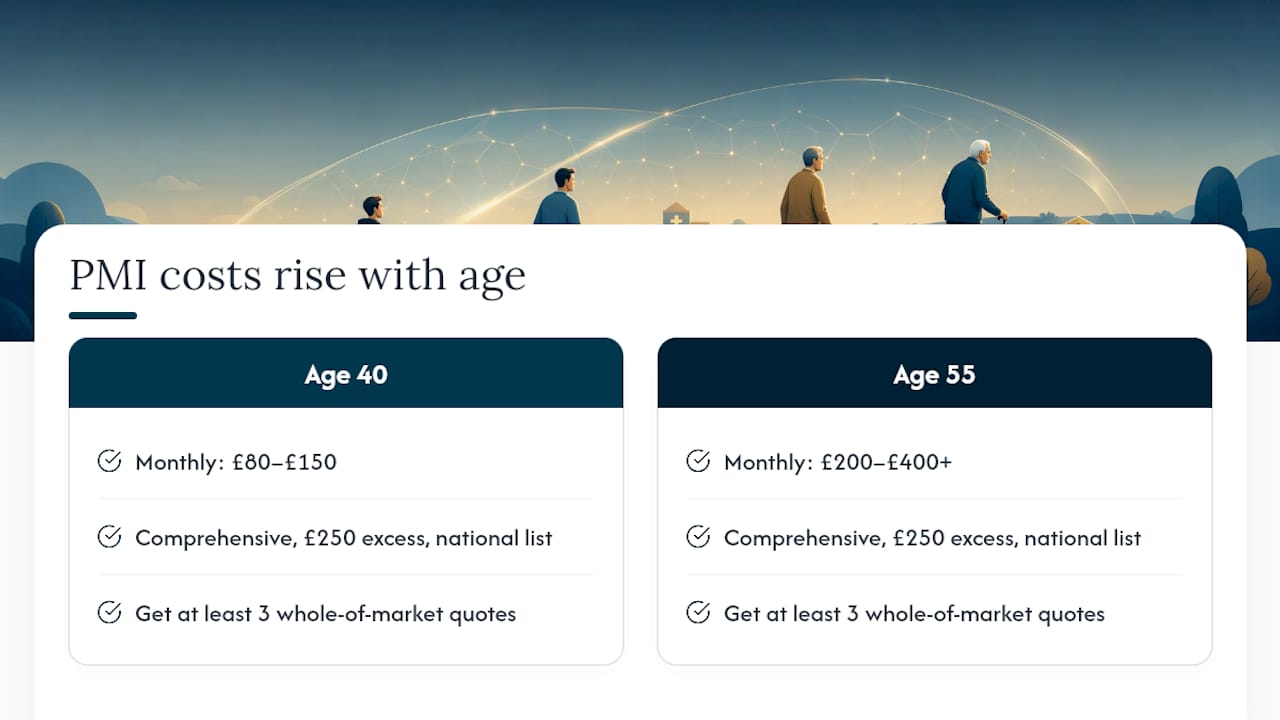
Illustrative premium bands are often provided, but actual quotes vary widely by individual factors.
These figures are illustrative. Get at least three quotes from a whole-of-market broker before making a decision.
How do leading UK private medical insurers compare?
The UK PMI market is concentrated among a small number of large providers. Financial press analysis has documented the consolidation and product differentiation that characterises this market, which means provider choice matters as much as policy structure.
Bupa is the largest UK PMI provider by market share and suits buyers who want a broad hospital network, established digital GP access, and a well-known brand with a long claims history. Its direct-access physiotherapy pathway is one of the more developed in the market.
AXA Health (formerly AXA PPP) suits buyers who want strong outpatient cover and a wide hospital network, particularly in the South East. Its cancer care benefit is well regarded, and it offers a range of excess options that make it competitive for budget-conscious buyers.
Aviva is a strong option for buyers who want PMI bundled with other financial products (life, income protection, buildings) under one provider relationship. Its digital tools and renewal pricing transparency are generally well rated.
Vitality suits health-conscious buyers who want premium reductions tied to activity and wellness behaviours. Its rewards programme links gym usage, fitness tracking, and healthy lifestyle choices to premium discounts and partner benefits. It is particularly popular with younger, active policyholders.
WPA (Western Provident Association) is a mutual insurer that suits buyers who want a more personal claims experience and are willing to trade some brand recognition for a provider with a strong reputation for customer service and flexible policy design. It is often recommended for self-employed professionals and small business owners.
| Criteria | What to look for |
|---|---|
| Best for overall cover | Broad hospital list, comprehensive outpatient, strong cancer benefit |
| Best for value | Higher voluntary excess, guided hospital list, limited outpatient |
| Best for rewards/wellness | Activity-linked premium discounts, digital health tools |
| Best for customer service | Mutual or specialist provider with strong FOS complaint data |
| Best for expats/complex needs | FMU underwriting, confirmed UK residency terms, continuity provisions |
Before buying from any provider, read the Product Information Document (PID). Check the hospital list for your area, the fee cap per consultant session, and the pre-authorisation process. These three details determine whether the policy will actually work for you when you need it.
How do you choose the right PMI policy?
The right policy is the one that matches your actual health needs, geography, and budget, not the one with the most impressive brochure. Work through these decision criteria before requesting quotes:
Core cover needs. Do you primarily want surgical cover, or do you also need outpatient diagnostics and specialist consultations? If you have a family history of a specific condition, check whether that condition’s diagnostic pathway is covered.
Outpatient requirement. If you are likely to need physiotherapy, talking therapies, or specialist consultations without a surgical endpoint, outpatient cover is not optional.
Hospital list geography. If you live outside a major city, check whether the hospitals on the policy’s list are within practical travel distance. A national list is not useful if the nearest listed hospital is 90 minutes away.
Underwriting certainty. If you have any significant medical history, FMU is worth the extra paperwork. Moratorium underwriting is simpler but can produce claim refusals years later.
Excess affordability. Choose an excess you can genuinely absorb. A £500 excess on a policy you claim against twice a year costs £1,000 in out-of-pocket payments.
Renewal pricing approach. Ask how premiums are calculated at renewal: community-rated (based on the whole pool), age-banded, or individually risk-rated. The answer affects long-term cost significantly.
Questions to ask a broker or insurer before buying
- What is the annual policy limit, and is it per condition or aggregate?
- Is the excess per claim or per policy year?
- Which hospitals are on the list for my postcode?
- What is the maximum consultant fee per session, and what happens if my consultant charges above that?
- Is direct access available for physiotherapy or mental health without a GP referral?
- How are pre-existing conditions treated at renewal if my health changes?
- What is the claims authorisation process, and how long does pre-authorisation typically take?
- Can you provide examples of recent claims that were declined and the reasons?
Red flags to watch for
- No Product Information Document provided before purchase.
- No FCA firm reference number on the insurer or broker’s documentation. The FCA regulates PMI as a general insurance product under ICOBS and the Consumer Duty, requiring transparent pre-sale information and fair value outcomes.
- Unusually low introductory premiums with no explanation of how renewal pricing is calculated.
- Poor Financial Ombudsman Service (FOS) complaint data or a high uphold rate against the insurer.
- Vague policy wording on what constitutes an “acute” condition versus a “chronic” one.
Pro Tip: Check the insurer’s FCA register entry and its FOS complaint data before buying. The FOS publishes half-yearly data on complaint volumes and uphold rates by firm. A high uphold rate against an insurer is a reliable signal of claims handling problems.
What happens from application to claim settlement?
The practical timeline from buying a policy to receiving treatment is longer than most buyers expect. Here is the typical sequence:
- Application and underwriting. You complete the application (moratorium: minimal medical questions; FMU: full medical history declaration). The insurer assesses risk and issues policy terms, typically within a few days to two weeks for FMU.
- Cooling-off period. You have a statutory 14-day cooling-off period after receiving your policy documents to cancel without penalty.
- Policy activation. Cover begins on the agreed start date. Moratorium exclusions apply from day one for any condition with prior symptoms in the exclusion window.
- GP referral. You see your NHS or private GP, who provides a referral letter to a named consultant or speciality.
- Pre-authorisation. You contact the insurer (by phone or online portal) before booking the private appointment. The insurer confirms whether the consultant, hospital, procedure, and diagnostic codes are covered and within fee limits. Get this confirmation in writing.
- Treatment. You attend the private appointment or hospital. The consultant and hospital bill the insurer directly in most cases.
- Claim settlement. The insurer settles the bill, minus any applicable excess. Settlement timelines vary: straightforward claims are often settled within two to four weeks; complex or disputed claims take longer.
Waiting periods under moratorium underwriting mean that a condition excluded at outset may become eligible for cover after a defined period (typically two continuous years) without symptoms or treatment. This is not guaranteed and depends on the specific policy wording.
Pro Tip: Keep a written record of every pre-authorisation confirmation: the date, the name of the person you spoke to, the reference number, and what was confirmed. If a claim is later disputed, this record is your primary evidence. If a dispute cannot be resolved with the insurer, escalate to the Financial Ombudsman Service free of charge.
What are the alternatives to PMI and when do they make sense?
PMI is not the only route to private healthcare. The alternatives suit different needs and budgets:
- Pay-as-you-go private treatment. For a single procedure or one-off consultation, self-funding can be cheaper than paying PMI premiums for years. Many private hospitals publish fixed-price packages for common procedures. The risk is unpredictability: if complications arise, costs escalate quickly without insurance.
- Health cash plans. Products from providers such as Simplyhealth or Westfield Health pay fixed cash amounts towards everyday health costs: dental, optical, physiotherapy, and GP appointments. They are not PMI and do not cover surgery or inpatient care, but they complement a hospital-only PMI policy well.
- Employer group PMI schemes. Group cover is underwritten on a pooled basis, which often means more favourable terms for individuals with pre-existing conditions. Employer-paid PMI is a taxable benefit in kind; employees pay income tax on the premium value. Check your P11D.
- NHS treatment. For non-urgent conditions, the NHS remains the practical choice for most people. Keeping your NHS GP registration active is important even if you hold PMI: most private referrals still start with an NHS GP letter, and NHS care remains your right for emergencies, chronic conditions, and anything outside your policy’s scope.
The most effective approach is usually to combine NHS registration with a well-structured PMI policy, using private care for diagnostics and elective treatment where speed and choice matter, and NHS care for everything else.
What industry trends are shaping PMI referrals and pricing?
GP referral remains the dominant pathway into private care, but digital GP services and direct-access options are growing. Several major providers now include virtual GP consultations as standard, which can generate a referral letter within hours rather than days. For specialities such as physiotherapy, dermatology, and mental health, direct-access pathways are available on some policies without requiring a GP letter at all. The practical effect is a faster entry point for policyholders who know what they need.
Industry context: The ONS bulletin on experiences of NHS services provides contemporary data on NHS waiting times and patient satisfaction that contextualises why demand for private diagnostics has grown. For buyers, the data supports a straightforward conclusion: the primary value of PMI is diagnostic speed, not a material difference in surgical quality.
Moratorium underwriting carries a long-term risk that is underappreciated at point of sale. If medical records later reveal symptoms that pre-date the policy, a claim can be refused even years after the policy started. Full medical underwriting removes that uncertainty at the cost of more paperwork upfront. For anyone with a meaningful medical history, the ABI consumer guide is explicit: FMU provides explicit written exclusions at outset, which is a more defensible position at claims time.
Regional pricing variation is significant and often underestimated. London and the South East carry the highest premiums in the UK, driven by private hospital costs and consultant fee levels in those areas. Buyers in those regions who are willing to use a guided hospital list rather than a full national list can achieve meaningful premium reductions without sacrificing clinical quality. Hospital fee caps are a related pressure point: a policy with a low fee cap per consultant session can leave policyholders with out-of-pocket costs even on covered procedures if their chosen consultant charges above the cap.
For entrepreneurs and business owners, tailored insurance solutions that account for both personal and business health cover needs are worth exploring alongside individual PMI.
Why this guidance matters for UK residents and expatriates
The gap between what a PMI policy appears to cover and what it actually pays for at claims time is where most buyer disappointment lives. Checking the underwriting approach and the hospital list before purchase is not optional admin; it is the difference between a policy that works and one that refuses your first significant claim.
For expatriates living in or returning to the UK, the position is more complex. Some UK PMI policies require you to be ordinarily resident in the UK and registered with a GP. If you split time between jurisdictions, confirm with the insurer whether your residency pattern affects cover eligibility and whether treatment received abroad is included or excluded. Continuity of care provisions, particularly for ongoing conditions that began under a previous policy, vary significantly between providers and are worth negotiating at the point of application rather than discovering at claims time.
The honest position is this: PMI is a product that rewards careful buyers and penalises those who buy on price alone. The headline premium is the least important number in the decision.
NXD Family Office: bespoke PMI advisory for high-net-worth clients
For clients who want the right policy rather than the most convenient one, the procurement process itself is where value is created or lost. Selecting the wrong underwriting route, accepting a hospital list that excludes your preferred consultant, or missing a fee cap that leaves you exposed on a major claim are all avoidable with the right advisory support.
NXD Family Office provides bespoke insurance advisory services for high-net-worth individuals and families, covering policy selection, underwriting engagement, hospital list negotiation, and ongoing claims support. The service operates on a fee-sharing basis with vetted partner advisers, meaning clients receive independent, unbiased guidance with no commission-driven product recommendations. There is no pressure to accept a policy that does not fit. For clients who want PMI as part of a broader wealth management and risk planning strategy, NXD Family Office coordinates that conversation across advisers so nothing falls between the gaps. To request a policy review or book an initial discovery call, contact NXD Family Office directly.
Sources
- Are you buying private medical insurance? — ABI consumer guide
- Buying private medical insurance | BMA
- How does private health insurance work? | Bupa UK
- Experiences of NHS health services in England — ONS (September 2025)
- United Kingdom health system review — WHO / European Observatory (2022)
This article is general information, not a substitute for advice from a qualified financial advisor. Consult a qualified financial professional about your own circumstances before acting on anything here.
FAQ
How much does private medical insurance cost in the UK?
Premiums vary by age, postcode, cover level, excess, and underwriting route. As a rough guide, a 40-year-old on a comprehensive policy with a £250 excess and national hospital list might pay £80–£150 per month, while a 55-year-old on equivalent cover could pay £200–£400 or more. Get at least three quotes from a whole-of-market broker before deciding.
Which is the best private medical insurance in the UK?
There is no single best provider; the right choice depends on your needs. Bupa suits buyers who want a broad network and digital GP access; Vitality suits health-conscious buyers who want activity-linked premium discounts; WPA is well regarded for customer service and flexible policy design. For high-net-worth clients who want policy negotiation and claims support handled independently, NXD Family Office provides a bespoke advisory route.
Is it worth paying for private medical insurance in the UK?
PMI is worth the premium if you need faster diagnostics, elective surgery, or a specific consultant and cannot afford to wait. ONS data on NHS patient experiences provides the clearest evidence for why speed of access drives demand for private cover. It is less compelling for people who are generally healthy and unlikely to need elective treatment in the near term.
Can I buy private health insurance in the UK?
Yes. Any UK resident can apply for PMI directly with an insurer or through a whole-of-market broker. Expatriates living in the UK should confirm residency requirements with the insurer before applying, as some policies require ordinary UK residency and GP registration. There is no requirement to cancel NHS registration when taking out PMI.
What does private medical insurance not cover in the UK?
Most UK PMI policies exclude chronic and long-term conditions, routine GP and A&E attendance, normal maternity care, cosmetic procedures, organ transplants, and established dialysis. Pre-existing conditions are either excluded passively under moratorium underwriting or explicitly listed under full medical underwriting. The ABI consumer guide provides a full summary of standard exclusions.